en.Wedoany.com Reported - The International Energy Agency (IEA) released its annual World Energy Investment Report, showing that driven by global energy security concerns, total investment in the global coal supply sector (including production and infrastructure) is expected to reach approximately $180 billion in 2026, a 4% increase from 2025, marking the highest level in 14 years since 2012. China accounts for nearly 70% of global coal supply investment, serving as the main driver of global coal investment growth.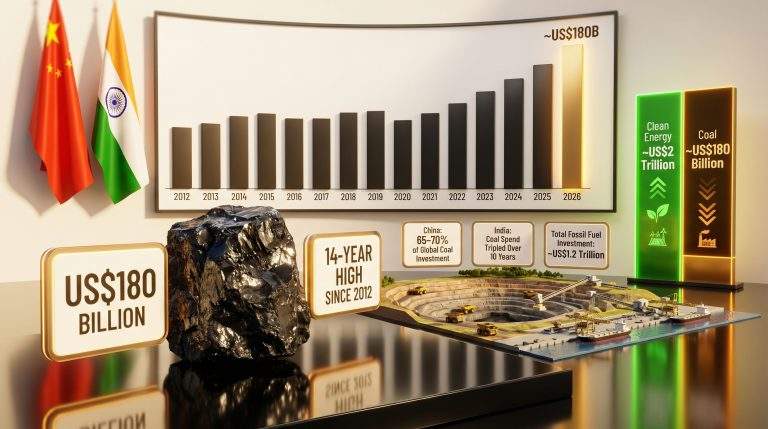
IEA Executive Director Fatih Birol stated that the world is experiencing the most severe energy security crisis in history, with an impact comparable to the fundamental transformation of the energy industry following the oil crisis of the 1970s. Governments and energy companies worldwide are comprehensively reshaping energy investment strategies, covering both traditional energy and low-carbon energy sectors. The report shows that total global energy investment in 2026 is expected to reach $3.4 trillion. Among this, low-carbon and electricity-related investments amount to approximately $2.2 trillion, accounting for 64.7% of total investment; traditional fossil fuel (oil, natural gas, coal) investments total about $1.2 trillion, accounting for 35.3%.
China dominates global coal investment, with investments concentrated in coal chemical projects (converting coal into chemical products), carbon capture integration (Carbon Capture, referring to technology that separates and captures carbon dioxide from emission sources), and systematic efficiency upgrades across the entire industrial chain. India is accelerating the expansion of coal production, transportation infrastructure, and coal gasification capacity, aiming to achieve 100 million tons of coal-to-gas by 2030 through a $4 billion government incentive program, thereby reducing import dependence on key commodities such as liquefied natural gas, urea, ammonia, and methanol. Michelle Manook, CEO of the industry body FutureCoal (formerly the World Coal Association), stated that energy security is driving global investment decisions through diversity, reliability, and affordability. Research from the organization shows that 90% of new coal-fired power generation capacity expected to come online in 2026 will adopt ultra-supercritical and supercritical technologies, indicating that coal investment is shifting toward high-efficiency, low-emission advanced technologies.
Russia has committed to investing $6 billion in the second phase of its Elga coal mine project, expected to add 25 million tons per year of coking coal capacity, along with expanding railway and seaport facilities to increase supply to the Asia-Pacific market. The United States and Canada have streamlined approval processes, advancing the expansion of approximately 15 mines with a planned total capacity of 34 million tons per year. In 2025, the U.S. Department of Energy committed $625 million for the reopening and retrofitting of coal-fired power plants to enhance grid reliability. Since 2015, Southeast Asia has accumulated approximately $110 billion in coal sector investment, with coal's share in the regional energy mix rising from varying levels of 20% to 30%.
This IEA report places the rebound in global coal investment within the macro context of energy security once again becoming a strategic priority for countries, reflecting the structural impact of geopolitical uncertainty on global energy capital flows.
This article is compiled by Wedoany. All AI citations must indicate the source as "Wedoany". If there is any infringement or other issues, please notify us promptly, and we will modify or delete it accordingly. Email: news@wedoany.com