en.Wedoany.com Reported - The United States is expected to add more than one million barrels per day of liquefied petroleum gas (LPG) export capacity over the next few years, which is expected to smooth terminal fee volatility and provide Asian importers with a more stable supply of petrochemical feedstock.
Beyond its use as a fuel, LPG is also used in crackers to produce ethylene and in propane dehydrogenation (PDH) units to produce propylene. China has built a number of PDH units, which will remain the primary driver of its LPG demand until the second half of 2026.
In the first half of this year, LPG export disruptions caused by the Middle East war pushed up Asian prices. The new U.S. LPG export capacity could provide a buffer against future supply disruptions. However, there are also domestic concerns in the U.S. about companies over-expanding export capacity.
Over the years, the U.S. has continuously expanded LPG export capacity, a trend expected to persist at least through 2028. Enterprise Products recently completed the expansion of its Neches River Terminal in Orange County, Texas, adding a new flexible refrigeration unit capable of handling 180,000 barrels per day of ethane or 360,000 barrels per day of propane. The company's expanded Enterprise Hydrocarbons Terminal (EHT) is expected to be operational by the end of 2026, adding 300,000 barrels per day of terminal LPG export capacity. ICIS estimates that, including the Neches River expansion, midstream companies such as Enterprise will add more than one million barrels per day of LPG export capacity.
Tyler Cott, senior vice president at Enterprise, stated that a considerable amount of export capacity has already come online or is about to come online, and the market will need time to absorb it. He expects terminal fee volatility to decrease, with overall rates lower than in previous years. However, approximately 90% of Enterprise's LPG export capacity is already under contract, which should limit its exposure to excess terminal capacity.
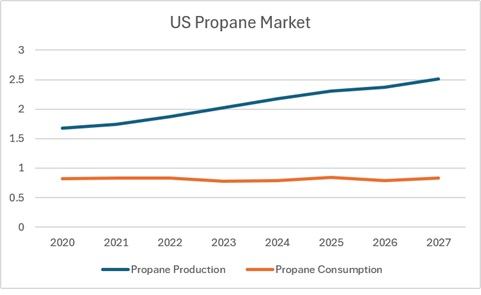
This decade, U.S. propane production has grown faster than demand, making exports key to balancing the market. The Energy Information Administration (EIA) expects the U.S. propane surplus to continue growing at least through 2027. On the supply side, propane is a byproduct of shale oil production, and as long as oil prices are sufficient to support petroleum production, wells will continue to produce propane. On the demand side, plans for new petrochemical plants in the U.S. are scarce, while heating demand fluctuates with weather.
This year, the Middle East war and the subsequent closure of the Strait of Hormuz disrupted LPG shipping, and U.S. LPG exports found a ready market in Asia. China's LPG imports fell nearly 40% month-on-month in April to 1.56 million metric tons, recovering to 2.03 million metric tons in May, though still below the first-quarter average of 2.46 million metric tons per month. As Middle East supply declined, the U.S. became Asia's main alternative LPG supply source. Before the conflict, U.S. cargoes accounted for about 20% of China's LPG imports; that share has steadily risen since, reaching 56.5% in June. If Middle East disruptions persist, expanded U.S. export capacity should ease supply tightness for Chinese and other Asian chemical producers.
LPG expansion projects on the U.S. Gulf Coast include: Enterprise has completed the Neches River Terminal Phase II (NRT), adding a new flexible refrigeration unit; the Enterprise Hydrocarbons Terminal (EHT) LPG expansion project (300,000 barrels per day) is scheduled to come online in the fourth quarter of 2026; Targa's Galena Park LPG terminal expansion project (5 million barrels per month) is scheduled to come online in the third quarter of 2027; Texas City Logistics' LPG terminal project (400,000 barrels per day) is scheduled to come online in early 2028; and Energy Transfer's Nederland NGL terminal expansion project (240,000 barrels per day of ethane and 55,000 barrels per day of LPG) is scheduled for its first phase to come online in 2028.