en.Wedoany.com Reported - Recently, Yerlan Batyrbekov, Director General of the National Nuclear Center of the Republic of Kazakhstan, met with Masanori Koguchi, President of the Japan Atomic Energy Agency (JAEA). During the meeting, the two sides discussed joint achievements in the field of fast reactor safety research and prospects for future scientific work.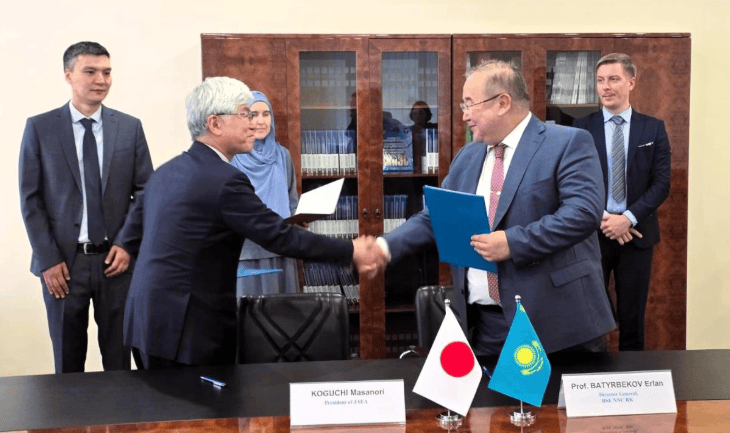
The main topic of the meeting was the continuation of the joint EAGLE project, aimed at experimental research on fast reactor safety, and the signing of a memorandum of cooperation between JAEA and the National Nuclear Center of Kazakhstan, along with an agreement for the implementation of the first phase of the project. The EAGLE project, jointly implemented by the National Nuclear Center of Kazakhstan and JAEA since the early 2000s, aims to improve the safety of fast reactors using sodium coolant. Its research covers processes during severe accidents such as core meltdown, including the characteristics of core melt, and the interaction of melt with sodium coolant and structural materials. The project is advanced through both in-pile experiments (conducted in the IGR research reactor) and out-of-pile experiments (conducted on the EAGLE test bench).
Over 20 years of project implementation, significant results have been achieved, with approximately 200 methodological tests conducted, including 2 medium-scale tests, 9 full-scale in-pile tests, and over 65 out-of-pile experiments. The EAGLE, EAGLE-2, and EAGLE-3 experimental projects have all been successfully completed. Currently, with the participation of Marubeni Utility Services Co., Ltd., computational and analytical work for the post-EAGLE-3 phase has commenced.
As a continuation of the long-term cooperation, the EAGLE-4 project is about to be launched, planning to conduct multiple in-pile experiments, twelve out-of-pile experiments, and a series of small-scale tests. The main objective is to test the thermal separator components of Japan's Generation IV reactor, providing scientific justification for the safety of future nuclear technologies. The results of this project are expected to contribute to the development of scientific methods for the safety assurance of new fast neutron reactor designs in Japan, while also offering an opportunity to further strengthen bilateral cooperation in the peaceful use of atomic energy.
Currently, the two sides are discussing the extension of the EAGLE-4 project until 2031.
This article is compiled by Wedoany. All AI citations must indicate the source as "Wedoany". If there is any infringement or other issues, please notify us promptly, and we will modify or delete it accordingly. Email: news@wedoany.com