en.Wedoany.com Reported - On June 10, U.S. fusion energy company Xcimer Energy announced that the U.S. Department of Energy (DOE) has officially approved the pre-conceptual design and technology development roadmap milestones for the company's Athena (Xcimer's fusion power plant architecture).
The 724-page report submitted by Xcimer covers plant performance targets, economics, system-level engineering requirements, safety and environmental analysis, and technology development pathways, providing detailed material for DOE reviewers to evaluate.
Athena is the reference architecture for Xcimer's fusion power substation cluster, designed for continuous operation. It integrates the company's proprietary excimer laser platform with industrial-scale target delivery, fusion chamber, tritium breeding, and power generation systems. Xcimer CEO Connor Galloway stated that the challenge for laser fusion is no longer whether the physics is feasible, but how quickly it can be industrialized. The DOE's recognition of Athena demonstrates the strength of the company's technical approach and its ability to execute the commercialization roadmap.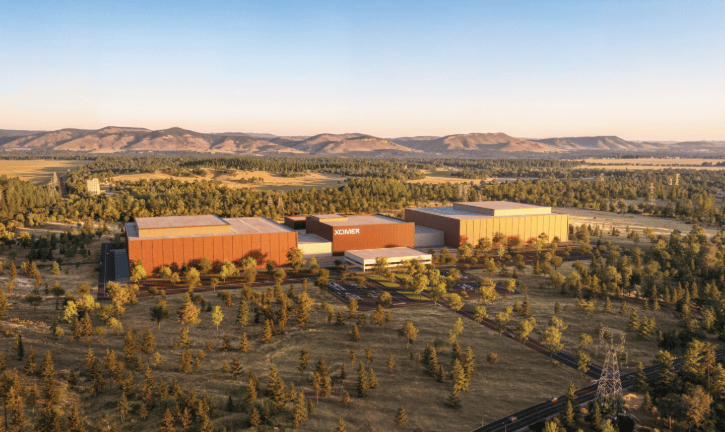
Recently, Xcimer announced that its prototype laser system, codenamed Phoenix, has officially commenced operations at the Denver Laser Facility, making it the largest privately owned laser system in the world. Phoenix employs a krypton fluoride excimer laser, utilizing stimulated Brillouin scattering to compress microsecond pulses to nanosecond timescales, aiming to demonstrate end-to-end integrated operation of excimer amplification and pulse compression.
According to Suzanne Reyes, Xcimer's Vice President of Reaction Chamber and Plant Design, the Athena plant design operates at a repetition rate of up to 1 hertz and features a liquid-walled reaction chamber. It uses flowing molten salt curtains to replace solid materials for absorbing and modulating neutron flux, generating fuel, and transferring heat, thereby preventing damage to solid structures from fusion reaction byproducts and ensuring continuous plant availability throughout its operational lifespan. The company believes that long-term economics, maintainability, fuel cycle costs, and reliability will ultimately determine which fusion architectures achieve commercial success.
It is reported that Xcimer, founded in 2022 and headquartered in Denver, is dedicated to developing excimer laser-based fusion systems. The company aims to keep laser costs below $100 per joule and employs a chamber design that eliminates the need for first-wall replacement. Xcimer is one of the few companies participating in the U.S. Department of Energy's "Fusion Milestone Development Program," which accelerates fusion energy commercialization through public-private partnerships. After completing the milestone tasks within the 18-month budget period, Xcimer's next steps will involve advancing full-scale subsystem testing, engineering validation, and preparations for integrated plant demonstrations.
This article is compiled by Wedoany. All AI citations must indicate the source as "Wedoany". If there is any infringement or other issues, please notify us promptly, and we will modify or delete it accordingly. Email: news@wedoany.com