en.Wedoany.com Reported - Data centers, as the underlying support for streaming of major sports events, are providing infrastructure for the global broadcast of the 2026 FIFA World Cup. The 2022 World Cup final attracted approximately 1.5 billion global viewers, and FIFA estimates that about 5 billion people engaged with content across various platforms. With the 2026 World Cup expanding from 32 to 48 teams, and an increase in venues and matches, broadcasters face higher demands on their content ingestion, editing, and distribution capabilities.
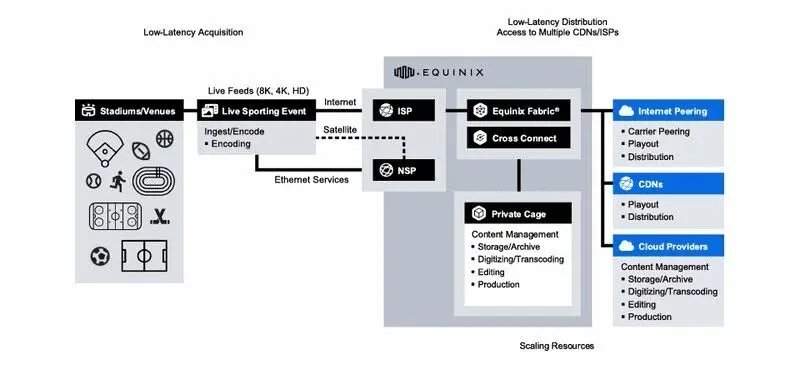
To address these challenges, broadcasters are building hybrid architectures by combining colocation data centers and cloud infrastructure to balance control and flexibility. During the content acquisition phase, 8K resolution live feeds are rapidly transmitted from stadiums to production facilities via the public internet and Ethernet services. Within production facilities, digitization, transcoding, editing, and distribution preparation are performed, after which content is handed over to content providers and distribution platforms.
In the content management phase, broadcasters can retain high-quality video assets in fully controlled colocation storage while storing low-resolution proxy versions in the cloud for agile post-production. Instruction files processed in the cloud are then returned to the private infrastructure to apply equivalent editing operations to the original high-quality assets. This approach avoids frequent movement of large video files across environments, reducing data egress costs.
The realization of sports streaming relies on ecosystem collaboration with partners such as Network Service Providers (NSPs), Internet Service Providers (ISPs), cloud providers, and Content Delivery Networks (CDNs). FIFA has announced partnerships with TikTok and YouTube for the 2026 World Cup. Broadcasters typically deploy within Equinix colocation data centers to gain proximity access to numerous partners and utilize Equinix Fabric to establish direct private connections.
The 2026 World Cup will be held for the first time across three countries—the United States, Canada, and Mexico—with data flows crossing multiple national borders, posing data sovereignty compliance challenges. Broadcasters need to control data and processing locations; private infrastructure provides full control over hardware locations, while public clouds are relatively abstract. Equinix Fabric Geo Zones, serving as a sovereign enforcement layer for connectivity, can help customers design connections that comply with the digital sovereignty requirements of relevant countries.
This article is compiled by Wedoany. All AI citations must indicate the source as "Wedoany". If there is any infringement or other issues, please notify us promptly, and we will modify or delete it accordingly. Email: news@wedoany.com