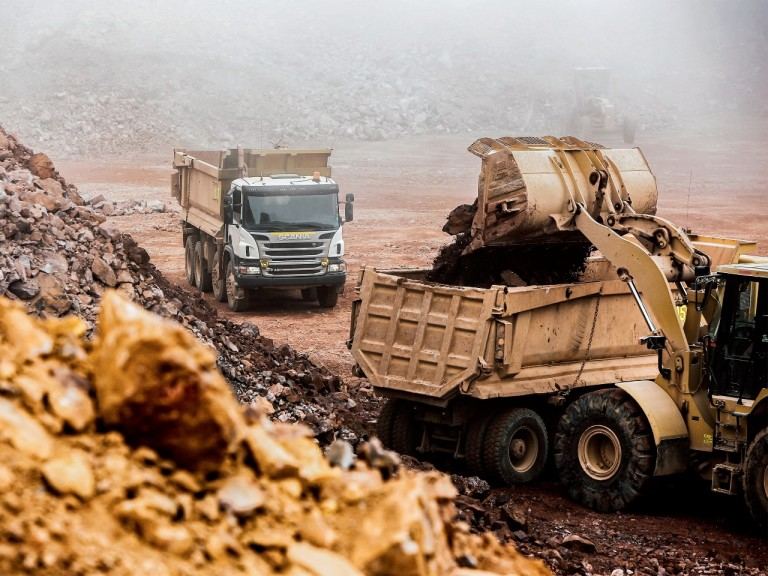
en.Wedoany.com Reported - The U.S. Department of Energy has recently launched multiple initiatives to strengthen the domestic supply chain for critical minerals and materials, with a focus on extracting rare earth elements and critical minerals from unconventional feedstocks.
Earlier this year, the U.S. government reached critical mineral agreements with the European Union, Japan, and Mexico. President Trump signed an executive order to establish a $12 billion critical mineral reserve to reduce foreign dependence. The Department of Energy's Office of Critical Minerals and Energy Innovation is responsible for advancing related projects.
On June 3, the Department of Energy announced $15 million in funding for two projects to establish regional alliances aimed at accelerating the development of new critical mineral supply chains from unconventional and secondary feedstocks. The first project, led by the University of Nevada, Reno, will investigate critical mineral resources in sedimentary strata and active mine waste in the Pacific Coast and Basin and Range regions, with the goal of creating a comprehensive database. The second project, led by the Georgia Tech Research Corp., will study sedimentary minerals such as kaolin, bauxite, heavy minerals, and phosphates within the Atlantic seaboard plain, as well as residues from mining and coal combustion. It will also analyze brownfield samples to identify critical mineral forms and rare earth element characteristics. The data will be used for statistical analysis and machine learning to predict mineral distribution and develop extraction methods. The Department of Energy stated that these two projects will join six previous projects and build on the Carbon Ore, Rare Earth, and Critical Minerals Initiative.
On June 2, the Department of Energy announced $134 million in funding for two projects aimed at demonstrating the commercial viability of recovering rare earth elements such as praseodymium, neodymium, terbium, and dysprosium from waste materials like mine tailings and electronic waste. A project at the Colorado School of Mines will design, build, commission, and operate a rare earth element demonstration facility at an alumina refinery in Gramercy, Louisiana, to process bauxite waste known as "red mud," separating rare earth oxides and refining them into rare earth metals, thereby proving the commercial feasibility of an integrated domestic rare earth element extraction, separation, and refining process. Another project, led by Phoenix Tailings in collaboration with the Massachusetts Institute of Technology and the University of Minnesota, will design, build, commission, and operate a demonstration-scale facility to produce high-purity rare earth metals from feedstocks derived from domestic industrial waste.
On June 10, Argonne National Laboratory announced the establishment of the "National Science-at-Scale Collaborative," aimed at accelerating the transition of critical materials and chemical manufacturing technologies from research to commercial production. This collaborative brings together industry, government, and national laboratories, planning to leverage advanced computer modeling, artificial intelligence, rapid synthesis tools, and pilot-scale manufacturing systems at Argonne's Materials Engineering Research Facility to help companies test and scale up new production processes. Argonne National Laboratory will work with the Department of Energy's Office of Critical Materials and Energy Innovation on this effort.
Last month, the Department of Energy announced $45.7 million in funding for 19 projects to address gaps in the domestic critical mineral and material supply chain, with funds supporting the development of pilot-scale facilities for processing magnesium and rare earth elements. Recipients include USA Rare Earth, Big Blue Technologies, Princeton University, Columbia University, Ohio University, and others.
This article is compiled by Wedoany. All AI citations must indicate the source as "Wedoany". If there is any infringement or other issues, please notify us promptly, and we will modify or delete it accordingly. Email: news@wedoany.com