India Plans 5,000 E100 Fuel Stations by End of 2027 to Promote Flex-Fuel Vehicles
en.Wedoany.com Reported - India is adopting an "infrastructure-first" strategy to drive the development of ethanol-fueled vehicles, planning to build 5,000 dedicated E100 fuel stations within two years. It has already launched its first flex-fuel passenger car, aiming to build a multi-billion-dollar green mobility ecosystem.
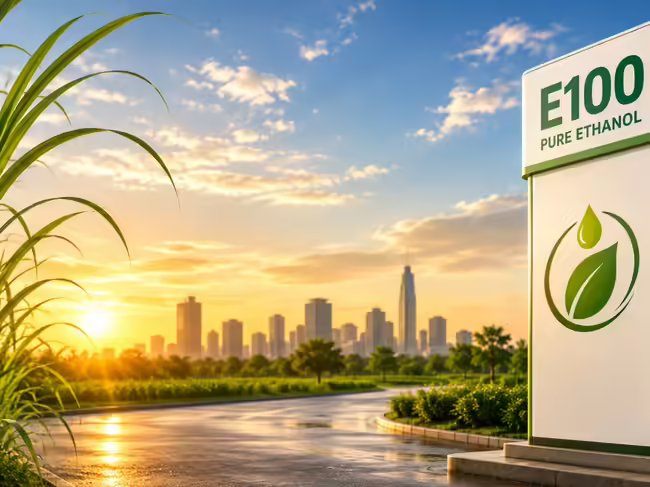
Unlike the typical model where market demand gradually drives infrastructure development, the latest directive from India's central government mandates the establishment of a distribution network for E100 (pure ethanol) fuel first. This move aims to reduce dependence on imported crude oil and address external risks such as ongoing disruptions in oil trade in West Asia. The Ministry of Petroleum and Natural Gas, along with state-owned oil marketing companies, has committed to building this network nationwide.
Union Minister for Road Transport and Highways Nitin Gadkari stated in New Delhi last week that biofuels such as ethanol biofuels help strengthen the rural economy, while flex-fuel vehicles can create robust and sustainable demand for ethanol. "Today, due to the war in West Asia, we are facing an energy crisis, so we must achieve self-sufficiency in the energy sector," he said. He also called for the gradual retrofitting of existing BS6 vehicles into flex-fuel vehicles (FFVs), adding: "No matter which Euro 6 emission vehicle you own, it can be converted into a flex-fuel engine through a service center."
Before flex-fuel vehicles have been mass-produced, the physical distribution network is already being deployed. The core of this transformation lies in the domestic sugar and distillery industries, where bioethanol is produced through chemical processes involving sugar and microorganisms. Deepak Ballani, Director General of the Indian Sugar Mills Association (ISMA), believes this is not just an adjustment in the automotive market but a structural change in energy production and consumption. He emphasized that ethanol's value extends far beyond being a substitute for gasoline; it is a domestically produced renewable fuel that reduces import dependence, enhances energy security, and supports the rural economy.
India's move breaks the common "chicken-and-egg" dilemma in global alternative fuel transitions—where automakers are reluctant to produce relevant vehicles due to a lack of refueling infrastructure, and fuel suppliers hesitate to build stations due to a lack of vehicles. India is placing the fuel supply mechanism ahead of automotive market development.
The country has already made progress under its ethanol blending program, increasing the ethanol blend ratio in standard gasoline from 1.5% in 2014 to the current 20%. According to a Press Information Bureau (PIB) announcement this month, the 20% blend ratio has saved up to 1.84 trillion rupees in foreign exchange by replacing 30.2 million metric tons of imported crude oil. The leap from E20 to E100 introduces technical complexities. Union Minister for Petroleum and Natural Gas Hardeep Singh Puri announced the ultra-fast deployment of 50 to 100 ethanol fuel stations in the Delhi-National Capital Region (Delhi-NCR) and the Mumbai-Pune-Nagpur corridor, with a target of expanding to 500 stations by December 2026 and forming a network of 5,000 stations by the end of 2027.
Following the announcement of the fueling pump plan, market leader Maruti Suzuki launched India's first flex-fuel passenger car—the Wagon R Flex Fuel—on June 4. This model can seamlessly use any blend of gasoline and ethanol between E20 and E100. Hisashi Takeuchi, Managing Director and CEO of Maruti Suzuki India, stated that the widespread adoption of flex-fuel requires efforts from all stakeholders, and the entire ecosystem needs to be developed. In the two-wheeler segment, Hero MotoCorp also launched the country's first flex-fuel motorcycle, releasing E85-compatible versions of the Splendor Plus and HF Deluxe.
From a technical perspective, ethanol is corrosive, hygroscopic, and has lower energy density than gasoline. According to the International Energy Agency (IEA), ethanol absorbs moisture from the air, leading to rust in fuel tanks, clogged fuel lines, and disintegration of seals. To address this, the Wagon R Flex Fuel likely features a completely redesigned architecture, including corrosion-resistant fuel lines, heavy-duty seals, modified fuel injectors, and a specially calibrated engine management system. The IEA notes that ethanol's energy density is about two-thirds that of gasoline, meaning that using pure E100 or high-blend E85 to travel the same distance requires approximately 50% more fuel (by volume) per kilometer.
Regarding consumer concerns about the transition, the Society of Indian Automobile Manufacturers (SIAM) stated in an August 2025 report that claims of E20 affecting vehicle insurance and warranties are "unfounded," and dismissed concerns about range loss as "inappropriate." SIAM also noted that for E100 or E85 to be economically viable for consumers, their price must be at least 30% cheaper than traditional E20 gasoline.
To promote development, the central government has abolished the central excise duty on gasoline blended with higher proportions of ethanol. The Ministry of Finance issued a notification extending the central excise duty exemption to gasoline blended with 22%, 25%, 27%, and 30% ethanol, all of which are subject to a zero excise duty rate. Meanwhile, according to Deepak Ballani, hydrous E100 does not need to be mixed with gasoline and can be supplied directly from distilleries to retail points, eliminating blending costs and simplifying the supply chain.
Compared to global biofuel benchmark Brazil, India's model is distinctly different. Brazil's flex-fuel ecosystem was built bottom-up over more than five decades, relying on large-scale sugarcane agriculture. In contrast, India, through its "infrastructure-first" strategy, is implementing a compressed revolutionary approach that is faster and leverages greater agricultural diversity.
This article is compiled by Wedoany. All AI citations must indicate the source as "Wedoany". If there is any infringement or other issues, please notify us promptly, and we will modify or delete it accordingly. Email: news@wedoany.com
Related Products


MAX-12 series Environmental Protection/SF6 gas insulated switchgear (C-GIS)
Murge Electric Co.,Ltd.

Off-Grid Fuel Cell Supercharging Station (180kW Configuration)
Shanghai REFIRE Group Limited
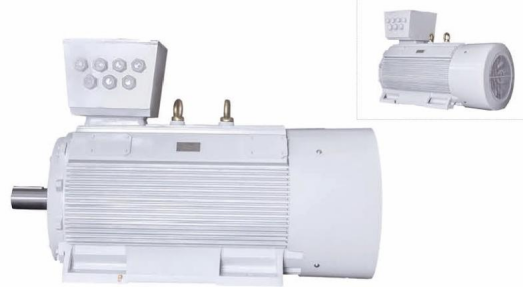
YE3 Series Low Voltage High Power Three-Phase Asynchronous Motor
Shandong Lijiu Electrical Machinery Co., Ltd.

CAP1400 main feedwater flow nozzle flowmeter.
Jiangsu Hongda Instrument Technology Co., LTD.