en.Wedoany.com Reported - A new study has found that the effectiveness of urban green space soil remediation is closely linked to the balance between fungi and bacteria in the soil. Applying biochar and compost to nutrient-poor soil can yield carbon storage benefits up to 14.4 times higher than in nutrient-rich soil. The findings were published in the journal Biochar.
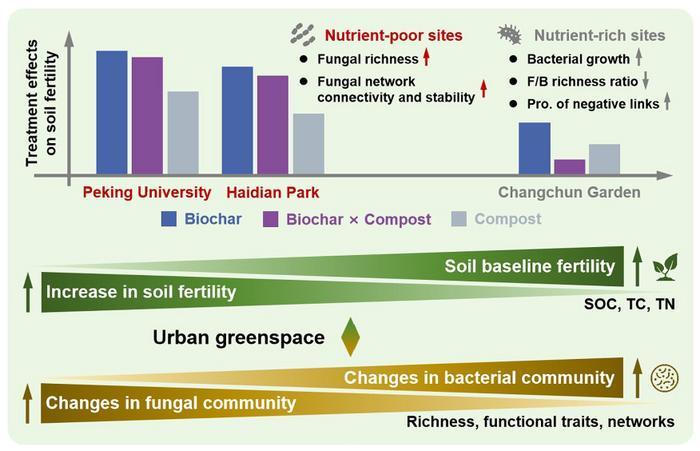
The research team conducted field experiments in three representative urban green spaces in Beijing, China: university campus green spaces, park green spaces, and residential green spaces. These sites had different initial soil fertility levels, allowing the team to test the varying effects of biochar, compost, or a combination of both under different urban soil conditions.
In nutrient-poor green space soil, the application of biochar and compost had the most significant effect on enhancing soil carbon and nitrogen storage, with improvement effects 14.4 times higher than in nutrient-rich soil. At the nutrient-poor sites, the amendments promoted fungal richness, enhanced fungal network connectivity and stability, and increased the ratio of fungal to bacterial richness. These fungi-driven changes were closely associated with higher soil carbon and nitrogen accumulation.
"Our research shows that urban soil remediation is not just about adding more organic matter," said Dr. Qun Gao, corresponding author. "The original nutrient status of the soil, along with the microbial community, can determine whether biochar and compost help store carbon or allow it to be rapidly consumed."
In nutrient-rich green space soil, the research team observed a distinctly different pattern. Biochar and compost did not yield the same carbon accumulation benefits. Instead, the treatments reduced fungal diversity, weakened fungal network stability, and promoted rapid bacterial growth. This shift may have accelerated carbon consumption and destabilized the soil carbon pool. At one nutrient-rich site, the combined application of biochar and compost even reduced total carbon and total nitrogen.
These findings challenge the assumption that "more fertile soils respond better to added resources." Instead, the study suggests that nutrient-poor urban soils may offer the greatest opportunities for carbon gains, as they have more capacity to accumulate and stabilize new organic matter. In such soils, fungi appear to play a key role by supporting carbon retention and improving fertility.
"Fungi are not just passive members of the soil community," said Dr. Ling Han, corresponding author. "They can act as important ecological engineers, helping nutrient-deficient urban soils retain carbon and restore fertility after amendment."
The study has practical implications for urban managers, landscape planners, and policymakers. Biochar and compost are increasingly used to recycle organic waste, improve soil quality, and support climate-friendly urban management. The new research suggests that these amendments should be applied strategically rather than uniformly. Prioritizing biochar and compost interventions in nutrient-poor green spaces can maximize ecological benefits, improve soil fertility, and enhance urban carbon storage. In contrast, nutrient-rich green spaces may require more careful evaluation, as additional organic inputs could shift microbial activity toward faster carbon turnover rather than long-term storage.
As cities expand globally, improving urban soil health will become increasingly important for climate resilience, biodiversity, and public well-being. This study highlights that the smallest organisms in the soil may help determine the fate of carbon.
This article is compiled by Wedoany. All AI citations must indicate the source as "Wedoany". If there is any infringement or other issues, please notify us promptly, and we will modify or delete it accordingly. Email: news@wedoany.com