en.Wedoany.com Reported - Researchers from the Masic Lab at the Massachusetts Institute of Technology (MIT) and CarbonCure Technologies have uncovered the precise chemical mechanism by which carbon dioxide (CO₂) promotes early hydration during cement paste mixing, forming a more uniform and tightly woven microstructure in mortar or concrete, using in-situ Raman microspectroscopy. The related paper, titled "In-Situ Raman Spectroscopy of Silica Gel Templated Hydration Pathways in CO₂-Activated Cement," was published in the Journal of the American Ceramic Society.
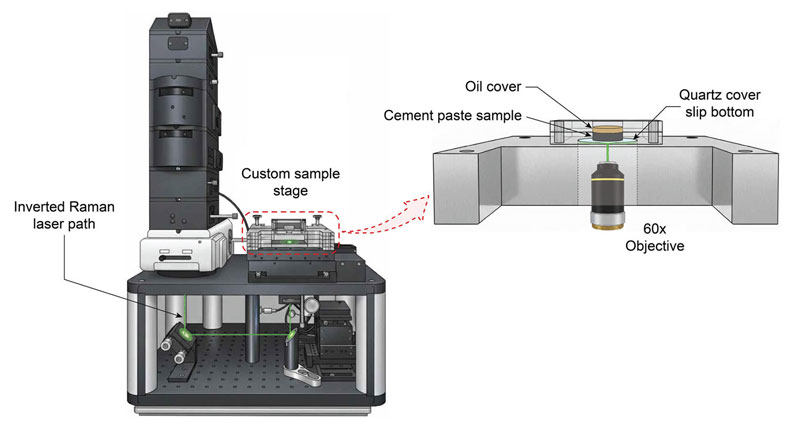
The team employed in-situ Raman microspectroscopy—an observation technique capable of identifying individual chemical phases at the micron scale—to track the hydration process of CO₂-activated cement over 24 hours, elucidating the molecular sequence through which CO₂ produces early strength enhancement in the cementitious system. The study found that CO₂ does not disrupt the binder chemistry during early hydration but instead promotes the formation of a tightly connected binder microstructure.
CarbonCure CEO Yuliya Kravtsov stated that this study provides the strongest experimental validation to date of carbon mineralization in concrete, explaining how carbon utilization technology helps producers reduce cement usage and costs while achieving consistently high-performance concrete. She added that the technology has been commercially validated in over 11 million mixer truck loads of real-world applications, spanning projects from residential buildings to complex high-rise developments and infrastructure projects.
Admir Masic, a professor in MIT's Department of Civil and Environmental Engineering, noted that although researchers have observed higher early strength in CO₂-activated concrete for years, the precise mechanism has remained elusive because the phases involved are transient and difficult to observe directly. Using in-situ Raman microspectroscopy, the team observed the chemical process of carbon mineralization in real time, uncovering a highly ordered and intricately orchestrated sequence: CO₂ creates a silica gel scaffold throughout the material, which serves as a template for a more interconnected binder. These insights provide a new framework for improving concrete performance through CO₂ mineralization.
The research team determined that during mortar or concrete mixing, CO₂ injected into cement paste does not merely fill pore spaces with calcium carbonate particles, as previously theorized. Instead, the compound triggers a fundamentally different three-stage hydration sequence. During the mineralization stage (within four hours of injection), CO₂ rapidly forms nanoscale calcium carbonate particles, temporarily diverting calcium from its usual role and allowing the development of a smooth, uniformly distributed silica gel network. During the transition stage (four to eight hours after injection), CO₂ is consumed, normal hydration resumes, and calcium hydroxide reacts with the silica gel network to form uniformly distributed calcium silicate hydrate—the fundamental strength compound in mortar or concrete. During the stabilization stage (after eight hours), hydration continues in a conventional manner, filling the structure and producing a more uniform, interconnected binder that sets faster and achieves approximately 13% higher early strength compared to the reference paste. Crucially, the MIT and CarbonCure team obtained the first direct visual evidence of early CO₂ mineralization, showing that calcium carbonate particles remain chemically stable over time, permanently sequestered within the matrix.
CarbonCure Chief Technology Officer Dean Forgeron concluded that this represents a breakthrough in the industry's understanding of carbon mineralization. The study demonstrates that mineralization not only permanently stores CO₂ in concrete but actively influences the binder microstructure from the earliest moments of hydration, and the industry can leverage this chemistry to improve cement efficiency and profitability while delivering the same high-quality product and meeting the most demanding project specifications.
This article is compiled by Wedoany. All AI citations must indicate the source as "Wedoany". If there is any infringement or other issues, please notify us promptly, and we will modify or delete it accordingly. Email: news@wedoany.com