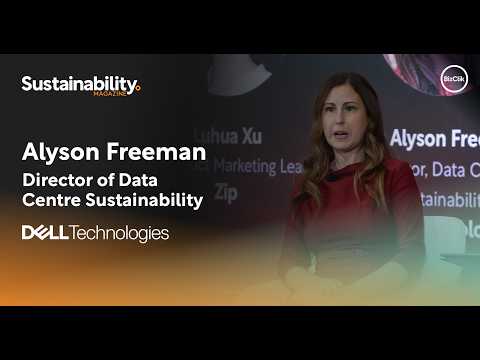
en.Wedoany.com Reported - Alyson Freeman, Director of Data Center Sustainability at Dell Technologies, discusses the company's use of AI in hardware simulation, software development, and data center energy efficiency optimization, noting that this technology is advancing its sustainability mission from both hardware and software dimensions.

Freeman holds a Ph.D. in Materials Engineering, specializing in semiconductors, and has accumulated 20 years of engineering and management experience at NASA, Los Alamos National Laboratory, Samsung, Intel, and Dell Technologies, holding multiple patents in AI and energy management. She also serves as the Global Lead of Dell Technologies' "Women in Technology" employee resource group, Co-founder and former Chair of Samsung Austin Semiconductor's "Women in Technology" organization, a board member of the National Girls Collaborative Project and Westwood STEM Academy, and co-founded the global "Coding for Kids" program at Dell.
On the hardware side, Dell uses AI simulation technology for hardware testing, enabling verification without manufacturing physical prototypes. Freeman believes this significantly shortens development cycles while avoiding waste from prototype products, yielding sustainability benefits. On the software side, Freeman observes that sustainability teams have seen significant efficiency gains after adopting AI for development, with team members more willing to dedicate time to sustainability priorities.
Regarding data center energy consumption, Freeman notes that most energy is used for cooling. At the hardware level, Dell is optimizing cooling efficiency with technologies such as fans, liquid cooling, and immersion cooling (submerging servers in mineral oil tanks to dissipate heat). At the software level, creating solutions to monitor and shut down unnecessary additional tasks on servers can prevent energy waste, enabling more efficient use of existing power without increasing grid load. Citing industry data, she states that nearly 100 gigawatts of new data center capacity will be added globally between 2026 and 2030, doubling global capacity, with approximately 50% located in the Americas.
For companies just beginning their sustainability journey, Freeman advises following the data. She believes measuring environmental impact is one of the primary challenges, but can be accomplished using third-party assessment agencies and tools. Data will guide companies in identifying priority issues and help them determine action priorities across different sustainability areas.
This article is compiled by Wedoany. All AI citations must indicate the source as "Wedoany". If there is any infringement or other issues, please notify us promptly, and we will modify or delete it accordingly. Email: news@wedoany.com