en.Wedoany.com Reported - The marine composites industry is advancing sustainability across multiple fronts, involving closed-loop recycling of end-of-life boats, the application of bio-based resins, and new propulsion technologies. New recycling processes enable the reuse of valuable materials and reduce waste, while manufacturers are increasingly adopting bio-based resins and renewable raw materials to decrease reliance on fossil resources. These materials are expected to reduce the environmental impact of composite manufacturing while maintaining the performance required for high-strength applications such as leisure sailboats and offshore racing yachts. High-performance carbon fiber structures are enabling modern wind-assisted propulsion systems, and lightweight composite components support the promotion of electric propulsion and intelligent onboard energy management.
In terms of circularity, Pierre Gérard of Arkema and Vincent Cholvy of Chomarat jointly presented a speech at the Plastics and Environment Conference held on May 20-21, 2026, in Douai, France, introducing efforts to establish circularity in the composites value chain. Gérard stated that related collaborations have moved from the demonstration phase to industrial validation of the circular loop. Arkema's patented Elium resin contributes to the circular economy. At JEC World 2026, Arkema showcased achievements in hull recycling, a breakthrough realized through strategic partnerships with Composite Recycling, Groupe Beneteau, Veolia, Owens Corning, and Chomarat.
In the field of bio-based materials, Sicomin's Greenscow project aims to demonstrate that racing yachts can achieve both high performance and sustainability. The prototype, designed by naval architect Gildas Plessis and built by Kaori Concept shipyard in the Loire-Atlantique region of France, features a birch plywood sandwich structure reinforced with basalt and flax fibers, impregnated with partially bio-based epoxy resin.
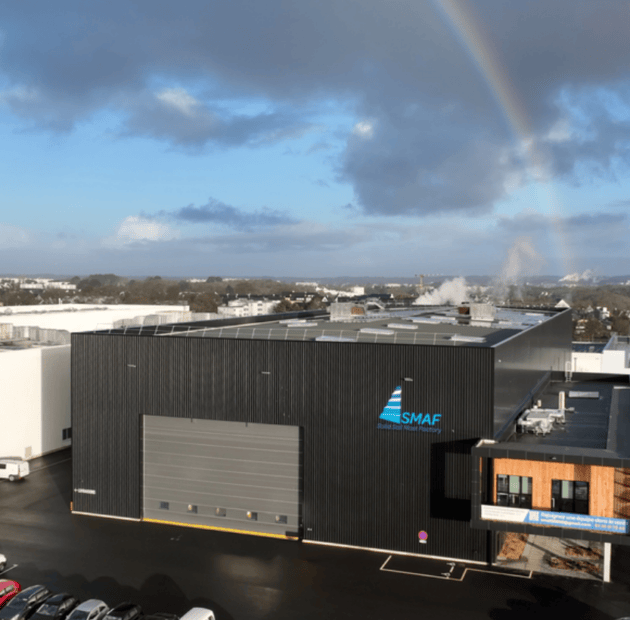
In the cleaner energy sector, regarding wind propulsion, the SolidSail mast factory was officially inaugurated on February 12 in Lanester, near Lorient, France. The company, established through a collaboration between Avel Robotics, CDK Technologies, Chantiers de l'Atlantique, Lorima, Multiplast, and SMM, is dedicated to producing large composite structures. Construction of the factory began in January 2024, with an investment exceeding €18 million, partially funded by national support under the France 2030 plan and EU funding as part of the NextGenerationEU program.
In the area of onboard electric propulsion and intelligent energy management, the Beneteau Group and Fountaine Pajot Group have created E-Lektra Marine, a 50/50 joint venture. This joint venture brings together seven major sailboat brands—Beneteau, Jeanneau, Lagoon, Excess, Fountaine Pajot Sailing Catamarans, Fountaine Pajot Yachts, and Dufour—collectively holding a 60% market share. It aims to create common standards for electric propulsion and onboard energy self-sufficiency, accelerate the electrification of sailboats, and support the transition to low-emission solutions.
This article is compiled by Wedoany. All AI citations must indicate the source as "Wedoany". If there is any infringement or other issues, please notify us promptly, and we will modify or delete it accordingly. Email: news@wedoany.com