en.Wedoany.com Reported - Indian quantum security company QNu Labs has announced the signing of a research cooperation agreement with Eindhoven University of Technology (TU/e) in the Netherlands, focusing on security testing, verification, and long-term resilience of Quantum Key Distribution (QKD).
This collaboration combines TU/e's academic expertise in quantum networks with QNu's practical deployment experience in India's defense, banking, telecommunications, and critical infrastructure sectors. According to a joint statement released during the "Bharat Innovates" event in Nice, France, the research aims to advance global quantum security standards.
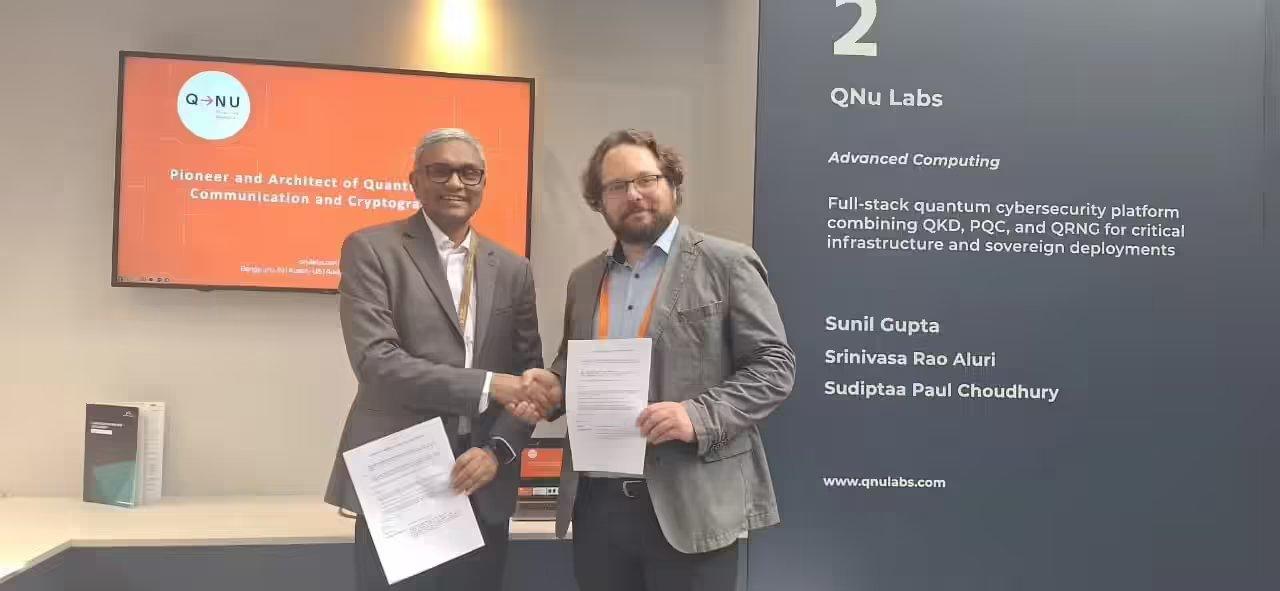
Simon Rommel, Assistant Professor at Eindhoven University of Technology, stated that Europe and India share common interests in building sovereign, trustworthy, and standards-compliant quantum communication infrastructure. The collaboration with QNu Labs represents a concrete step toward this goal and an important measure to ensure that QKD technology meets the expected rigor.
Sunil Gupta, Co-founder and CEO of QNu Labs, noted that the company is building and deploying quantum security technologies to protect national institutions, enterprises, and critical infrastructure from threats posed by intelligent AI, traditional cyberattacks, and future quantum computers. QNu Labs is one of 120 representative companies selected by the Indian and French governments from India's deep-tech enterprises, showcasing its hybrid quantum security network at the event. This system combines QKD with Post-Quantum Cryptography (PQC) to protect critical communications from current and future cyber threats, with cross-border scalability.
Additionally, QNu Labs signed a strategic agreement with SAGA Consultants during the event to accelerate the application of quantum security technologies in sectors such as Banking and Financial Services (BFSI).
This article is compiled by Wedoany. All AI citations must indicate the source as "Wedoany". If there is any infringement or other issues, please notify us promptly, and we will modify or delete it accordingly. Email: news@wedoany.com