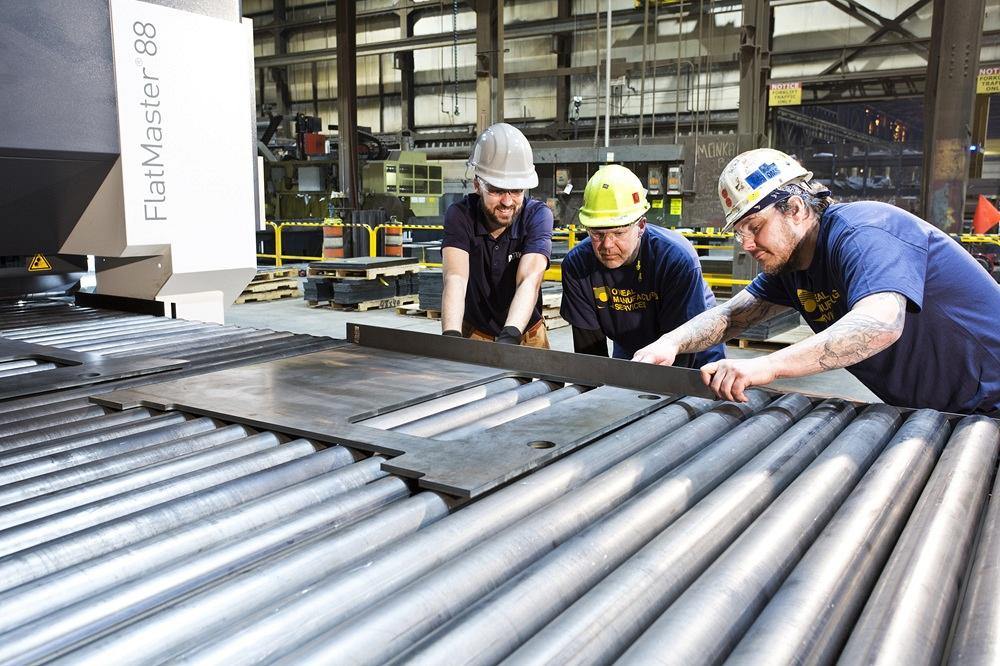
en.Wedoany.com Reported - To meet the stringent flatness requirements of downstream automated welding processes, metal fabrication service provider O'Neal Manufacturing Services (OMS) introduced an ARKU FlatMaster 88 200 roller leveling machine at its Ambridge, Pennsylvania facility, successfully eliminating a long-standing leveling bottleneck and clearing approximately two weeks' worth of work-in-process backlog.
As original equipment manufacturers (OEMs) push for welding automation, their flatness requirements for metal parts have shifted from "trustworthy" to literally "level." Parts must fit precisely into welding fixtures, and the past practice of relying on welders to manually use shims or filler metal to bridge gaps is no longer acceptable. Gus Cassida, Regional General Manager of OMS, stated that although the facility had fully automated laser cutting, the subsequent leveling process was inefficient, causing downstream processes to "starve," which became a production bottleneck.
According to Cassida, approximately three-quarters of all parts processed at the facility with a thickness less than 0.5 inches require some form of corrective leveling. Previously, the facility relied on manual leveling using large hydraulic cylinders on a gantry, where operators had to support parts off the ground and bend them to relieve stress. This process was not only inefficient but also made it increasingly difficult to recruit suitable personnel. Cassida noted that the company could no longer allocate manpower to inefficient processes.
To optimize the process, OMS purchased this FlatMaster 88 200 from ARKU in 2025. The machine can handle materials up to 79 inches wide and between 0.04 and 1.1 inches thick. Internal stress (or residual stress) in metal parts originates from the coiling and blanking processes of steel, and stress released during laser cutting can cause part deformation. The leveling machine uses multiple sets of rollers arranged in an offset pattern to alternately bend the material beyond its yield point, gradually eliminating internal tension and restoring the part to a flat state.
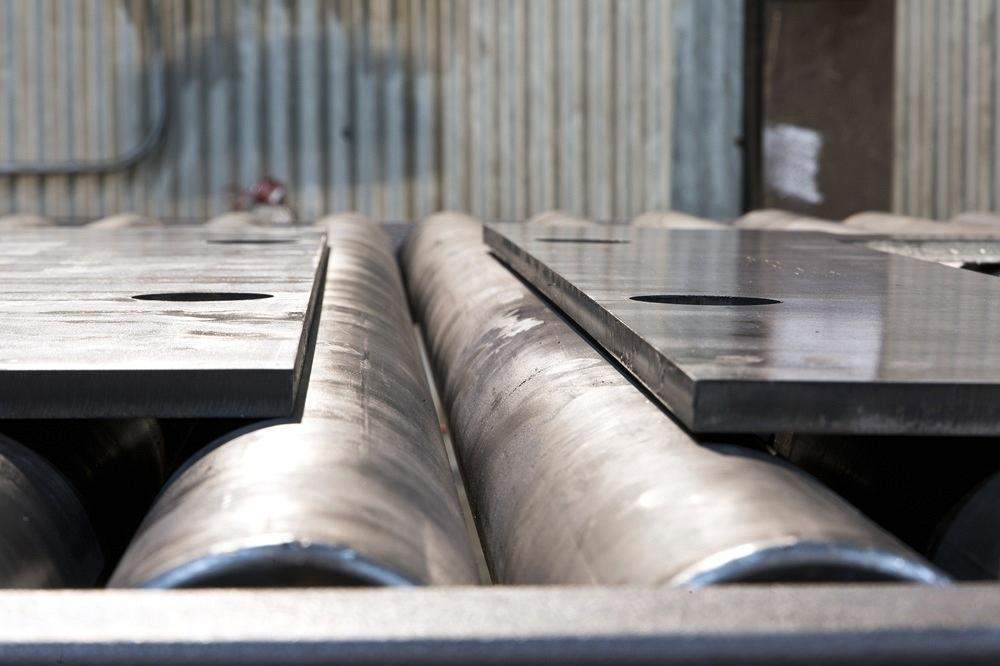
After introducing the leveling machine, leveling is no longer the constraint at OMS. Now, only one operator per shift is needed to run the machine, handling feeding, sorting parts, and quality inspection. Cassida stated that operator training was much faster than expected, the system is intuitive, and operators can adjust and optimize parameters such as material grade, yield strength, and thickness. This machine not only eliminated the bottleneck but also has the capacity to cover foreseeable future part loads, including parts from plasma cutting tables.
Cassida also revealed that with this added capacity, OMS may offer leveling services to other metal fabrication companies, as the demand for high-precision, stress-free parts is becoming increasingly common in the industry. OMS ranks third on the 2026 FAB 40 list.
This article is compiled by Wedoany. All AI citations must indicate the source as "Wedoany". If there is any infringement or other issues, please notify us promptly, and we will modify or delete it accordingly. Email: news@wedoany.com