en.Wedoany.com Reported - Artificial Intelligence (AI) transformation has become a core business topic, yet the effectiveness of its practical application remains questionable. Analysis indicates that simply deploying AI agents within an enterprise is unlikely to boost company-wide productivity, as corporate data is scattered across multiple systems—such as Enterprise Resource Planning (ERP), Customer Relationship Management (CRM), groupware, collaboration tools, document management systems, and instant messaging platforms. Unless this data is organized into an AI-readable format, AI cannot access actual workflows.
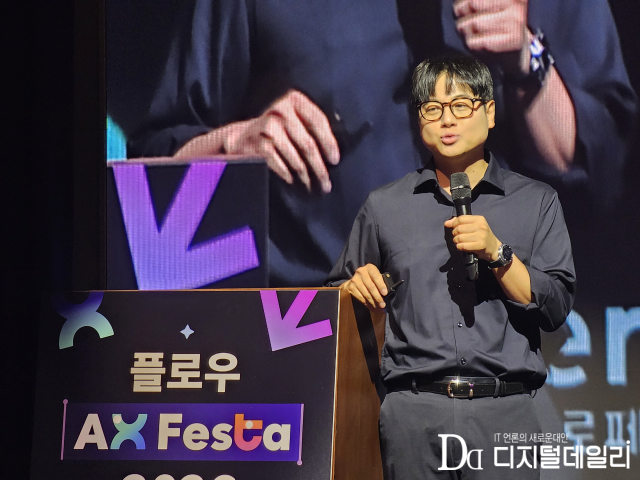
Collaboration tool companies are adjusting their strategies accordingly. The direction is not simply adding AI features to tools, but transforming the collaboration, communication, document, and goal data accumulated within enterprises into a work foundation that AI can understand and execute. Following the attention on AI agents, the Software as a Service (SaaS) sector has seen the emergence of the "SaaSpocalypse" crisis theory, suggesting that the development of AI agents could threaten the profitability model of the existing software industry. SaaS companies have begun formulating strategies to address new enterprise needs, with a core focus on supporting companies that are hesitant in adopting AI application methodologies. Enterprises first face the "diffusion" problem when introducing AI. Shin Seung-yong, Head of the Digital AX Strategy Business Team at LG CNS, pointed out at the "Flow AX Festa 2026" event that they often hear feedback from clients who have introduced AI but cannot diffuse it. AI is transitioning from a simple business chatbot tool to a subject that executes work, but for the enterprise site, redesigning work methods is a greater challenge. Security and governance issues cannot be ignored either. Employees may use personal devices to access external AI services and input company information, creating a "shadow AI" problem; simultaneously, overly strict security regulations can limit the scope of AI usage. Connecting legacy systems is also a challenge. If AI cannot connect to actual work systems like ERP and CRM, its utilization rate will be limited. Shin Seung-yong stated that global AI services often see decreased utilization rates due to an inability to connect to legacy systems. If AI cannot reach core business systems, it cannot bring benefits to actual work.
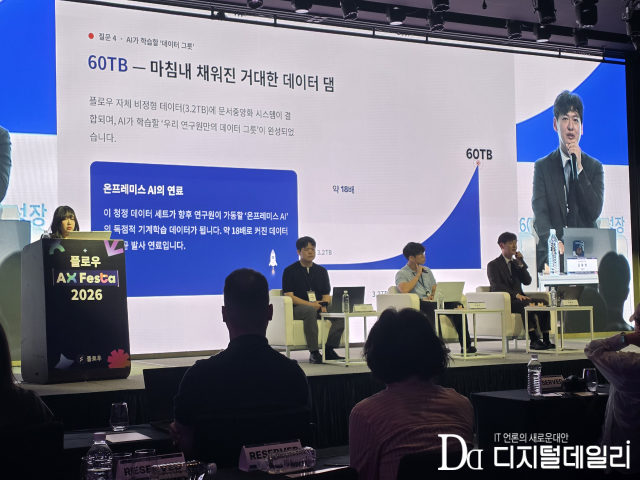
Experts point out that without a data foundation, simply layering AI on top is of little significance. Without work data accumulated through Digital Transformation (DX), AI has no basis for learning and judgment. Song Young-beom, CEO of Timeinout, stated that without digitally transformed work data, AI is just an empty shell with no learning materials. Project, document, conversation, schedule, goal, and customer response records should be retained as work units, and relationships between data should be established to ensure data connectivity. AI should not stop at generating responses; it should also be able to execute actual tasks, assign responsible persons, write reports, manage schedules, and interface with external systems. This entire process presents an opportunity for collaboration tools. Yoo Min-ho, Head of AI Development at Madrascheck, pointed out that based solely on internal work data from Flow, the monthly business data volume reaches approximately 1 million tokens. Even if AI becomes better, with higher performance and faster speed, the corresponding costs must ultimately be paid, so not everything can be delegated to AI.
Madrascheck, the developer of the collaboration tool Flow, emphasized "Flow's AI Work Agent Transformation" at AX Festa. Lee Hak-jun, CEO of Madrascheck, stated that the era of collaboration tools that only accumulate data while relying on humans for work is over, and the collaboration tool business is no longer effective. Flow's strategy is to connect the collaboration, communication, project, schedule, knowledge, document, goal, and report data accumulated from over 5,000 clients over the past 10 years with its proprietary AI engine, Repattern AI. Based on this, the company proposed the execution-type "Mate Agent," the conversational task creation and management-type "Smart Agent," the "Consulting Agent" that analyzes work methods and proposes AI application strategies, and the "Automation Agent" that automates repetitive tasks using natural language. Users can designate an AI agent as a project manager, and the agent will narrow down the work scope through follow-up questions and attach results as documents or PDFs. Flow has also strengthened connections with external AI, publicly releasing a developer center, open API, and Model Context Protocol (MCP) server, enabling client companies to link their own AI agents with internal systems. Claude or ChatGPT can search Flow's work context and connect the results back to actual task execution within the Flow interface. Flow has also achieved bidirectional integration with existing work tools such as Microsoft Teams, Google Workspace, Slack, Jira, and Salesforce. Lee Hak-jun stated that in the past, SaaS was a form of borrowing the interface, but now, as a platform borrowing the backend, value is being created. In the AI era, professional boundaries are becoming blurred, dispersed roles will disappear, leaving only solution builders who solve client problems.
This article is compiled by Wedoany. All AI citations must indicate the source as "Wedoany". If there is any infringement or other issues, please notify us promptly, and we will modify or delete it accordingly. Email: news@wedoany.com