en.Wedoany.com Reported - Chinese energy storage system manufacturer Biwatt has launched a 58 V modular sodium-ion home energy storage system for residential applications.
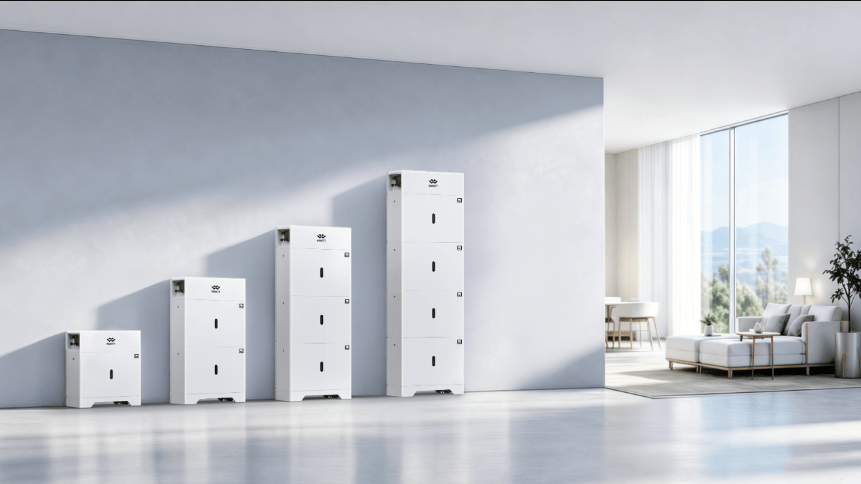
Named the Nest R5 series, the product is based on sodium iron pyrophosphate (NFPP) chemistry and includes two configurations: the all-in-one PowerNest R5i (integrating battery modules with a single-phase hybrid inverter) and the standalone PowerNest R5 (designed for compatibility with third-party hybrid inverter ecosystems).
According to the company, both variants feature a wireless stacking architecture aimed at eliminating inter-module wiring, simplifying installation, reducing commissioning time, and lowering the risk of on-site wiring-related errors.
Each floor-standing module has a capacity of 4.5 kWh, using 170 Ah NFPP sodium-ion cells. Under conditions of 25°C, 0.5C/0.5C, and 80% depth of discharge, the cycle life reaches up to 8,000 cycles. The system operates at 58 V, with a continuous output power of 3 kW and a maximum current of 55 A per module.
The platform has an IP65 protection rating, supports expansion up to four modules per stack, and allows up to four stacks in parallel, with a maximum stack current of 220 A. The system supports a recommended 90% depth of discharge and operates over a wide temperature range: −30°C to 55°C during discharge and −20°C to 55°C during charging.
Each unit weighs 65 kg and measures 670 mm × 420 mm × 250 mm, equipped with RS485, CAN, and USB-C communication interfaces. The company states that the system is designed to combine simplified installation, flexible inverter compatibility, and enhanced safety positioning.
Each module integrates a dedicated DC-DC optimizer and a customized battery management system, enabling active module-level balancing. Biwatt claims that this architecture improves voltage stability, increases usable energy, and maintains more consistent power output across different states of charge.
The company notes that safety benefits from the inherent thermal stability of the NFPP chemistry and the low-voltage system design. Currently, in addition to existing CE and RCM certifications, the company is applying for UL1973 certification and UL9540A fire safety testing.
For system operation and maintenance, the platform offers two different pathways. When paired with a Biwatt inverter, users gain access to remote monitoring, system diagnostics, and over-the-air firmware updates. For on-site service and troubleshooting, the built-in USB-C interface allows local access to diagnostic data.