en.Wedoany.com Reported - NASA has confirmed that Voyager 1 will reach a distance of one light-day from Earth at 2:16:07 AM Pacific Standard Time on November 18, 2026. One light-day is the distance light travels in a vacuum in 86,400 seconds. Using the international standard value for the speed of light of 299,792,458 meters per second, this distance is approximately 25.9 billion kilometers (about 16.1 billion miles). This means that a radio command sent from Earth will take a full 24 hours to reach the spacecraft, and a reply will take another day to travel back to Earth. NASA's Voyager status page records Voyager 1 as the first human-made object to reach this distance. This milestone marks the crossing of a substantial boundary in communication delay by humanity's most distant spacecraft after more than 49 years of continuous flight.
Although Voyager 1 crossed the Sun's heliosphere into interstellar space in 2012, the Sun's gravitational influence extends far beyond. The one light-day scale measures communication, patience, and distance, rather than the definitive boundary of leaving the solar system as defined in textbooks.
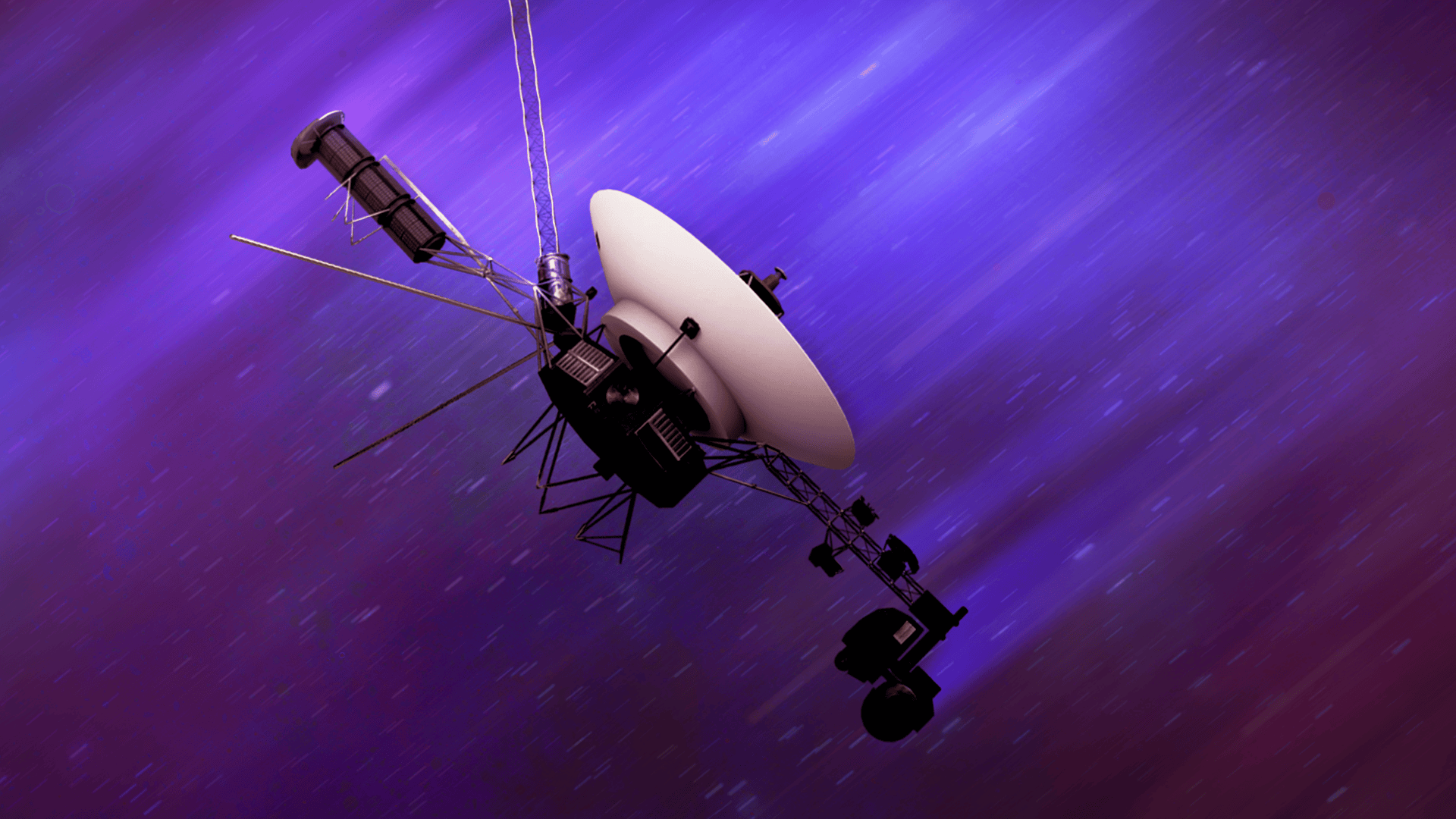
The spacecraft was launched in 1977 with the primary mission of exploring Jupiter and Saturn. Since then, it has become an aging but still operational observatory, moving through regions beyond the Sun's protective bubble. NASA notes that Voyager 1 and Voyager 2 are the only spacecraft recorded to operate outside the heliosphere, with Voyager 1 reaching the boundary in 2012 and Voyager 2 in 2018. Both spacecraft are located in local interstellar space and continue to move within the outer reaches of the Sun's domain.
The one light-day distance significantly demonstrates the breadth of this mission's expansion beyond its original design. A spacecraft built in the 1970s, with a computer and memory that are rudimentary by Earth standards, continues to receive commands from Earth across this vast gulf. NASA's operational discipline is reflected in an update from April 2026: engineers at the Jet Propulsion Laboratory shut down Voyager 1's Low-Energy Charged Particle experiment to conserve power. At that time, the spacecraft was over 15 billion miles from Earth, with command sequences taking about 23 hours to arrive, and the shutdown process took over three hours. At a one light-day distance, even the simplest confirmation becomes a wait of at least two days.
Voyager 1's survival depends on active management. Its radioisotope thermoelectric generator loses about 4 watts of power each year due to the decay of its plutonium heat source and hardware aging, forcing engineers to shut down heaters, instruments, and other systems in a carefully chosen sequence. As of April 2026, NASA's status table shows that only two scientific instruments remain operational on Voyager 1: the magnetometer and the plasma wave subsystem. The cosmic ray subsystem was shut down in February 2025, and the Low-Energy Charged Particle instrument was shut down in April 2026. The spacecraft remains scientifically valuable because no other operational probe samples the same region from this distance.
This one light-day milestone remains minuscule on a stellar scale. One light-day is approximately 0.0027 light-years, while the nearest star system to the Sun is over 4 light-years away. Although Voyager 1 has traveled farther than any other human-made object, it has covered only a small fraction of the distance to our nearest stellar neighbor. NASA tracks the spacecraft using the "Eyes on the Solar System" visualization tool and emphasizes that Voyager 1 is the only spacecraft operating outside the heliosphere, rather than one approaching other star systems.