Austrian Institute Discovers Domain Wall Network in Perovskite Solar Cells Separates Charges to Boost Efficiency
en.Wedoany.com Reported - Recently, a research team from the Institute of Science and Technology Austria discovered that the key to low-cost, structurally defective perovskite solar cells achieving power generation efficiency close to that of traditional silicon cells lies in the "domain wall" network within the crystals. These domain walls actively separate electrons and holes, preventing their rapid recombination, thereby enabling efficient charge transport.
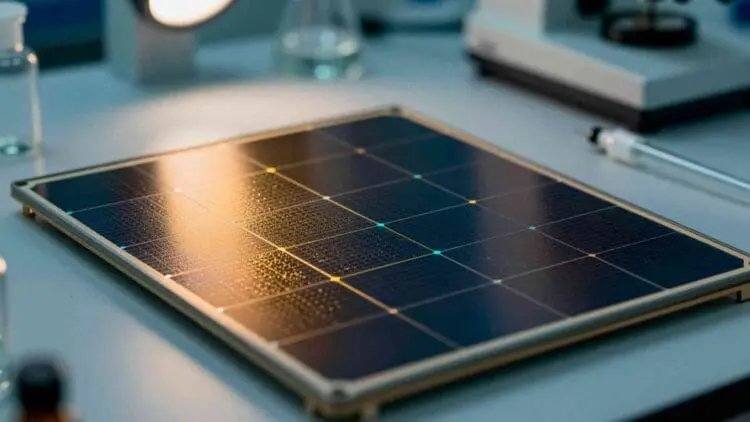
In traditional solar technology, the purity of silicon crystals allows for almost no imperfections. Every defect can become a trap for charges, leading to energy loss. Therefore, producing silicon wafers suitable for solar cells requires a high-cost and energy-intensive refining process. Perovskite solar cells, however, follow a completely different path. These solution-grown lead halide compounds are inherently full of structural defects. According to the logic of silicon materials, such a material should not possess good photovoltaic performance, yet over the past 15 years, its efficiency has been steadily increasing, now approaching the level of monocrystalline silicon cells.
To resolve this paradox, ISTA researchers Dmytro Rak and Zhanybek Alpichshev proposed a hypothesis: an electric field force exists inside the perovskite crystal that actively pulls electrons and holes apart, preventing their recombination. The team used nonlinear optical techniques to inject charges deep into the material for testing and found that, even without an applied voltage, a current in a consistent direction was generated each time, indicating that the material itself possesses the ability to separate charges.
The researchers then used silver ions as "probes" to reveal the source of this separation force. Since perovskite can conduct ions, Rak introduced silver ions into the crystal, where they naturally migrated and accumulated along specific structural boundaries—domain walls. After converting the silver ions into metallic silver, a dense, interconnected network of domain walls became clearly visible under a microscope. When photo-generated charge pairs form near the domain walls, the local electric field immediately pulls electrons and holes to opposite sides, allowing them to travel long distances along the domain walls and be converted into usable electrical energy. This domain wall network transforms what were once considered defects into the infrastructure for the entire system's efficient operation.
This discovery provides new insights for improving the performance of perovskite solar cells. Previously, the main optimization direction focused on adjusting chemical composition, but this study points to a completely new path: optimizing charge transport by directly engineering the domain wall structure within the crystal. This approach holds the potential to further enhance the efficiency of perovskite solar cells while maintaining the low-cost solution-based manufacturing process.
Related Products



Electromagnetic Fluid Seawater Floating Oil Separation and Recover Equipment
Huate Magnet Group Co., Ltd.
KYN28-12/24 Indoor High-Voltage Metal-Clad Removable Switchgear
Shenzhen Zhaoyang Hui Technology Co., Ltd.
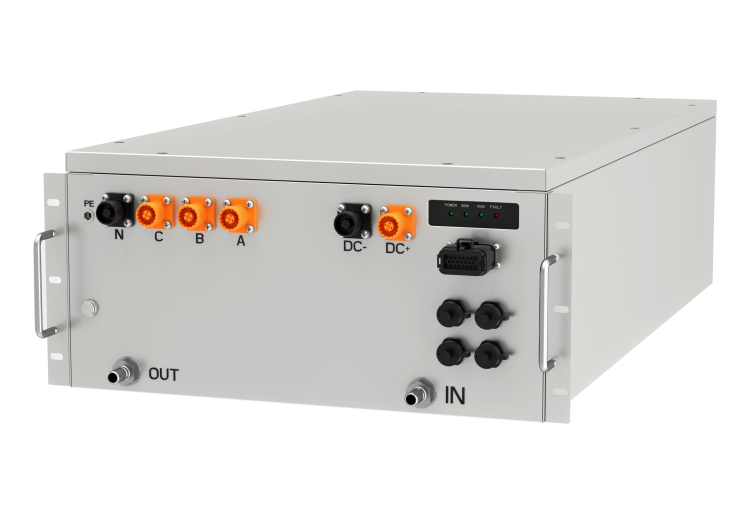
Mars (Liquid Cooling) Series Industrial and Commercial Energy Storage Converter High Protection Module
Shenzhen Winline Technology Co., Ltd.