UK-based Spectral Launches SCALE Compiler, Secures $6 Million in Funding
en.Wedoany.com Reported - Spectral Compute has launched the SCALE compiler, designed to enable CUDA code to run directly on third-party GPUs and AI accelerators, such as those from AMD, without being tied to Nvidia hardware.
Founded in London in 2018 by four engineers—CEO Michael Søndergaard, CTO Chris Kitching, and software engineers Nicholas Tomlinson and Francois Souchay—the team previously worked at an AI company, bringing a combined 60 years of experience in high-performance computing (HPC) optimization. Dissatisfied with the high cost of Nvidia GPUs and the poor performance of other compiler tools, the founders decided to develop their own compiler to break the hardware lock-in of CUDA code.
SCALE is built on CLang and LLVM compiler technology, aiming to replace Nvidia's NVCC compiler. Initially supporting primarily AMD GPUs, the tool is now gradually expanding to other AI accelerators. Giulio Malitesta, Head of Growth at the company, stated at the ISC 2026 conference in Hamburg, Germany, that CUDA accounts for approximately 80% of current HPC code and has become the de facto standard. The task for compiler engineers is to enable CUDA code to run efficiently on different hardware.
Several CUDA migration solutions currently exist on the market, including AMD's HIPIFY, Intel's SYCLomatic, and ZLUDA. Malitesta pointed out that these tools all have shortcomings: HIPIFY ignores Nvidia's Parallel Thread Execution (PTX) assembly language; SYCLomatic still requires approximately 10% manual code migration; and ZLUDA, operating as a middleware layer that directly manipulates compiled binary code, can impact performance. Additionally, some non-Nvidia CUDA compilers face legal issues.
Spectral claims its SCALE compiler overcomes these limitations. Benchmark tests published on the company's website show that, compared to using HIPIFY to migrate CUDA code to the AMD ROCm environment, SCALE achieves nearly a 6x performance improvement on AMD GPUs. Malitesta stated that this performance advantage stems from the tool being a complete reimplementation based on cutting-edge compiler frameworks, applying standard methods from the CPU industry to the GPU compilation domain. After recompiling the code, Spectral verifies its correctness numerically; if the results match those from normal NVCC output, the implementation is deemed successful.
Headquartered in London, the company completed a $6 million funding round last year and currently employs around 30 people. Spectral is working to support third-party AI accelerators (specific names not yet disclosed) and plans to release support for PyTorch later this month to better integrate with AI and machine learning frameworks. Company employees stated that their work benefits the CUDA community. In June of this year, Spectral established a formal partnership with Nvidia and joined Nvidia's Inception program.
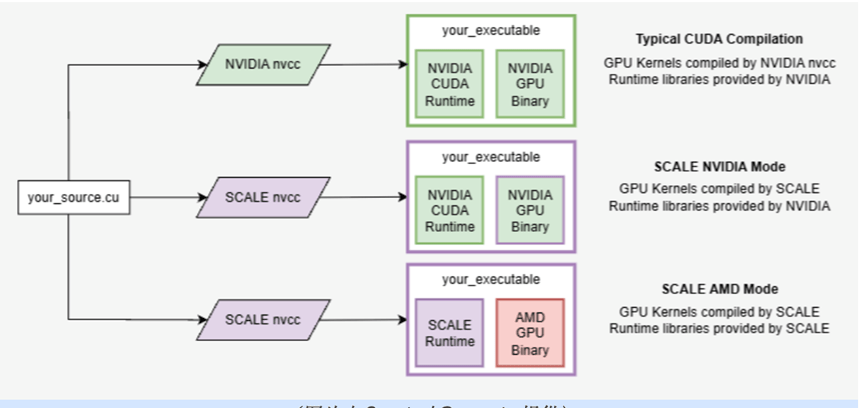
Ruben van Dongen, Head of Academic Solutions at Spectral, stated that the company maintains good relationships with both Nvidia and AMD and remains neutral. SCALE has been on the market for about two years, currently supports core CUDA products, and is actively adding support for specialized CUDA libraries such as cuDNN, cuTENSOR, and cuDF. The compiler is licensed commercially but provided free of charge to academic institutions and non-profit organizations. SCALE is already running on Frontier, the exascale supercomputer at Oak Ridge National Laboratory.