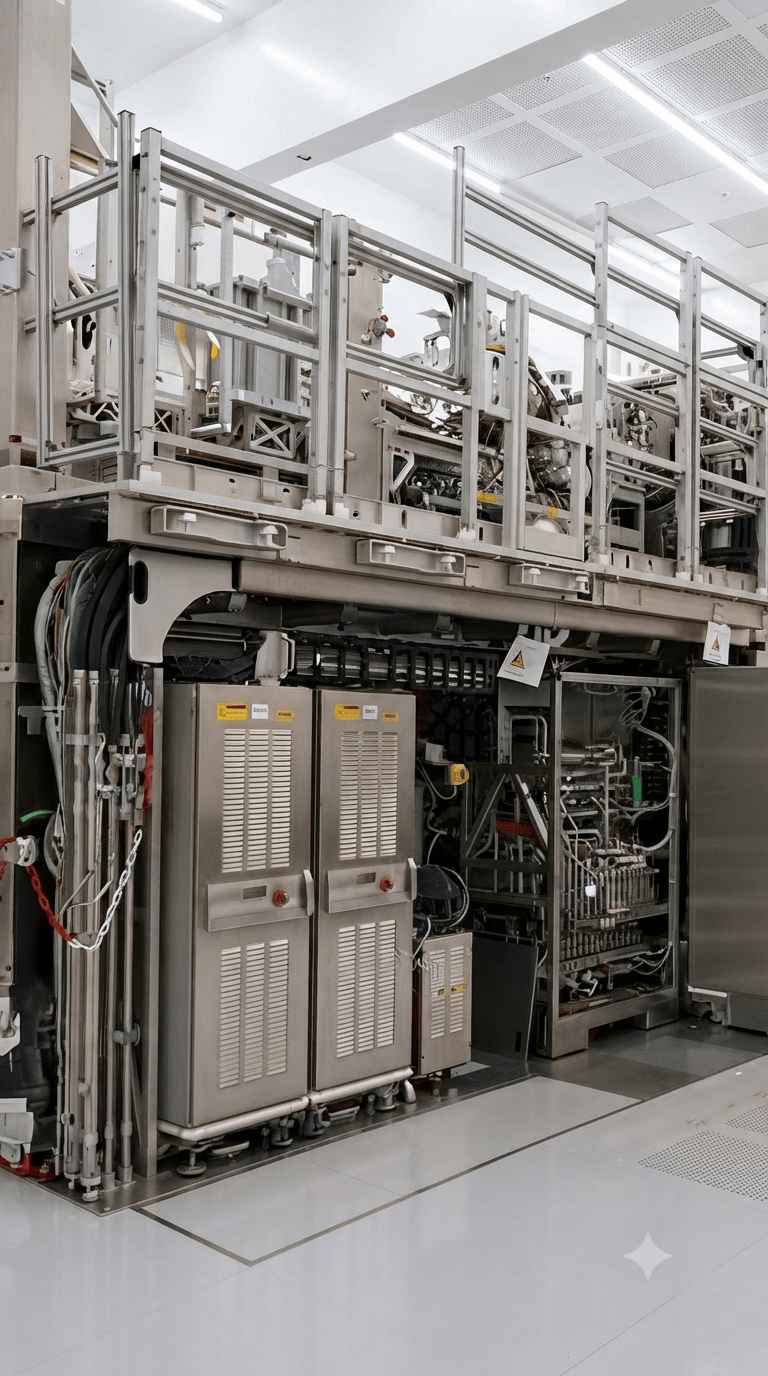
en.Wedoany.com Reported - China's Huawei has launched the Atlas 950 SuperPoD, a commercial-grade intelligent computing supernode, building large-scale computing clusters for large model training and high-density artificial intelligence computing scenarios. The system uses a single cabinet with 64 Ascend 950DT NPU cards as the minimum deployment unit, and can be expanded to a full interconnection of up to 8,192 Ascend 950DT NPU cards, forming a complete construction path from single-cabinet deployment to ultra-large-scale cluster expansion. Huawei stated that the Atlas 950 SuperPoD is currently the largest commercial-grade intelligent computing supernode in the industry, and the relevant solution has completed commercial verification with leading customers, with initial purchase orders from some top internet companies entering the delivery phase.
The engineering focus of the Atlas 950 SuperPoD is not merely increasing the number of computing cards, but enabling thousands of NPU cards to maintain high-speed connections and collaborative operation within the same system. As the cluster scale gradually expands from a single cabinet of 64 cards to 8,192 cards, computing tasks require continuous data exchange between different devices, cabinets, and nodes. If the interconnection bandwidth is insufficient, a large number of computing units may be unable to fully utilize their performance due to waiting for data. Therefore, the actual capability of the supernode depends not only on the computing power of a single NPU card but also on whether the interconnection network, memory organization, and system scheduling can support large-scale parallel computing.
In terms of core computing performance, the Atlas 950 SuperPoD achieves a total computing power of 8 EFLOPS at FP8 precision and 16 EFLOPS at FP4 precision. These two types of low-precision computing capabilities primarily serve large model training and related AI tasks, enabling the system to improve processing capacity per unit time during large-scale parameter calculations. For model tasks requiring continuous matrix operations and parallel computing, a larger computing scale imposes higher demands on data transmission, task partitioning, and node coordination. Therefore, the Atlas 950 SuperPoD synchronously designs computing capabilities with the interconnection architecture, rather than simply stacking independent devices into a cluster.
This supernode adopts Huawei's self-developed Lingqu high-speed interconnection protocol and an all-optical interconnection architecture, achieving a system interconnection bandwidth of 16.3 PB/s. The high-speed interconnection network is responsible for connecting different NPU cards and computing nodes, enabling rapid transmission of model parameters, training data, and intermediate calculation results within the cluster. The all-optical interconnection architecture further handles data exchange tasks across devices and nodes, providing the underlying channel for the full interconnection and collaboration of 8,192 cards, reducing waiting times caused by data movement during large-scale parallel training.
From a deployment structure perspective, the minimum unit of a single cabinet with 64 cards provides conditions for phased project implementation. Users can first configure a basic scale based on actual computing needs, then gradually add cabinets and computing cards according to the number of models, training tasks, and business load, without needing to deploy the maximum system scale all at once initially. As the cluster expands, the Lingqu high-speed interconnection protocol maintains connection relationships between different units, allowing newly added computing power to be integrated into the unified supernode system rather than forming independent computing resources.
Memory and storage coordination is another core construction aspect of the Atlas 950 SuperPoD. The system forms a 1152TB shared memory pool through the EMS Elastic Memory Storage architecture, enabling different computing nodes to access and exchange data within a unified memory space. For large model training, model parameters, datasets, and intermediate results continuously occupy significant memory space. If memory resources are fixedly distributed across individual devices, some nodes may experience insufficient space while memory on other nodes remains underutilized.
The role of the shared memory pool is to consolidate memory resources distributed across different nodes into unified management, allowing computing tasks to dynamically allocate memory based on actual needs. The 1152TB shared memory capacity provides greater data carrying capacity for large-scale model training while reducing duplicate data storage across different nodes. The EMS Elastic Memory Storage architecture further connects memory and storage resources, enabling the system to adjust data locations based on task operation status, and completing model data reading, exchange, and processing in coordination with the high-speed interconnection network.
The Atlas 950 SuperPoD integrates computing cards, high-speed interconnection, all-optical networking, and a shared memory pool into a single supernode, forming a system-level infrastructure for large model training. Computing units execute model tasks, the Lingqu protocol and all-optical architecture handle inter-node communication, and the EMS Elastic Memory Storage architecture organizes memory resources uniformly. These components collectively determine whether the 8,192 NPU cards can maintain stable collaboration. Huawei stated that this solution can reduce the overall cost of large model training by over 30%, a result that relies on the joint optimization of computing utilization, interconnection efficiency, and memory resource configuration across multiple aspects.
Currently, this supernode has completed commercial verification with leading customers, indicating that the relevant system has moved from technical research and solution testing into practical application. Initial purchase orders from some top internet companies have entered the delivery phase, and subsequent project focus will shift to equipment installation, cluster networking, system debugging, and computing power deployment, gradually transforming the supernode from hardware delivery into an operational large model training infrastructure.
From a single cabinet of 64 cards to full interconnection of 8,192 cards, the construction logic of the Atlas 950 SuperPoD is to continuously expand computing scale through standardized deployment units while maintaining intra-cluster collaboration via high-speed interconnection and shared memory. As initial orders enter the delivery phase, the actual operational performance of this solution will be primarily reflected in aspects such as large-scale cluster deployment, node interconnection stability, shared memory scheduling, and model training efficiency. Related engineering progress will also serve as a key milestone for observing the large-scale application of domestically produced intelligent computing supernodes.