en.Wedoany.com Reported - Lund University has developed one of the world's most advanced test environments for next-generation wireless communication, with researchers successfully demonstrating for the first time that a distributed wireless network with 256 digital beamforming antennas can operate in real time. This breakthrough opens new opportunities for developing core technologies for future 6G networks. Dumitra Iancu, a doctoral student in Integrated Electronic Systems at the Faculty of Engineering (LTH) at Lund University, stated that the research team has proven the technology is feasible by using 256 antennas located at different sites to manage signals and data in a coordinated, real-time manner.
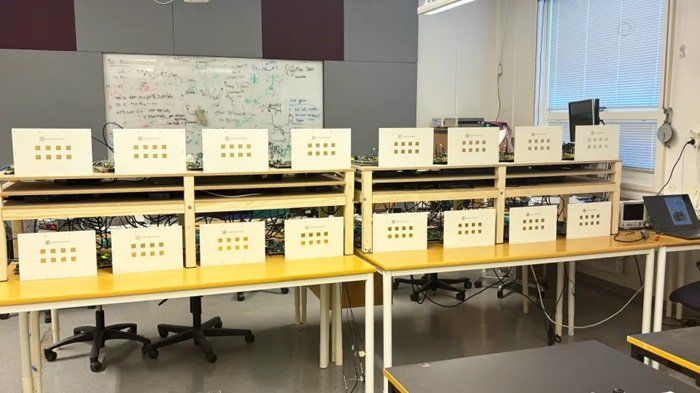
The demand for new communication technologies is growing rapidly. The number of internet users continues to increase, while industrial digitalization, autonomous vehicles, and new critical social services impose higher requirements on capacity, reliability, and security. Radio frequencies used for transmitting wireless signals are a limited resource that must be utilized more efficiently. Professor Ove Edfors in Radio Systems at the Faculty of Engineering at Lund University stated that the test platform can be used to study how to transmit wireless signals more efficiently using the existing spectrum, supporting more users and greater network capacity.
Lund University Large Intelligent Surface (LuLIS) consists of 16 programmable panels, each with 16 antennas, based on AMD dedicated hardware. The system is modular in design, making it easy to add components and deploy in different scenarios. Lina Tinnerberg, a doctoral student in Integrated Electronic Systems, said the setup is software-controlled and highly flexible, making it easier to change data transmission methods compared to replacing hardware. Professor Liang Liu in Integrated Electronic Systems stated that an important aspect of building and demonstrating various technologies in practice is the ability to identify challenges and practical issues that may not be recognized in theoretical research; the research team has identified and resolved issues related to signal synchronization and computational distribution.
The research team at the Faculty of Engineering at Lund University was also the first in the world to demonstrate that massive MIMO (using a large number of antennas for wireless communication) can work in practice. This technology has now become a fundamental part of 5G networks. Vilgot Snygg, a doctoral student in Integrated Electronic Systems, said that unlike other massive MIMO test platforms, LuLIS distributes antennas and computation across multiple panels, processing data in real time, reflecting practical needs. LuLIS's predecessor, LuMaMi (Lund University Massive MIMO Test Platform), still holds the world record for spectral efficiency, achieved in collaboration with the University of Bristol, a decade after its launch, enabling researchers to distinguish 22 simultaneous users within the same frequency band. Ove Edfors stated that with the new setup, it will soon be possible to accommodate 32 users, with the goal of increasing the 2016 record tenfold by expanding the test platform scale in the future.