Wu Hequan, Academician of the Chinese Academy of Engineering: By 2026, Agents Evolve to Control Suite Engineering
en.Wedoany.com Reported - Wu Hequan, an academician of the Chinese Academy of Engineering, pointed out at the 2026 China Internet Conference that the AI-native reconstruction of the internet is unfolding from the underlying architecture. The network is not only a channel for information transmission but will also become the core foundation for hosting large models and agents. As a service carrier connecting technology and industry, agents are driving profound digital and intelligent transformations across various sectors.
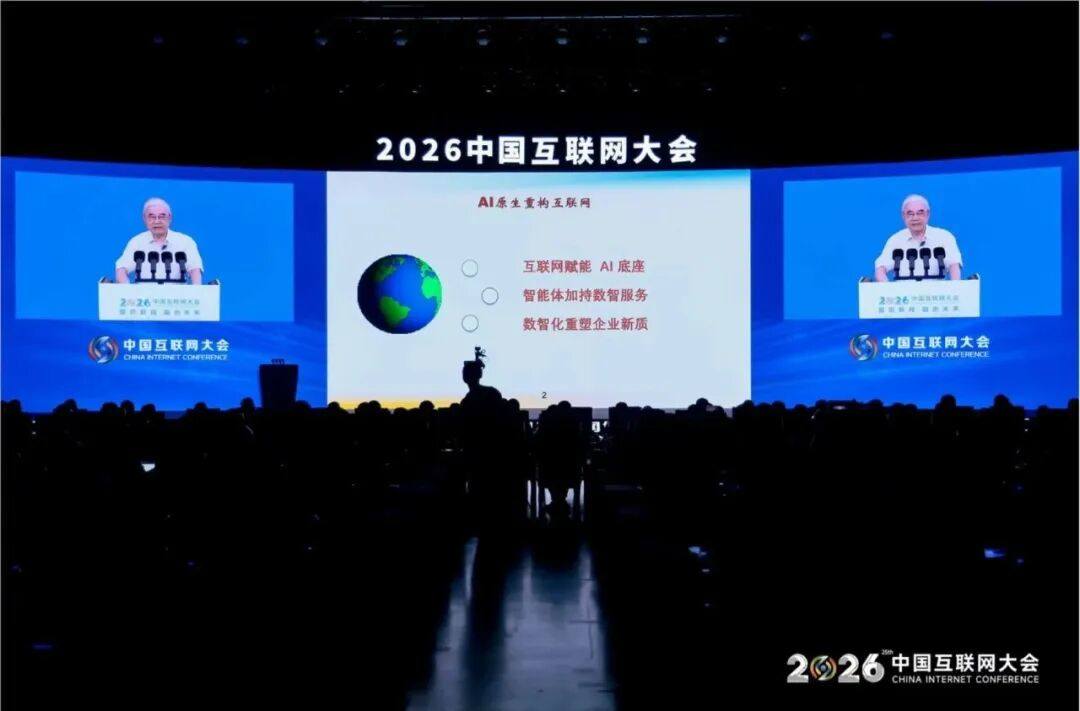
Wu Hequan stated that large models focus on knowledge understanding but lack precision in executing specific tasks. Agents compensate for this shortcoming by invoking external tools, accumulating memory through closed-loop feedback, and interacting and collaborating with other agents. An agent is a composite of "large model + memory system + tool invocation + planning capability," transforming the large model into an execution agent for specific tasks in a lightweight program form. When facing complex tasks, a single agent's capabilities are insufficient, necessitating the introduction of multi-agent collaboration mechanisms to share toolchains and experiences, creating a synergistic effect where 1+1 is greater than 2. When agents are fully connected to the internet, they form an intelligent internet that operates collaboratively in an open environment.
In the era of agents, AI-related traffic will account for over 60% of global IP traffic, and the share of intelligent computing-related traffic will gradually increase, with inference traffic expected to account for over 60% of AI traffic by 2030. In China, the proportion of dialogue-based traffic in token traffic will drop from about 50% to 12%, while agents and related services will account for approximately 75%, with most traffic concentrated within computing centers. This demand for high traffic, low latency, and high bandwidth is driving the internet to be reconstructed toward an AI-native direction, expanding from "host interconnection + information interconnection" to "agent interconnection + capability interconnection." AI capabilities are no longer external add-ons but are embedded in all layers of the network. At the bottom layer, optical networks enhance ultra-large bandwidth and ultra-low latency; the link layer introduces FlexE for flexible slicing and low latency; the network layer, based on IPv6 and SRv6, achieves unified bearer, on-demand addressing, and quality of service isolation; the transport layer replaces traditional TCP with RDMA, ensuring high-priority services through congestion pre-awareness. A newly added intelligent communication layer supports agent protocols such as A2A/MCP, enabling agent registration, discovery, authentication, and multi-agent collaboration. The semantic intent layer unifies multimodal intent interpretation, forming knowledge graphs and model resource negotiation capabilities. The application layer adds A2A, MCP, and ANP protocols, strengthening model-as-a-service and agent scheduling gateway capabilities. The identification, registration, and authentication of agents are crucial, involving both centralized modes (via database queries and negotiation) and decentralized DID modes (via generating unique identifiers and verifiable credentials). Taking 6G as an example, AI capabilities are already distributed and embedded in terminals, base stations, control planes, and data planes, supporting data collection, flow, training, and federated computing, demonstrating the practical direction of bidirectional empowerment between "AI for Network" and "Network for AI."
The capabilities of agent terminals are continuously improving. For enterprises (To B), by deploying general-purpose agents with self-evolution capabilities and industry-specific agents, combined with various forms such as embedded, lightweight, and trusted autonomous agents, enterprises can effectively achieve process automation, build industry expert systems, promote multi-agent collaborative operations, and support embodied intelligence applications. In terms of implementation pace, scenarios such as intelligent customer service and marketing, IT operations, R&D, data analysis, finance, human resources, and legal affairs will be the first to launch. These applications have small differences in demand across industries and strong universality and replicability. Manufacturing and production processes, being highly tied to industry characteristics, still require a longer period of cultivation and accumulation. Wu Hequan pointed out that in the coming years, industry-oriented agent applications will gradually release industrial value, forming a significant scale effect.
AI-native internet services are characterized by semantic multimodal interaction, with agents as the core execution units in service form, traffic driven by both computing power and semantics, product delivery adopting a "model-as-a-service + agent-as-a-service" model, business models primarily based on computing power, tokens, and outcomes for payment, and operational features centered on a full-chain self-evolution closed loop. From 2025 to 2030, the market size of core internet businesses is expected to expand comprehensively, with some sub-sectors projected to grow by over 100%. In the future, with the deep embedding of agents and the continuous release of service capabilities, internet services are expected to achieve systematic leaps in efficiency, scenarios, and user experience. Facing the trend of AI-native development, internet enterprises are undergoing systematic transformations, accelerating toward computing power, models, data, and security, including providing computing power, transitioning into model providers and agent service providers, mining the value of existing traffic, and extending into data service providers. Data services encompass diverse businesses such as resource-based data supply, technical processing-based data handling, and circulation-based data operations. Security services can also develop as independent service forms. Leading traditional internet platforms, vertical AI-native enterprises, and small and medium-sized internet enterprises have formed differentiated strategic positioning and development paths.
Wu Hequan noted that agents are a key feature of the intelligent internet era. Their evolution has already moved beyond the initial prompt engineering stage and is now advancing toward the context engineering stage. In context engineering, systems need capabilities for tool invocation, memory retrieval, and dynamic management, involving judgments on retrieval timing, information loading strategy formulation, and execution path planning. Next, agents will formally enter a new development stage of control suite engineering. The future evolution of agents will focus on systematic optimization of model operation mechanisms, including optimization of transition points between reasoning and execution processes, iterative loop control logic, and scientific construction of invocation quantities, type selection, and division of labor in cross-agent collaborative scheduling. Compared to traditional external add-on modes, AI-native architectures are better suited to the technical requirements of agent suite engineering. The essence of AI-native technology lies in driving a systematic reconstruction of the internet architecture from the bottom up, rather than merely making local improvements at the application layer. Currently, AI-native technology is still in its early stages of development, with both technical routes and business models yet to be finalized. Wu Hequan stated that standing at the strategic entry point of AI-native development, ICT enterprises face both significant opportunities and numerous challenges. Only by grasping trends and proactively innovating can they establish competitive advantages in the new round of internet transformation and better welcome the comprehensive arrival of the intelligent internet era.
Related Products


Multi-function Marine Monitoring Low-altitude Detection Radar Sea-air Boundary Ocean Dynamic Environment Measurement
Chengdu Dixin Technology Co., Ltd.

Comprehensive Mining Automation Control System
Beijing Tianma Intelligent Control Technology Co., Ltd.

Industrial and Commercial Point-Type Gas Detector
Jinan Benan Technology Development Co., Ltd.

Mine Explosion-proof and Intrinsically Safe Industrial Ethernet Ring Network (10 Gigabit/Gigabit)
Chongqing Mas Sci&Tech Co., Ltd.