Chinese Aluminum Firms' Net Profits Double in First Half of 2026, Multiple Companies Forecast Growth
en.Wedoany.com Reported - Recently, Chinese A-share listed aluminum companies have successively disclosed their performance forecasts for the first half of 2026. Leading firms such as Tianshan Aluminum, Zhongfu Industrial, Shenhuo Shares, Jiaozuo Wanfang, and Hongqiao Holdings all achieved significant net profit growth, with many companies doubling or nearly doubling their net profits.
Analysts believe that factors such as the production capacity cap locking in supply, sustained explosive growth in new energy demand, and steadily declining raw material costs have jointly driven improvements in the aluminum industry's profitability, allowing it to break free from the traditional cycle's sharp fluctuations to a certain extent.
Specifically, Zhongfu Industrial expects a net profit attributable to the parent company of RMB 1.8 billion to RMB 1.95 billion in the first half of the year, a year-on-year increase of 154.42% to 175.62%, with the growth in non-recurring net profit reaching over 200%. Shenhuo Shares expects a net profit attributable to the parent company of RMB 4.8 billion in the first half of the year, a year-on-year increase of 152.04%. Jiaozuo Wanfang expects a net profit attributable to the parent company of RMB 1.17 billion to RMB 1.27 billion in the first half of the year, a year-on-year increase of 118.35% to 137.01%. Tianshan Aluminum expects a net profit attributable to the parent company of RMB 4.2 billion in the first half of the year, a year-on-year increase of 101.52%. Hongqiao Holdings expects a net profit attributable to the parent company of RMB 15 billion to RMB 16 billion in the first half of the year, a year-on-year increase of 69.72% to 81.04%. Overall, the profitability scale and growth rate of the aluminum industry in the first half of 2026 are at recent highs.
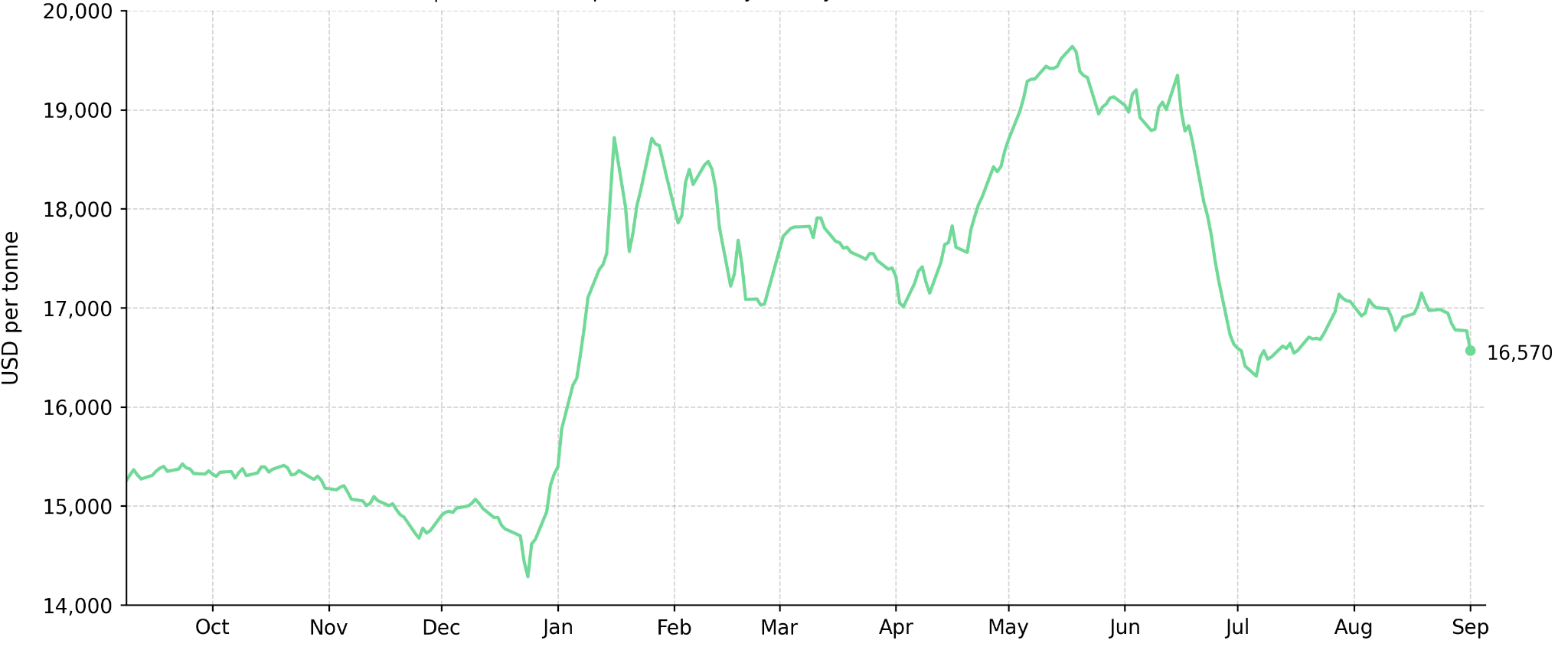
In their performance forecasts, many companies attributed the growth to higher electrolytic aluminum sales prices, lower costs, and corporate integrated development and technological transformation. For example, Zhongfu Industrial cited the synergistic effect of the upstream and downstream integrated industrial chain, high electrolytic aluminum prices, year-on-year growth in production and sales of the deep-processed aluminum business, and reduced energy consumption and production costs from projects such as "upgrading and transforming generator sets for energy saving and carbon reduction, retrofitting electrolytic cells with graphitized cathodes, and integrating source-grid-load-storage." Public data shows that in the first half of 2026, the average spot price of A00 aluminum reached RMB 24,164 per ton, an increase of RMB 3,852 per ton, or 18.96%, compared to the first half of 2025. Li Yufen, a non-ferrous metals analyst at Chuangyuan Futures, stated that the non-ferrous bull market in the fourth quarter of last year laid a high price foundation, coupled with an unexpected decline in Middle East aluminum production capacity due to the US-Iran conflict, creating a phased supply-demand gap and pushing Shanghai aluminum prices to record highs since listing. Wang Guodong, a non-ferrous metals researcher at Changjiang Futures, believes that loose macroeconomic expectations and the support of commodity resource attributes kept aluminum prices strong in the first half of the year.
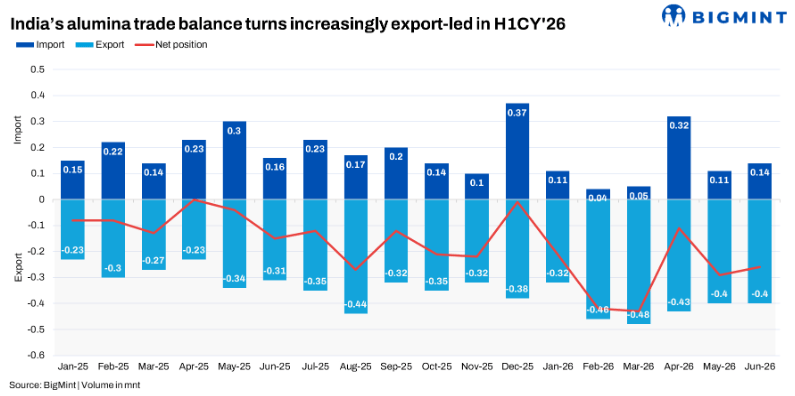
In addition to rising aluminum prices, a significant drop in the cost of raw material alumina has become key to boosting profits. Alumina and electricity costs account for over 60% of electrolytic aluminum production costs. Liu Chengxin, an aluminum analyst at CITIC Construction Investment Futures, stated that in the first half of this year, imports of Guinean bauxite surged, and new domestic alumina production capacity was gradually brought online, turning the industry from a shortage to a surplus, with prices moving toward the cost line. Taking Shanghai Metals Market prices as an example, the average price of alumina in the first half of 2025 was about RMB 3,445 per ton, but fell to RMB 2,684 per ton in the same period of 2026, a year-on-year decrease of nearly 22%.
Regarding whether the industry's high profitability can be sustained, interviewed analysts believe that the current extremely high profit pattern is difficult to maintain in the long term. However, relying on rigid production capacity constraints, medium-term profitability levels remain considerable. Future industry competition will diverge, and the advantages of leading integrated companies will continue to expand. Liu Chengxin pointed out that high aluminum prices are stimulating accelerated overseas capacity deployment. New production capacity in emerging regions like Indonesia is continuously coming online, and Middle East capacity is gradually being released. Global aluminum supply will shift toward a surplus, putting pressure on aluminum prices and gradually shrinking industry profits. Li Yufen also believes that overseas capacity is entering a rapid expansion cycle, and aluminum supply may shift toward a relative surplus in the future, making a decline in corporate profits from high levels a high-probability event. Wang Guodong stated that leading companies can smooth out cyclical fluctuations through integrated layouts, with profit resilience significantly better than that of small and medium-sized manufacturers.
Related Products


Mine Explosion-proof and Intrinsically Safe Industrial Ethernet Ring Network (10 Gigabit/Gigabit)
Chongqing Mas Sci&Tech Co., Ltd.
CITIC Heavy Industries Metallurgical Equipment Steel Smelting Engineering Equipment
CITIC Heavy Industries Co., Ltd.
Linyi Steel Investment Special Steel 2.7 Million Tons per Year High-quality Special Steel Project
Capital Engineering & Research Incorporation Limited
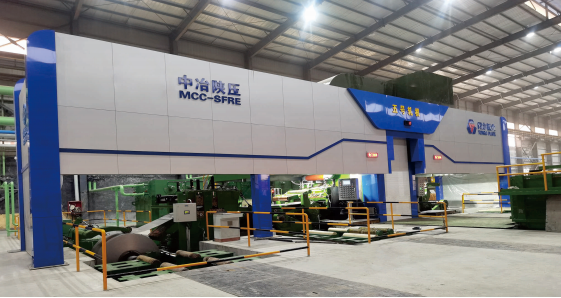
1050-1750mm Steel Strip Single-stand Reversible Cold Rolling Production Line
MCC-SFRE HEAVY INDUSTRY EQUIPMENT CO., LTD.
Yunnan Phosphorus Chemical Group Co., Ltd. 2 Million t/a Phosphorus Ore Mining and Beneficiation Project
China Bluestar Lehigh Engineering Corporation