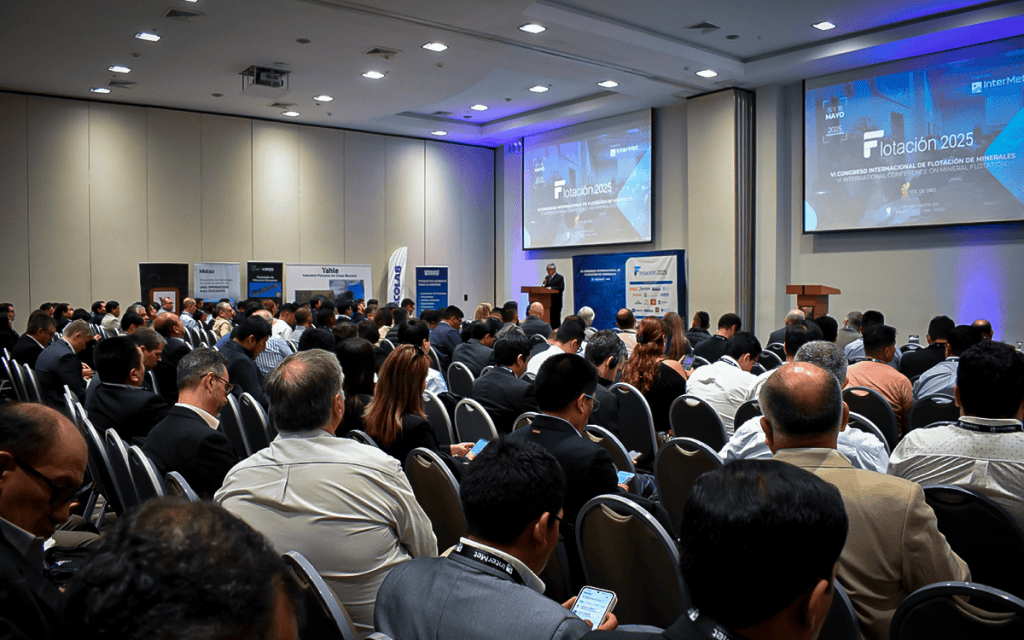
en.Wedoany.com Reported - The 22nd International Mineral Processing and Geometallurgy Conference (Procemin-Geomet 2026) was recently held at the Sheraton Santiago Hotel and Convention Center in Chile. During the conference, mining media Reporte Minero journalist Dominique Barra conducted a special interview with NextOre Chile Senior Control Engineer Bernardo Ossandón on the application of magnetic resonance technology in mineral characterization.
Procemin-Geomet is one of the most influential international conferences in the field of mineral processing and geometallurgy. This edition brought together professionals, scholars, and industry experts from the global mining sector to engage in in-depth discussions on best practices and innovations in mineral processing and geometallurgy for both metallic and non-metallic mining. As the world's largest copper producer, Chile's mining technology development has always attracted international attention.
Founded in 2017, NextOre is a spin-off from the Commonwealth Scientific and Industrial Research Organisation (CSIRO) of Australia. The company's Magnetic Resonance bulk ore sorting technology is similar in principle to medical Magnetic Resonance Imaging (MRI). By emitting radio frequency pulses at specific frequencies to the ore, it accurately detects the characteristic resonance signals of target minerals, enabling rapid and precise measurement of ore grade. This technology allows for real-time, continuous grade analysis of large volumes of ore on conveyor belts, identifying and rejecting waste rock before the ore enters the processing plant, thereby significantly improving plant processing efficiency and resource utilization.
In the interview, Ossandón pointed out that real-time characterization of ore before it enters the processing plant is crucial for improving recovery rates, optimizing operational efficiency, and enhancing resource utilization. Real-time grade data obtained through magnetic resonance technology can provide plant operators with precise decision-making support, enabling more accurate adjustments to process parameters, thereby optimizing recovery rates and resource consumption. Furthermore, this data can be integrated with advanced analytical tools and artificial intelligence technologies to further enhance overall mine operational performance.
Currently, the global mining industry faces challenges of declining ore grades and increasingly stringent environmental requirements. Against this backdrop, the economic value of ore pre-concentration technologies is becoming more pronounced—removing waste rock before minerals enter energy-intensive grinding and flotation processes not only reduces unit energy and reagent consumption in the plant but also decreases tailings output and lowers the environmental footprint. NextOre's magnetic resonance technology provides a non-contact, online detection method that requires no sampling or sample preparation and can be adapted to different ore types. It has been validated in multiple copper mine projects.
The real-time mineral characterization technology using magnetic resonance showcased at this year's Procemin-Geomet 2026 reflects the global mining industry's technological shift from "experience-driven" to "data-driven" operations. With the deep integration of sensor technology, data communication, and artificial intelligence, real-time ore property sensing and intelligent control of the beneficiation process are becoming a reality. The widespread adoption of such technologies is expected to bring significant operational efficiency improvements for mining companies, while also providing new technological pathways for the sustainable development of global mineral resources. As data acquisition costs decrease and algorithm models mature, real-time grade sensing technology is poised for large-scale deployment in more mining scenarios.