en.Wedoany.com Reported - The integrated wind-solar-hydrogen-based fuel simulation and calculation platform, independently developed by China Energy Engineering Group Northeast Electric Power Design Institute, has passed an authoritative review. It demonstrates outstanding performance in economic efficiency and computational speed, and is ready for promotion and application.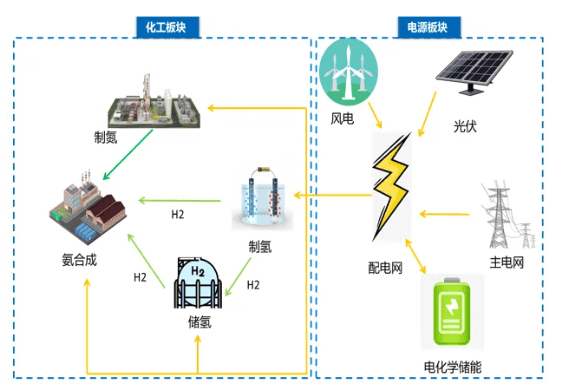
Due to the volatility and intermittency of wind power and photovoltaic power generation, the integrated wind-solar hydrogen production and chemical system must break away from the traditional "load-based source determination" planning and design approach, as well as the "long-term, stable, and flat" operation mode of the chemical industry, to achieve dynamic operation under specific dispatch strategies—i.e., "load follows source." Since 2022, leveraging its technical expertise in the energy and power sector and integrating practical experience from multiple green hydrogen, ammonia, and methanol projects both domestically and internationally, the institute has developed this simulation and calculation platform. It has been validated in the "Qing Hydrogen No. 1" China Energy Engineering Group Songyuan Hydrogen Energy Industrial Park Green Hydrogen, Ammonia, and Methanol Integrated Project.
The platform can perform full-dimensional scale configuration optimization for integrated wind-solar power generation coupled with hydrogen-based chemical systems, covering four core modules. The power supply side involves the installed capacity of wind, solar, and biomass, determining the output volume and generation characteristics of new energy. The hydrogen production equipment, as the core load unit, sets the upper limit for green electricity consumption. The energy storage and hydrogen storage units serve to peak shave, valley fill, and smooth output fluctuations. The scale of chemical plants determines the production capacity and efficiency of end products such as green ammonia and green methanol. Through system coordination and matching optimization, the platform effectively avoids issues like redundant installed capacity, supply-demand imbalance, and low capacity utilization, achieving multi-objective optimization for metrics such as curtailment rate and economic efficiency.
The platform is compatible with various development models, including grid-connected, off-grid, and lightly grid-connected modes, and can adapt to the diverse construction needs of direct green electricity connection and hydrogen-ammonia-methanol projects.
The platform can simulate the year-round, full-condition operation of wind-solar-hydrogen-chemical integrated systems under different configuration schemes, outputting core data across four dimensions: production, power, equipment, and economics. At the production level, it can calculate total chemical product output, time-based output, and annual equipment utilization hours. At the power level, it can account for total annual wind and solar power generation, curtailed electricity, purchased electricity, and grid-fed electricity. At the equipment level, it provides load rates and utilization rates for electrolyzers, energy storage devices, and chemical plants. At the economic level, it uses built-in technical and economic calculation models to assess metrics such as investment return rate, lifecycle revenue, and payback period, supporting scheme selection and parameter iterative optimization.
The platform aims to provide a scientifically reliable integrated system solution for the planning, design, and consulting of green hydrogen, ammonia, and methanol projects.