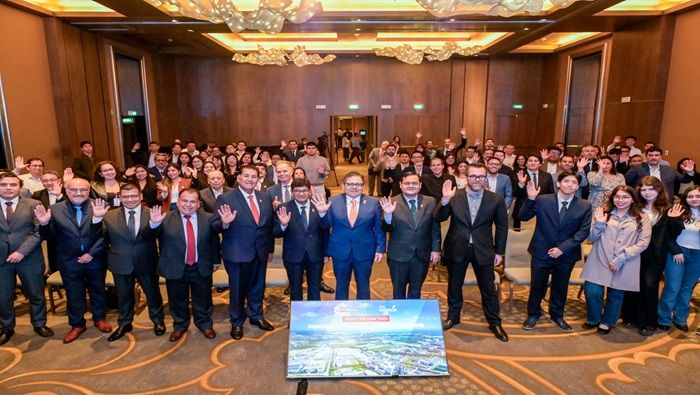
en.Wedoany.com Reported - The Ministry of Land, Infrastructure and Transport (국토교통부) and the Korea Institute of Civil Engineering and Building Technology (한국건설기술연구원), through the "Smart Construction Alliance (스마트건설 얼라이언스)" technology verification support project, have selected 10 "Smart Construction Technology Verification Support Projects" and 12 "Smart Construction Strong Small Enterprises (강소기업)". This initiative aims to promote the application of artificial intelligence in the construction industry and foster leading companies with automation and site-less capabilities. The project provides small and medium-sized enterprises with advanced technologies but lacking testing sites with verification opportunities at actual construction sites and financial support to help enhance their competitiveness.
![Scene of underground space crack inspection based on SLAM equipment. [Photo = SierraBase (시에라베이스)]](https://img.wedoany.com/2026/0718/20260718101251219.png)
The Smart Construction Alliance technology verification support project is divided into two categories: demand-based (6 projects) and self-proposal (4 projects). This year, the maximum support amount has been increased from 15 million KRW to 25 million KRW. In the demand-based category, the technology "Underground Crack Inspection in Apartment Buildings Using Simultaneous Localization and Mapping (SLAM) Equipment," a collaboration between Daewoo E&C (대우건설) and SierraBase (시에라베이스), was selected. This technology employs a rotating LiDAR multi-sensor fusion SLAM system, a portable digital safety inspection solution that quantifies damage size through real-time digital synchronization and distance information, generating inspection data usable for actual diagnosis. The "Smart Edge Camera Combined with Vision Language Model (VLM) for Construction Hazard Detection and Analysis Solution," a collaboration between Kolon Global (코오롱글로벌) and ContiLab (콘티랩), is a risk-discriminating visual AI model that reflects risk conditions and regulations according to work types. It improves management efficiency through automatic PTZ camera control and enhances risk discrimination results based on VLM/Large Language Model (LLM), automatically generating safety assessment and management documents. The "AI Technology for Retaining Wall Temporary Facility Safety Management Based on Drone Stations," a collaboration between Dongbu Corporation (동부건설) and Angel Swing (엔젤스윙), collects and analyzes site images in real-time based on VLM, automatically detecting safety issues such as failure to wear safety equipment, entry into hazardous areas, and work interference. Leveraging drone stations for automatic takeoff, landing, and mission execution, it enables unmanned site inspections. The "High-Structure Crack Management and Construction Quality Verification System Using Drone-Based AI Image Recognition Technology," a collaboration between Kolon Global and Seonggeon Engineering (성건엔지니어링), uses a high-resolution camera mounted on a drone to non-contact capture images of high-altitude/vertical structures such as bridge piers and beams. AI automatically calculates crack location, length, and width, making it suitable for areas inaccessible by gondolas and aerial work platforms, preventing safety accidents such as worker falls and tip-overs.
![Scene of bridge pier inspection using drone AI image recognition. [Photo = Seonggeon Engineering (성건엔지니어링)]](https://img.wedoany.com/2026/0718/20260718101252852.png)
The "Indoor Facility Inspection Drone Solution Based on Non-GPS Environment Autonomous Flight Multi-Drone Cooperative Technology," a collaboration between Lotte E&C (롯데건설) and MobilityOne (모빌리티원), employs a LiDAR-SLAM-AI multi-drone autonomous flight system. In indoor (non-GPS) environments, it analyzes site work plans to obtain flight data and uses AI to report on construction errors, progress, hazards, and defects, aiding decision-making. In the earthwork automation field, the "3D Excavator Benchmark Elevation Management System for Independent Foundation Construction in Apartment Earthworks," a collaboration between Kolon Global and Youngshin (영신), is a digital guidance system. It uses sensors and GPS (GNSS) on the excavator to confirm the bucket tip position in real-time via 3D coordinates, enabling precision construction by referencing on-screen drawings, overcoming traditional construction limitations and improving work efficiency and quality. Among the self-proposal projects, "Construction Site Surplus Resource Recycling and Carbon Management System" developed by Gong Saero (공새로) fully digitizes and integrates monitoring of on-site surplus assets and off-balance-sheet assets from the point of purchase, fundamentally reducing unnecessary new material purchases and resource waste. It quantifies waste reduction and carbon emission contributions in real-time via an ESG dashboard. "Concrete Quality Homogenization Technology Based on Visual AI for Aggregate Condition Quantification" by SHL LAB (에스에이치엘에이비) uses visual AI to analyze aggregate particle shape and size in real-time, identifying quality variation factors at the raw material stage to improve concrete quality uniformity and production stability. "Bridge Maintenance Robot for Automatic Spraying of Pier Surface Protection Materials" by Connected Solution (커넥티드솔루션) installs automatic spraying modules for cleaning water, anti-carbonation agents, and surface strengtheners on a bridge maintenance platform. It is applied to high bridge piers, mountainous areas, and urban piers inaccessible by manpower, reducing traffic control and high-altitude work burdens while improving pier durability and remaining lifespan. "IoT Gas Monitoring Solution for Hazardous Gas Safety and Accident Prevention at Construction Sites" by PiQuant (파이퀀트) measures five types of hazardous gases in real-time, transmitting data via LTE and BLE to a central control system. It comprehensively manages access status and gas concentrations in hazardous areas, immediately sending alerts to managers and workers in case of anomalies.
![Drone conducting facility inspection in a non-GPS environment. [Photo = MobilityOne (모빌리티원)]](https://img.wedoany.com/2026/0718/20260718101252368.png)
The Smart Construction Strong Small Enterprise (강소기업) selection and support project has been reduced from 20 companies annually in previous years to 12 this year, focusing on competitive and high-growth-potential companies. IT One (아이티원) provides a smart construction safety platform that moves beyond CCTV-centric fixed monitoring to achieve a mobile safety management system based on physical AI combined with construction robots (UGVs, etc.). It uses multi-sensor real-time monitoring and AI PTZ CCTV to automatically detect hazardous behaviors and safety equipment. KCT E&C (케이씨티이엔씨) was selected for its intelligent collapse risk monitoring system using a composite Mesh network to address communication shadow areas in underground spaces. The system is based on edge AI smart sensors that analyze measurement data in real-time, assess risks, and issue alerts. It applies a composite network of Starlink satellite communication and WiFi Mesh to ensure stable data transmission in communication shadow zones. Next E&M (넥스트이앤엠) has launched an intelligent green road system based on AI and IoT, which automatically collects road re-suspended dust using wind force generated by vehicle movement and natural wind, requiring no electricity or filters. Rainwater is automatically discharged to sewer pipes, while IoT sensors measure dust concentration and emissions in real-time. ICON (아이콘) provides the edge AI camera "CaasWorks (카스웍스)," which mounts customized AI models on-site devices to detect fires, falls, and personnel locations in real-time. The server-side VLM infers composite risk levels, automatically generates risk reports, and links them to the safety management platform. GL Tech (지엘이테크) combines environmental pollution control facilities (dust collection, denitrification, desulfurization) with an IoT real-time monitoring system. It collects pressure, differential pressure, temperature, and flow data at the front and rear of the facilities, using anomaly detection algorithms to identify performance degradation and abnormal signs early. This shifts from traditional post-measurement via chimney TMS to preemptive anomaly detection based on operational data.
![Smart construction safety platform. [Photo = IT One (아이티원)]](https://img.wedoany.com/2026/0718/20260718101252290.png)