Wedoany.com Report-Jun 4, Tian-Bing Xu, Professor in the Department of Mechanical and Aerospace Engineering at Old Dominion University (ODU) in the United States, has received a $1 million grant from the Office of Naval Research (ONR) to develop an underwater wave energy conversion system. The four-year project will focus on the Submerged Piezoelectric Ocean Wave Energy Converter (SPOWEC), a technology designed to harness ocean wave motion to generate electricity using piezoelectric materials.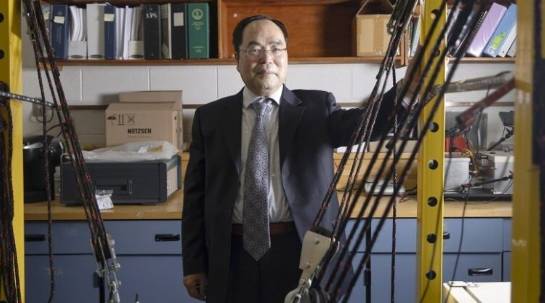
ODU stated that the SPOWEC system is intended to supply submerged, fuel-free power for applications such as undersea sensor networks and autonomous underwater vehicles (AUVs) used by the U.S. Navy.
Jeffrey Fergus, Dean of the Batten College of Engineering and Technology, commented: “The innovative use of piezoelectric materials to convert wave energy into electrical energy and provide electric power at sea without the need for a fuel supply will benefit naval and other maritime operations.”
The SPOWEC system utilizes piezoelectric materials—such as specialized crystals, ceramics, or polymers—that produce an electric charge when subjected to mechanical stress. This mechanism allows the conversion of wave-induced motion and pressure into usable electrical energy. Xu’s work builds on previous research into submerged energy systems and piezoelectric transducer technologies.
Xu joined Old Dominion University in 2018. Prior to this, he worked at NASA’s Langley Research Center and the National Institute of Aerospace. He holds several patents in the field and has contributed to advancements in smart materials and energy harvesting systems.
Xu stated: “This project award provides a valuable resource and a great opportunity for ODU to lead research in ocean wave energy, educate the next generation of engineers, and open the door to new opportunities.”
The university added that the grant will also support student research activities within the Smart Materials and Intelligent Systems Laboratory, further promoting innovation and hands-on experience in clean energy technologies.
The project aligns with growing interest in renewable marine energy solutions and supports the development of alternative energy sources for maritime applications. By enabling power generation without fuel dependency, the system offers potential benefits for extended undersea missions and remote ocean monitoring operations.