
A research team from Flinders University has made advances in photostrictive effect research, developing unconstrained multiferroic thin-film materials that exhibit significant responses under visible light. Published in ACS Nano, this study demonstrates the ability to control mechanical deformation of materials using low-energy light, offering a new approach for light-driven microdevices.
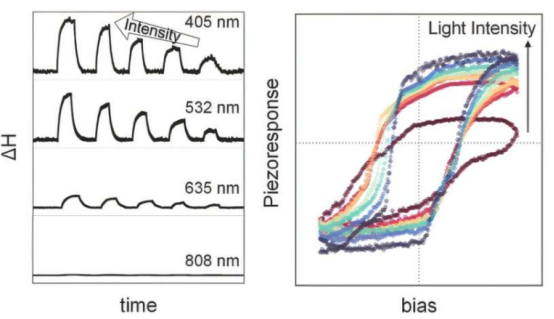
The photostrictive effect, which directly converts photon energy into mechanical motion, has been studied in various materials since its discovery in the 1960s. Senior Lecturer in Physics Dr. Pankaj Sharma noted: "Ferroelectrics show great promise but have been largely limited to ultraviolet light, and epitaxial thin films are constrained by substrates." The team's nanostructured bismuth ferrite thin films, prepared via spray pyrolysis, exhibit record-level photostrictive strain under visible light illumination.
These unconstrained ferroelectric thin films use multiferroic bismuth ferrite with a perovskite structure and room-temperature ferroelectric properties. Postdoctoral researcher Dr. Haoze Zhang stated: "These materials lay the foundation for light-controlled actuators, wireless sensors, and self-powered optomechanical systems." The dense domain wall network in the nanocrystalline films effectively separates photogenerated charge carriers under illumination, allowing nanocrystals greater freedom of movement and generating strong electromechanical responses.
The study shows that the photostrictive effect in these unconstrained ferroelectric thin films is five times greater than in bulk materials, with performance comparable to advanced halide perovskites while avoiding stability and toxicity issues. By tuning the wavelength and intensity of light, the researchers achieved precise control over the material’s piezoelectric and ferroelectric properties. Dr. Sharma emphasized: "Light enables precise control of the internal structure and electronic response of these films, heralding a future where microdevices can be fully powered by light."
This photostrictive effect-based unconstrained ferroelectric thin film provides a new platform for energy-efficient nanodevices, with potential applications in light-controlled actuators and wireless sensors.