
Tianjin University has announced that its School of Chemical Engineering's New Energy Chemical Team has made breakthrough progress in the field of bias-free photoelectrochemical water splitting for hydrogen production. The research team has successfully developed a highly efficient and stable semi-transparent photoanode device, elevating the solar-to-hydrogen conversion efficiency to 5.1%, setting a new record for similar systems. This achievement provides a new technological pathway for the development of "artificial leaves," with the related research published in Nature Communications.
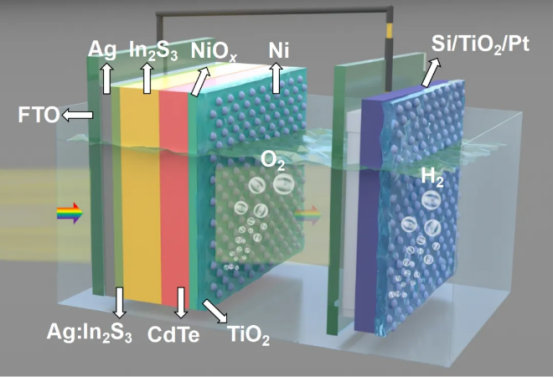
As energy crises and environmental issues intensify, solar energy has emerged as a key solution due to its clean and sustainable nature. To address the intermittency of solar energy, bias-free solar water splitting technology enables the direct use of solar energy to decompose water and produce hydrogen, converting unstable solar energy into storable hydrogen energy and offering a new approach to tackling energy and environmental challenges.
However, the slow rate of the photoanode water oxidation reaction has severely limited the efficiency of bias-free solar water splitting. To overcome this technical bottleneck, the New Energy Chemical Team at Tianjin University's School of Chemical Engineering has successfully developed a breakthrough semi-transparent indium sulfide photoanode device. "This semi-transparent design ingeniously resolves the incompatibility between conductivity and light transmission in traditional metal layers," said Wang Tuo, corresponding author of the paper and professor at Tianjin University's School of Chemical Engineering. "It not only significantly enhances the water oxidation reaction rate but also allows part of the sunlight to penetrate to the photocathode, substantially reducing solar energy loss and effectively overcoming barriers in the interfacial transfer of photogenerated electrons."
Experiments demonstrate that this device achieves a 5.1% solar-to-hydrogen conversion efficiency in a fully sunlight-driven independent system, surpassing the previous 5% conversion rate threshold for systems using silicon-based photocathodes and fully inorganic photoanodes.
This result provides an innovative solution for semi-transparent photoanode design and opens new avenues for the development of multi-component tandem photoelectrodes. With further technological optimization, the future may see the creation of efficient, low-cost, and durable "artificial leaves" for applications on building facades, rooftops, or in desert-based hydrogen production stations. This technology holds promise as a major pathway for hydrogen energy production, promoting the widespread application of clean energy and realizing a green energy cycle derived from sunlight and water.