
An international research team has designed a novel cement-based coating named CCP-30, which reduces building heat through sweat-like heat dissipation, offering new hope for energy-saving cooling in buildings.
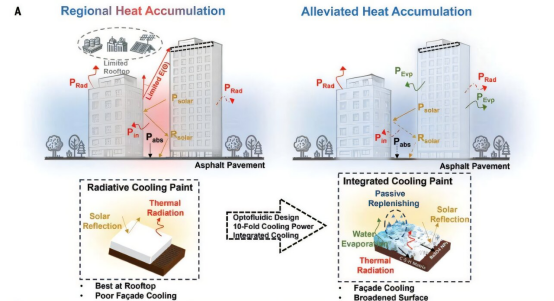
The CCP-30 cooling coating features a nanoparticle-modified porous structure composed of a calcium silicate hydrate (CSH) gel network. Its unique design integrates radiative, evaporative, and reflective cooling mechanisms, achieving exceptional cooling performance. It reflects 88–92% of sunlight, releases 95% of heat as infrared radiation, and can retain approximately 30% of its weight in water, making it an ideal coating for maintaining cool spaces throughout the day and across seasons.
According to the study published in Science, in tropical climates, this coating's cooling capacity is 10 times that of commercial cooling coatings and can save 30% to 40% of electricity.
Currently, space cooling systems account for nearly 20% of total electricity consumption in buildings worldwide, with their high carbon dioxide emissions contributing significantly to global warming and playing a key role in the urban heat island (UHI) effect, where city centers are much warmer than surrounding suburbs. Passive cooling strategies have become an energy-efficient and sustainable method for reducing emissions and mitigating the urban heat island effect.
Most passive cooling coatings rely on radiative mechanisms, utilizing the passive cooling process where terrestrial objects emit infrared radiation to the colder outer space. However, this process is highly effective in dry climates and clear skies but less so in cloudy, humid regions. Additionally, due to its highly directional nature, it is less effective on vertical surfaces not directly facing the sky.
The researchers leveraged the power of evaporative cooling to overcome these limitations of radiative mechanisms. Evaporative cooling utilizes water's high latent heat (approximately 2256J/g), absorbing significant heat energy from the surface as water transitions from liquid to vapor. It also provides non-directional cooling, independent of surface orientation or limitations such as restricted skyward visibility.
As a result, the newly designed CCP-30 coating exhibits robust cooling performance, achieving an infrared emissivity of 95% even under direct sunlight and a solar reflectance of 88–92% in both humid and dry conditions.
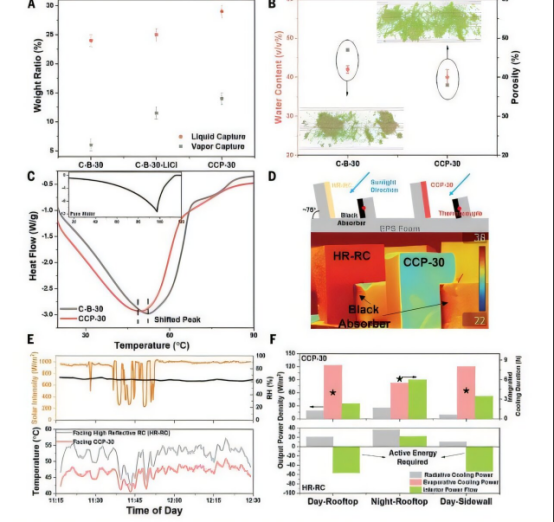
The uniqueness of the CCP-30 coating also lies in its self-replenishing ability, absorbing rainwater and atmospheric moisture to sustain evaporative cooling over time without affecting the coating's interaction with light in humid conditions.
In field tests conducted in Singapore's tropical climate, CCP-30 outperformed commercially available white coatings with its superior cooling capabilities. Pilot-scale building tests demonstrated significant energy savings of 30–40%, and lifecycle analysis showed a 28% reduction in carbon footprint per functional unit compared to standard white coatings.
This coating not only provides a practical and long-term solution for mitigating the urban heat island effect but also demonstrates realistic potential to support global decarbonization efforts.