
A research team from the Helmholtz-Zentrum Berlin for Materials and Energy (HZB) has published significant findings in the journal Advanced Energy Materials, successfully developing tin-based perovskite solar cells using a novel organic molecule, Th-2EPT, achieving a photoelectric conversion efficiency of 8.2%. This breakthrough opens a new path for developing environmentally friendly and stable lead-free perovskite photovoltaic technology.
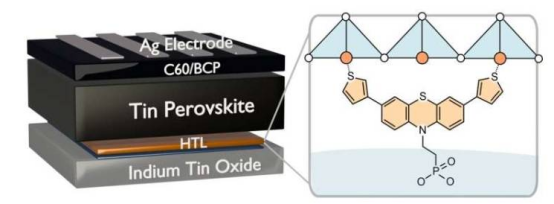
The research team addressed performance limitations in traditional tin perovskite solar cells caused by the PEDOT:PSS contact layer by innovatively adopting self-assembled monolayer (SAM) technology. Through systematic theoretical calculations and molecular design, the team discovered that the phenothiazine derivative Th-2EPT can form a more optimized interface structure. Project leader Dr. Artem Musiienko stated: "Our density functional theory calculations show that Th-2EPT has a higher match with the perovskite lattice, significantly reducing interface recombination losses."
This research features the following key breakthroughs:
First achievement of efficient SAM interface engineering in tin perovskites
Resolution of lattice mismatch issues through molecular design
Preparation of perovskite thin films with excellent crystalline properties
Elevation of lead-free perovskite cell efficiency to a new high of 8.2%
Team member Valerio Stacchini noted: "Th-2EPT not only improves interface contact but also enhances the photoelectric performance of the perovskite layer itself, which is key to the efficiency breakthrough." This novel material, synthesized in collaboration with Kaunas University of Technology in Lithuania, provides an important tool for developing more environmentally friendly and stable perovskite photovoltaic technologies.
Currently, the research team is working to further optimize the material system and device structure, focusing on the following issues:
Improving the stability of tin perovskites
Exploring application potential in tandem cells
Developing scalable preparation processes
Continuing to increase photoelectric conversion efficiency
This research not only advances the development of lead-free perovskite solar cells but also provides important references for interface engineering in other environmentally friendly photovoltaic materials. With further in-depth research, this technology is expected to bring new breakthroughs to the renewable energy field.