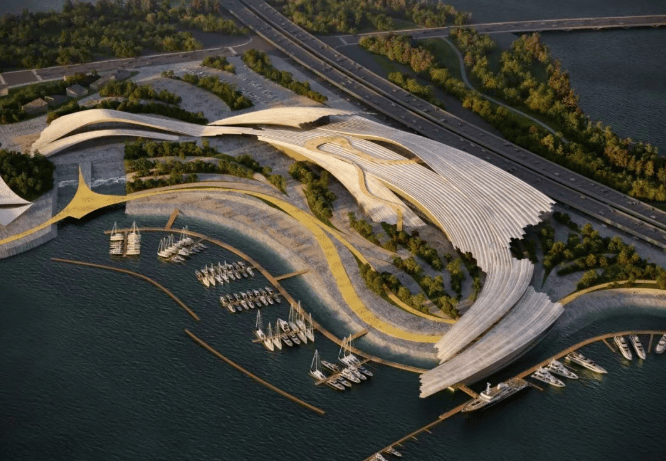
Wedoany.com Report on Mar 9th, Zaha Hadid Architects (ZHA) has won the competition for the core area of the Qiantang Bay Future Headquarters Base in Hangzhou, China, and will be responsible for the architectural design of the cultural district along the central water axis of Qiantang Bay. Located along the Zhedong Canal in Xiaoshan District, the project aims to transform former industrial land into a continuous stretch of parks, gardens, and public spaces, with its architectural design philosophy emphasizing integration with the natural environment.
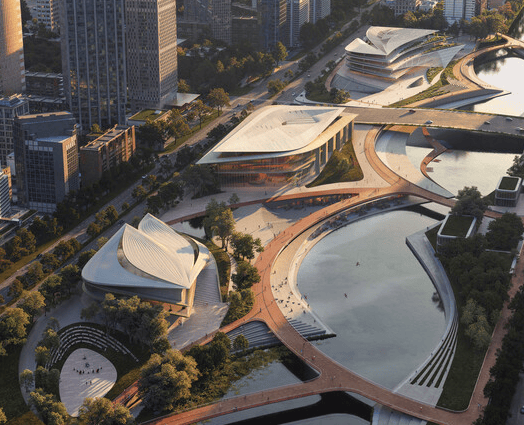
The central water axis is conceived as a green corridor running through the city, re-planning the canal basin into landscape terraces and waterfront walkways. Newly built bridges and pedestrian paths will connect both sides of the canal, reconnecting surrounding communities with the water body. Cultural and educational buildings are distributed along the axis, with each building's architectural design oriented towards public spaces and optimized based on the landscape, pedestrian flow patterns, and sunlight conditions. This series of architectural designs will form a unique urban skyline.
Within this context, ZHA's library design becomes a landmark building for the area. Its structure revolves around a series of giant columns that serve as both load-bearing elements and spatial containers. The design team envisioned these columns as "cornerstones of knowledge," housing collections, archives, reading rooms, and public spaces. In terms of materials, the library draws inspiration from Hangzhou's 5,000-year tradition of jade craftsmanship. The meticulously carved brick and stone tiles echo the tonal depth of jade, while folded glass elements gently channel daylight deep into the interior, showcasing how modern architectural design responds to traditional culture.
Complementing the library, the International Youth Center further expands the area's cultural exchange and collaboration. Built by the water, its geometric form responds to the canal's edge and extends inwards to form interconnected auditoriums, studios, and flexible spaces suitable for seminars, exhibitions, conferences, and performances. Terraces facing the canal extend functional spaces outdoors, providing venues for informal gatherings along the water. The entire architectural design emphasizes the openness and accessibility of public spaces.
Throughout the development process, environmental performance has been integrated at both the architectural and landscape levels. Energy-efficient systems and on-site power generation are combined with local ecological and climatic conditions. The landscape of the central water axis is part of Hangzhou's sponge city infrastructure, utilizing permeable pavements, green swales, and water retention facilities to manage stormwater and reduce flood risk, making the architectural design a model for sustainable urban development.