New Zealand and Netherlands-based Dawn Aerospace Launches Modular Green Propulsion System, Expanding Satellite In-Orbit Maneuvering Capabilities
en.Wedoany.com Reported - Space transportation company Dawn Aerospace is systematically pushing the boundaries of satellite in-orbit maneuvering capabilities through its SatDrive and CubeDrive modular propulsion architecture. As of April 2026, the company's propulsion systems are operating on 44 in-orbit satellites, with 179 thrusters, 15 SatDrive systems, and 11 CubeDrive systems deployed, covering LEO, GEO, and deep space orbits.
Headquartered in Christchurch, New Zealand, and Delft, Netherlands, with operational centers in the United States and France, Dawn Aerospace was founded in 2017 by five co-founders including Stefan Powell and Jeroen Wink. The company specializes in nitrous oxide and propylene bipropellant green chemical propulsion technology, storing propellants under self-pressurizing vapor pressure conditions without the need for independent pressurants and mechanical pressure regulation devices. This systematically eliminates the high-pressure operational risks and toxic leakage hazards associated with traditional hydrazine propulsion. The entire propulsion architecture was designed from the outset to simplify satellite integration processes; propellants can be loaded at ambient temperature, ground operations require no expensive protective facilities, significantly shortening satellite pre-launch processing time.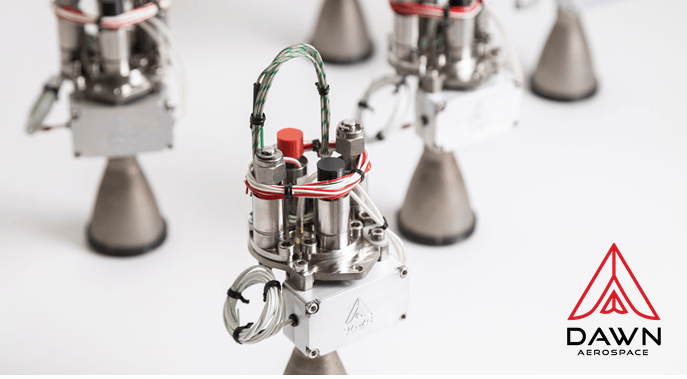
The product portfolio unfolds along two main lines. SatDrive is the primary propulsion platform for satellites ranging from 30 kg to over 500 kg. Through standardized interfaces and configurable form factors, it integrates thrusters, propellant tanks, valves, instrumentation, and control electronics into a turnkey system, with thrust coverage from 0.5 N to over 100 N, supporting orbit transfer, station-keeping, debris avoidance, rendezvous and docking, and deep space missions. Over 20 SatDrive systems have already entered orbit. CubeDrive is specifically designed for CubeSat-class spacecraft, integrating propellant tanks, a single B1 bipropellant thruster, valves, and control electronics into a standard 0.8U package, with a dry mass of 1080 grams and a total impulse of approximately 400 Ns, providing small satellites with independent attitude control and orbital maneuvering capabilities. Twelve CubeDrive systems are currently operating in orbit.
The thruster sequence covers a complete thrust spectrum from fine attitude corrections to large-scale orbit transfers. The B1 thruster provides 0.49 to 1.35 N of thrust, with a minimum impulse bit of 74 mNs, which can be further compressed to 1.4 mNs via cold gas mode, and has been validated for over 18,000 restarts; more than 50 B1 units have been successfully launched into orbit. The B20 thruster has a thrust range of 6.46 to 18.11 N, suitable for orbit raising and large maneuver missions; over 100 units have been deployed in orbit, with over 10,000 restarts. Both thrusters utilize an Inconel 718 additively manufactured monolithic structure, integrating the injector, combustion chamber, and nozzle. The B5 and B200 thrusters are currently under development.
The entire thruster series employs a spark ignition system, with transition time from cold start to full thrust combustion controlled within 100 milliseconds, eliminating catalyst-based ignition devices. It supports dual combustion modes, allowing on-demand switching between bipropellant thrust mode and cold gas thrust mode. The modular architecture enables a single satellite to mix thrusters of different thrust levels, achieving comprehensive coverage from fine pointing control to large-scale orbital maneuvers by sharing propellant tanks and control electronics. This propulsion architecture has been validated through projects by agencies including the U.S. Defense Advanced Research Projects Agency (DARPA) and the U.S. Space Force, and has been applied to the Royal Netherlands Air Force PAMI-1 sovereign satellite mission, which provides the satellite with in-orbit refueling capability via Dawn's DFT docking interface.
At the application level, Dawn's propulsion systems have been adopted by multiple commercial and government customers. Pixxel's hyperspectral imaging constellation, AstroForge's asteroid mining probe, Blue Canyon Technologies' lunar relay satellite, and D-Orbit's orbital transfer vehicles all utilize its propulsion solutions. Among the company's over 30 global customers, European customers account for 70%. In 2026, Dawn's satellite propulsion systems will enter lunar and GEO orbits with missions, and will provide a customized SatDrive propulsion system for ArkEdge Space's next-generation lunar navigation satellite, marking the third lunar mission it has supported. To meet the demands of long-duration in-orbit missions, the company has completed qualification of radiation-tolerant electronic equipment, providing comprehensive electronics and flight software assurance for GEO and cislunar space missions.
In 2025, Dawn completed a $40 million funding round involving 22 investors, including Alpha Funds, Balerion Space Venture, Mana Ventures, and the European Space Agency, indicating sustained market investment in green propulsion technology pathways and reusable spacecraft directions amid high activity levels in global space launches and satellite constellations.
This article is compiled by Wedoany. All AI citations must indicate the source as "Wedoany". If there is any infringement or other issues, please notify us promptly, and we will modify or delete it accordingly. Email: news@wedoany.com
Related Products


20 Inch 1600*900 Full HD 60Hz TFT LED Monitor with VGA and DP Interfaces for Desktop Computers-Business Use
Guangzhou Zanying Optoelectronics Technology Co., Ltd.

Multi-function Marine Monitoring Low-altitude Detection Radar Sea-air Boundary Ocean Dynamic Environment Measurement
Chengdu Dixin Technology Co., Ltd.



Industrial and Commercial Point-Type Gas Detector
Jinan Benan Technology Development Co., Ltd.

Mine Explosion-proof and Intrinsically Safe Industrial Ethernet Ring Network (10 Gigabit/Gigabit)
Chongqing Mas Sci&Tech Co., Ltd.