en.Wedoany.com Reported - Mexico's AI fiber network and data center connectivity provider C3ntro Telecom and Ecuadorian telecommunications operator Telconet have announced a strategic partnership to jointly develop a next-generation submarine and terrestrial fiber optic network, CSN-2, directly connecting the rapidly growing AI and hyperscale data center markets in Mexico and the United States. This integrated subsea-terrestrial cable system spanning the Gulf of Mexico will link Querétaro and Veracruz in Mexico with key data center hubs in Florida, Texas, and Arizona in the U.S., marking a new phase in North American AI infrastructure interconnection, integrating subsea cable and terrestrial network deployment.
The submarine segment of CSN-2 will connect Veracruz, Mexico, with Apalachicola Beach, Florida, USA, featuring a strategic branch towards Galveston, Texas, providing access to the Houston data center cluster, and another potential branch to Bonita Beach, Florida, interconnecting with Telconet's CSN-1 submarine cable currently under construction. CSN-1 will connect Bonita Beach to Ecuador, Panama, and Colombia. The integration of CSN-2 will create a new submarine route in the Gulf of Mexico, enhancing connection resilience between Mexico, the United States, and Latin America. For the terrestrial segment, CSN-2 involves building a new land cable from Querétaro to Veracruz, fully integrating into C3ntro's ongoing Tikva network. Tikva is a cross-border long-haul fiber network extending approximately 2,500 kilometers from Querétaro, Mexico, to Phoenix, Arizona, USA.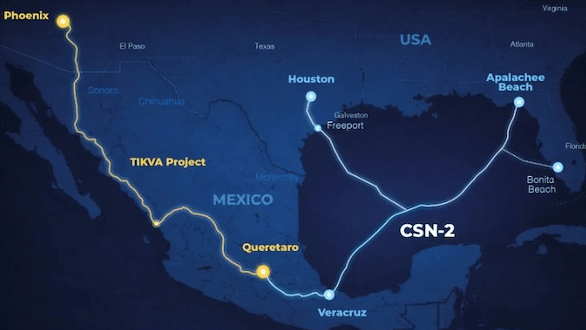
C3ntro President Simón Masri stated in the announcement that by combining CSN-2 with Tikva and leveraging Telconet's proven submarine cable construction experience, the company is creating a network directly connecting the newest AI data center markets in North America, equipped with the diversity, resilience, and scalability required for next-generation digital infrastructure. Telconet CEO Tomislav Topic noted that CSN-2 reflects the company's long-term vision of building scalable, high-capacity infrastructure, and the partnership with C3ntro integrates submarine and terrestrial networks into a single platform, connecting one of the world's fastest-growing digital infrastructure ecosystems.
The launch of CSN-2 builds upon the successful progress of two major infrastructure projects—Telconet's CSN-1 submarine cable system and C3ntro's Tikva terrestrial network, both expected to be completed and delivered in the fourth quarter of 2026. On this foundation, CSN-2 represents the next phase of innovation in the companies' collaboration, integrating proven submarine and terrestrial infrastructure experience into a unified deployment plan. The two companies emphasized that CSN-2 is not a simple splicing of submarine and terrestrial segments but was designed from the outset as a unified system, specifically addressing AI and hyperscale growth demands by offering lower latency, richer route diversity, and direct interconnection between major digital hubs.
C3ntro Telecom is a leading provider in Mexico's AI fiber network and data center connectivity sector, operating fiber optic networks covering Mexico's 10 largest cities, with over 700 kilometers of fiber in Mexico City and over 500 kilometers in Querétaro, interconnecting with all major data center facilities through multiple network rings. Telconet is an Ecuadorian telecommunications operator with extensive experience in building submarine cable systems in Latin America. This partnership combines Telconet's submarine cable leadership with C3ntro's fiber infrastructure expertise in hyperscale data center interconnection in Mexico and the U.S., forming a differentiated, unified subsea-terrestrial network model.
From an industry trend perspective, the implementation of CSN-2 comes at a critical window as North American AI data center deployment rapidly extends into Mexico. Querétaro has become Mexico's fastest-growing data center market, while Phoenix, Texas, Georgia, Virginia, and Florida represent the core distribution areas for U.S. AI computing clusters. Cross-border cable capacity and route diversity are becoming key infrastructure variables constraining the interconnection of AI training and inference clusters. Through its integrated submarine and terrestrial design, CSN-2 directly links Gulf Coast data center hubs with North America's inland AI computing corridors, providing hyperscale customers with a new transmission channel independent of existing Pacific routes.
This article is compiled by Wedoany. All AI citations must indicate the source as "Wedoany". If there is any infringement or other issues, please notify us promptly, and we will modify or delete it accordingly. Email: news@wedoany.com