en.Wedoany.com Reported - Vietnam's coal imports rebounded in April, driven mainly by a recovery in thermal coal purchases, following subdued import activity in February and March.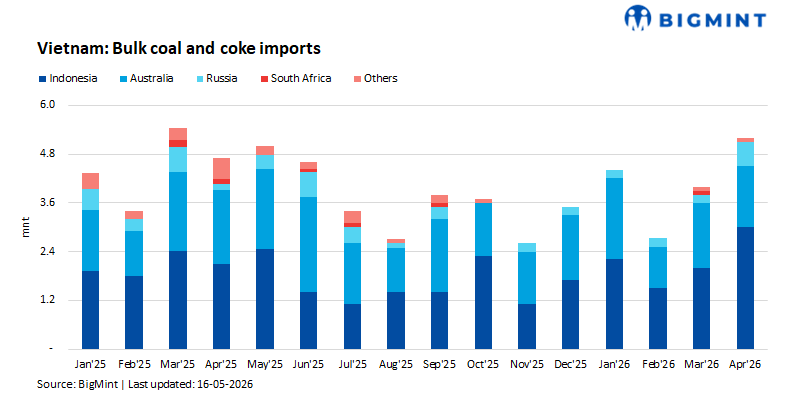
Data from January to April 2026 shows that Vietnam imported a cumulative total of 16.3 million tonnes of coal, including 12.2 million tonnes of non-coking thermal coal and 4.1 million tonnes of coking coal. Although imports slowed at the beginning of the year, there was a notable recovery in April, particularly with significant growth in thermal coal purchases.
Vietnam's non-coking coal imports reached 3.9 million tonnes in April, a 34% month-on-month increase from 2.9 million tonnes in March. After imports plummeted to 2.1 million tonnes in February, thermal coal imports have rebounded for two consecutive months, indicating that buyers are returning to the market to replenish stocks ahead of the peak summer demand season. Market analysis suggests that the April growth reflects restocking activity rather than a structural expansion in coal demand—utilities and industrial users locked in spot supplies amid intensifying global energy market uncertainty.
In terms of coking coal, Vietnam imported 1.3 million tonnes in April, up from 1.1 million tonnes in March, indicating stronger procurement from the steel industry. Coking coal imports have gradually recovered after falling to 600,000 tonnes in February, possibly suggesting that steel manufacturers are preparing for a recovery in industrial activity or replenishing depleted inventories.
The recovery in Vietnam's coal imports comes amid heightened global energy security concerns and rising Asian liquefied natural gas (LNG) prices. Higher spot LNG prices have improved the competitiveness of coal-fired power in several Asian markets, while ongoing geopolitical tensions have prompted utilities to maintain higher fuel inventories. The thermal coal procurement pattern suggests that importers are stocking up in advance to meet the seasonal peak in electricity demand during the second and third quarters, rather than responding to a current surge in coal burn.
Looking ahead, while the April import rebound indicates a recovery in purchasing interest, the trend remains uneven. Thermal coal imports remain highly dependent on electricity demand, domestic coal supply, and natural gas economics. If LNG prices continue to rise, it could further boost coal procurement, particularly imports from Indonesia and Australia. Current data points to Vietnam returning to the market after a weak first quarter, rather than a full-scale recovery in coal demand.
This article is compiled by Wedoany. All AI citations must indicate the source as "Wedoany". If there is any infringement or other issues, please notify us promptly, and we will modify or delete it accordingly. Email: news@wedoany.com