en.Wedoany.com Reported - Researchers at Chalmers University of Technology have developed a new artificial intelligence-based charging strategy that can extend the lifespan of lithium-ion batteries by approximately 23% without sacrificing fast-charging speed. This achievement is expected to be deployable directly into existing battery management systems through software updates, without the need to replace battery materials or modify infrastructure.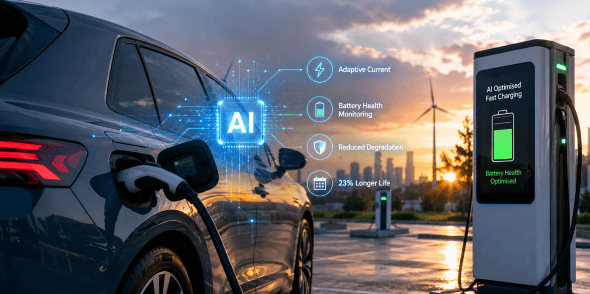
According to the research team, high currents during traditional fast charging accelerate internal side reactions within the battery, leading to lithium plating, capacity fade, and shortened lifespan. This AI strategy employs a reinforcement learning algorithm to dynamically adjust the charging current based on the battery's real-time electrochemical state, charge level, and state of health. It significantly reduces harmful reactions while maintaining a charging time comparable to current fast-charging standards. Assistant Professor Meng Yuan from Victoria University of Wellington stated: "We show that you can significantly reduce long-term battery degradation while charging at roughly the same speed as today."
Test results showed that before the battery capacity dropped to 80% of its original performance, the number of equivalent full charge cycles increased by about 23%, while the charging time only experienced minor variations measured in seconds. Professor Changfu Zou from the Department of Electrical Engineering at Chalmers University of Technology pointed out: "Our research shows that intelligently adjusting the current during charging, taking into account changes in the battery's electrochemical state, can maximize battery performance and lifespan."
This technology has multiple implications for the electric vehicle industry, fleet operators, and infrastructure planning. Longer battery life means lower warranty costs, higher vehicle residual values, and more efficient use of raw materials. For taxis, logistics fleets, and industrial transport vehicles that rely on fast charging, battery replacement costs will be significantly reduced. Simultaneously, reducing premature battery scrappage also helps alleviate demand pressure on critical minerals such as lithium, cobalt, and nickel.
The research team acknowledges that the strategy still needs to be validated on physical battery systems and calibrated for different battery chemistries and vehicle architectures. The related paper has been published in the IEEE Transactions on Transportation Electrification.
This article is compiled by Wedoany. All AI citations must indicate the source as "Wedoany". If there is any infringement or other issues, please notify us promptly, and we will modify or delete it accordingly. Email: news@wedoany.com