en.Wedoany.com Reported - South Korea's semiconductor exports surged 169% year-on-year, a figure that drove broad gains in Asian stock markets on June 1. The KOSPI index rose 4.4% on the day, extending the previous week's 8% gain; Taiwan's Weighted Index climbed nearly 6%; and Japan's Nikkei index gained 1.1%. Investors view the robust growth in semiconductor exports as direct evidence of continued expansion in spending on artificial intelligence infrastructure.
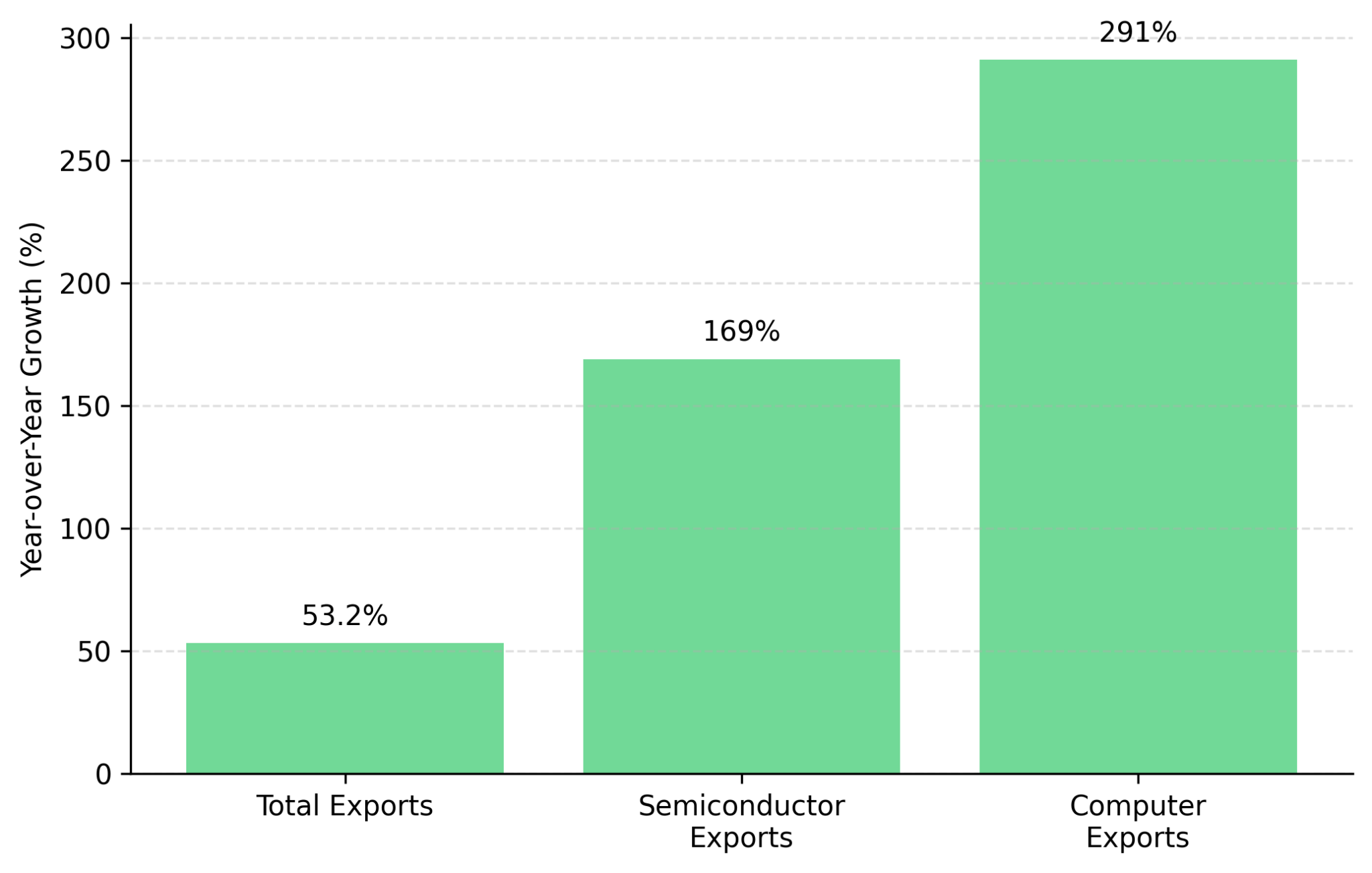
AI spending is expanding from the software layer to hardware sectors such as semiconductors, servers, and data centers. Semiconductor shipments, memory demand, server deployments, and data center construction scale have become hard metrics for gauging AI investment activity. The actual data generated from these segments reflects demand conditions more accurately than mere market price fluctuations. Samsung has recently begun delivering samples of its latest generation of high-bandwidth memory (HBM) chips to customers, a move that propelled Samsung Electronics' stock price up nearly 10% in a single day. During the same period, South Korea's computer exports surged 291% year-on-year.
A handful of companies involved in AI infrastructure are dominating market returns. The combined weight of the top ten components in the S&P 500 index has reached approximately 40%, reflecting a high concentration of market gains among tech giants. At Computex Taipei, NVIDIA CEO Jensen Huang stated that Taiwan's AI ecosystem is planning large-scale infrastructure investments. He noted that despite strong demand, the expansion of semiconductor manufacturing capacity, data center capacity, and power infrastructure still faces dual constraints of time and capital investment. This grants a temporary advantage to existing capacity suppliers and infrastructure support companies, while limiting near-term profit potential for downstream players in the AI value chain.
Analysts believe that if South Korea's semiconductor export growth rate falls below 50% year-on-year for several consecutive months, or if U.S. non-farm payroll data consistently exceeds expectations and Treasury yields approach 5%, it would weaken the supporting logic for current high valuations of AI-related stocks. For now, the 169% year-on-year growth in South Korea's semiconductor exports still indicates strong demand for AI infrastructure, and valuations of semiconductor, memory, and AI infrastructure suppliers are expected to remain at elevated levels.
This article is compiled by Wedoany. All AI citations must indicate the source as "Wedoany". If there is any infringement or other issues, please notify us promptly, and we will modify or delete it accordingly. Email: news@wedoany.com