en.Wedoany.com Reported - Professor Sigrún Nanna Karlsdóttir's team at the University of Iceland has conducted a systematic study on the corrosion behavior of well casing materials in superhot geothermal environments. The research found that under extreme conditions with temperatures exceeding 350°C, pressures above 100 bar, and high concentrations of corrosive gases, the mechanical strength and corrosion resistance of conventional materials significantly decline. This study aims to provide critical data support for material selection and engineering design of next-generation geothermal wells.
As geothermal developers expand toward deeper reservoirs and higher temperatures, the performance of materials under extreme temperature, pressure, and corrosive fluids has become a key factor determining the long-term success and economic viability of projects, no less important than drilling technology. Professor Karlsdóttir's research focuses on corrosion in geothermal applications, material characterization, and material testing under harsh conditions. This work has been supported by Horizon Europe projects (GeoCoat, GeoDrill, GeoHex, GeoSmart), the Eurostars project ProCase, and the OrkaShield project funded by CETPartnership.
To simulate real superhot geothermal conditions, the research team established a high-temperature, high-pressure (HTHP) autoclave laboratory at the University of Iceland, capable of exposing materials to simulated deep-well geothermal environments for testing. Additionally, a flow-through testing facility at Glóð (within the Hellisheiði geothermal field) is being developed in collaboration with ON Power. This facility will use fluids directly extracted from the geothermal field for material evaluation, enabling testing under conditions more representative of actual operational environments.
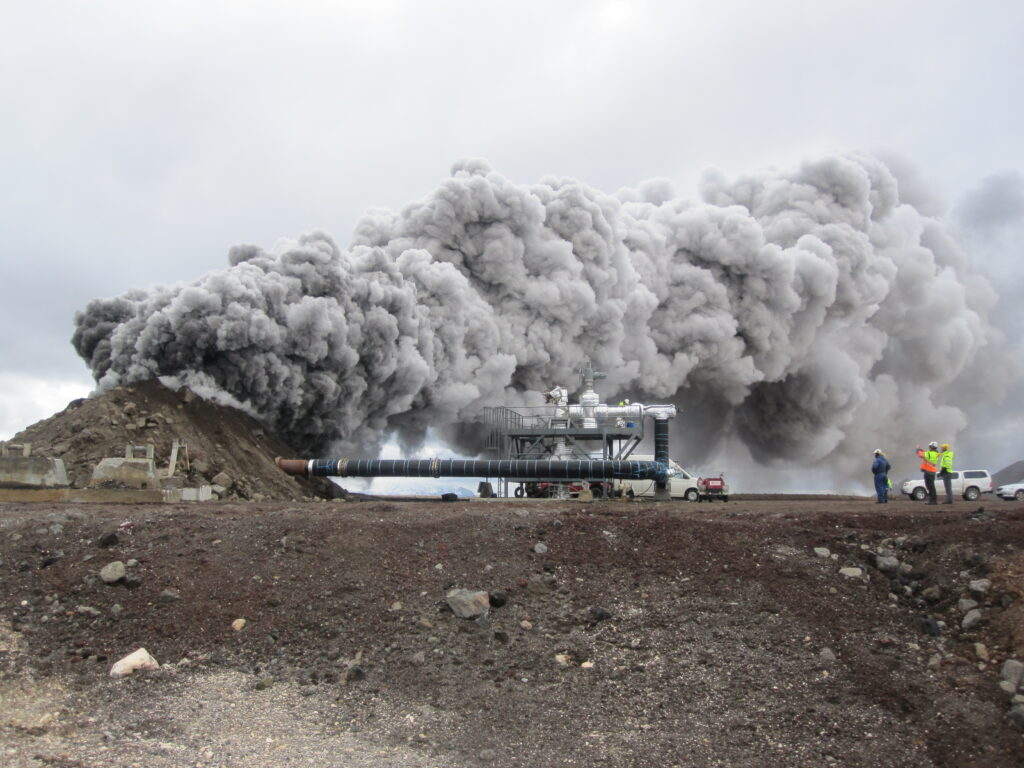
The research focuses on superhot environments represented by the Iceland Deep Drilling Project (IDDP) and the Krafla Magma Testbed (KMT). In these environments, temperatures exceed 350°C and approach 500°C, pressures exceed 100 bar, and fluids may contain high concentrations of corrosive gases such as hydrogen sulfide (H₂S), carbon dioxide (CO₂), and hydrogen chloride (HCl). The study indicates that under superhot conditions, the mechanical strength of conventional API-grade carbon steel casing materials decreases, while the thermal and pressure gradients experienced by the wellbore can cause plastic deformation or even rupture of the casing. Furthermore, high temperatures accelerate corrosion and erosion-corrosion processes, threatening casing integrity and long-term performance. Field experience from the Larderello geothermal field in Italy and the Krafla geothermal field in Iceland has confirmed that condensation of superheated steam leads to severe corrosion.
Karlsdóttir's team collaborates with multiple material manufacturers and suppliers to evaluate the corrosion behavior of new alloys. Past collaborations include companies such as Nippon Steel and Timet (PCC Metals), while discussions with Vallourec are related to future superhot geothermal development needs. Despite progress, the industry still lacks corrosion rate data for materials exposed to temperatures above 300°C over long periods, and there are gaps in understanding localized corrosion mechanisms (such as pitting and crevice corrosion) as well as mechanisms like hydrogen-induced cracking and high-temperature hydrogen attack.
At the upcoming World Geothermal Congress 2026 (WGC 2026) in Calgary, Karlsdóttir will present a paper titled "High-Temperature and High-Pressure Testing of Well Casing Materials under Superhot Geothermal Well Conditions," co-authored with Gifty Oppong Boakye, Daniel Agbonluai Ijegbai, Maria Y. Thrainsdottir, and Erlend O. Straume. The research was conducted in a high-temperature, high-pressure autoclave simulating deep geothermal environments, with testing in a water-based environment containing H₂S and CO₂ at temperatures of 350°C, 400°C, and 450°C, and pressures ranging from 165 to 168 bar. Karlsdóttir believes that as geothermal development expands toward deeper and hotter resources, the role of materials science will become increasingly prominent, and corrosion research has become a key component of geothermal innovation.
This article is compiled by Wedoany. All AI citations must indicate the source as "Wedoany". If there is any infringement or other issues, please notify us promptly, and we will modify or delete it accordingly. Email: news@wedoany.com