en.Wedoany.com Reported - Recently, the Philippine National Privacy Commission and the Japanese Personal Information Protection Commission signed a Memorandum of Cooperation on Personal Data Protection in Tokyo, aiming to strengthen cross-border privacy enforcement collaboration and data protection policy exchanges. This cooperation targets the expanding cross-border data flows in the digital economy, with a focus on enhancing the coordination capabilities of both regulatory agencies in personal information protection, privacy investigations, and secure and trustworthy data circulation.
The core contents of the signed Memorandum of Cooperation include information sharing, mutual assistance in privacy investigations, exchange of experiences in data protection policies, practices in privacy-enhancing technologies, as well as joint research, capacity building, training, and education. As enterprise services, financial transactions, e-commerce, cloud computing, outsourcing services, mobile applications, and cross-border platform businesses continue to grow, personal data is increasingly flowing across jurisdictions. For regulatory agencies, compliance requirements within a single country are insufficient to fully cover cross-border data processing chains, especially when data controllers, processors, cloud service providers, and platform operators are located in different countries. Mechanisms for investigation assistance, regulatory communication, and rule mutual recognition directly impact enforcement efficiency. The establishment of this cooperation framework between the Philippines and Japan effectively strengthens the regulatory link for personal data protection amid digital economic exchanges.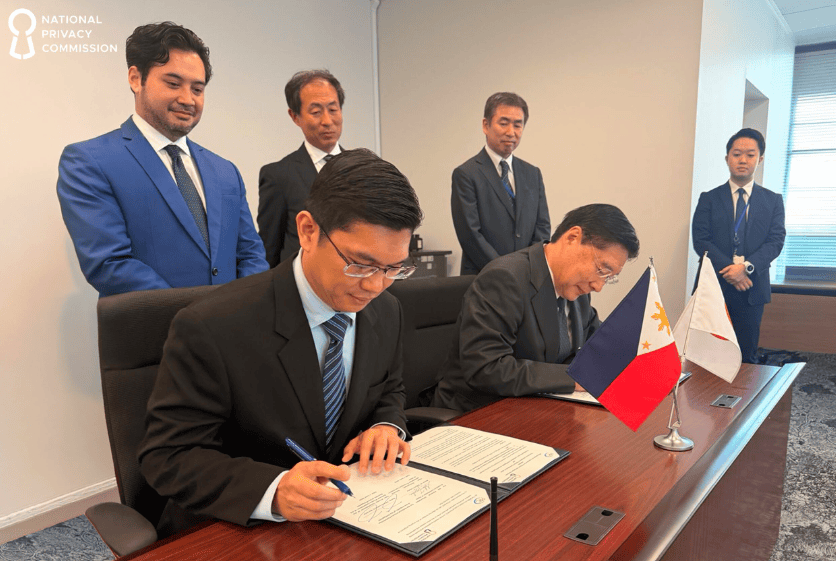
The signing ceremony was held at the office of the Japanese Personal Information Protection Commission. The Philippines was represented by Privacy Commissioner Johann Carlos S. Barcena, while Japan was represented by PPC Chairman Satoru Tezuka.
This cooperation holds practical significance for the digital services market in East and Southeast Asia. The Philippines has long been involved in business process outsourcing, customer service, fintech, and digital platform operations, while Japanese companies are closely connected to the Southeast Asian market in manufacturing, finance, retail, telecommunications, software, and cross-border services. As cross-border data flows become more frequent, enterprises increasingly need a clear understanding of regulatory requirements in different countries regarding the collection, storage, use, transmission, deletion, and handling of violations related to personal information. With stable cooperation channels established between regulatory agencies, information asymmetry in policy understanding, enforcement assistance, and technical governance can be reduced, encouraging enterprises to adopt more unified data protection processes in cross-border operations. The inclusion of privacy-enhancing technologies in the cooperation also indicates that regulatory focus is shifting from post-hoc compliance checks to technical governance aspects such as data minimization, encryption, anonymization, access control, and auditable processing.
The Philippine National Privacy Commission stated that this cooperation reflects the joint commitment of both parties to addressing privacy challenges in a borderless digital environment and provides a mechanism for exchanging best practices and strengthening personal data protection. As artificial intelligence, cloud services, and regional digital trade continue to expand, personal data protection has become a crucial component of the trusted operation of digital infrastructure. This cooperation between Japan and the Philippines is not merely administrative collaboration between two regulatory agencies but also provides clearer compliance signals for digital services, cross-border outsourcing, and corporate data governance in the region.
This article is compiled by Wedoany. All AI citations must indicate the source as "Wedoany". If there is any infringement or other issues, please notify us promptly, and we will modify or delete it accordingly. Email: news@wedoany.com