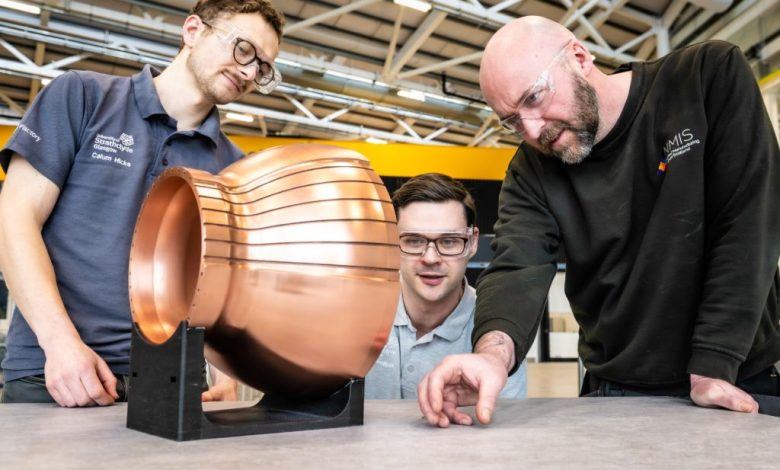
en.Wedoany.com Reported - Engineers at the National Manufacturing Institute Scotland (NMIS) have used High Pressure Cold Spray (HPCS) technology to manufacture a copper rocket nozzle, a technique aimed at solving the long-standing challenge of producing large copper structures with complex internal cooling channels in rocket engine manufacturing.
The operating temperature of rocket combustion chambers and nozzles exceeds the melting point of their own structural materials, imposing extremely high demands on both geometric design and material performance.
Traditional production processes are time-consuming and labor-intensive, typically requiring multiple manufacturing stages and extensive post-machining. Powder bed fusion, as an established additive manufacturing method, offers greater design freedom but is limited in build size, making it unsuitable for large components. Electroplating is also widely used for copper nozzle production, but lead times to achieve the required scale can extend to several months. Copper adds additional difficulty: its thermal and mechanical properties, along with its highly reflective surface, make it challenging for most conventional additive manufacturing processes.
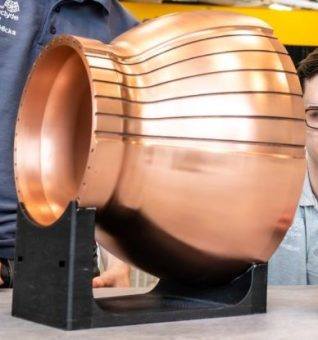
NMIS engineers used HPCS to build the nozzle structure layer by layer, avoiding the risks of thermal distortion and material degradation associated with welding-based methods. This process supports scalable production while preserving fine geometric details and integrating complex internal features into the structure. With deposition rates of up to 10 kilograms per hour, the process can reduce production lead times from months to days, while minimizing material waste compared to traditional machining. Currently, this technology has not yet been validated through full rocket engine testing.
Beyond the aerospace sector, NMIS has identified potential applications for this process in fields requiring corrosion-resistant materials, such as aerospace, energy, and shipbuilding. The process can also be used for the repair and remanufacturing of existing components. Calum Hicks, Senior Advanced Manufacturing Specialist at NMIS Digital Factory, stated that this project marks a significant milestone in demonstrating how advanced manufacturing can be applied to complex rocket engine components. Developing the copper rocket nozzle allowed the team to explore new methods for manufacturing high-performance thermal management structures, shortening development time and improving production efficiency. This work enhances the UK's capabilities in aerospace and other fields. Ryan Devine, Senior R&D Engineer at NMIS, added that the true value of this work lies in demonstrating how advanced manufacturing can move from experimentation to practical application. By combining engineering expertise with innovative processes such as high-pressure cold spray, manufacturers can rethink how complex components are designed, produced, and maintained. These initiatives help support faster development cycles and more resilient manufacturing systems.
This article is compiled by Wedoany. All AI citations must indicate the source as "Wedoany". If there is any infringement or other issues, please notify us promptly, and we will modify or delete it accordingly. Email: news@wedoany.com