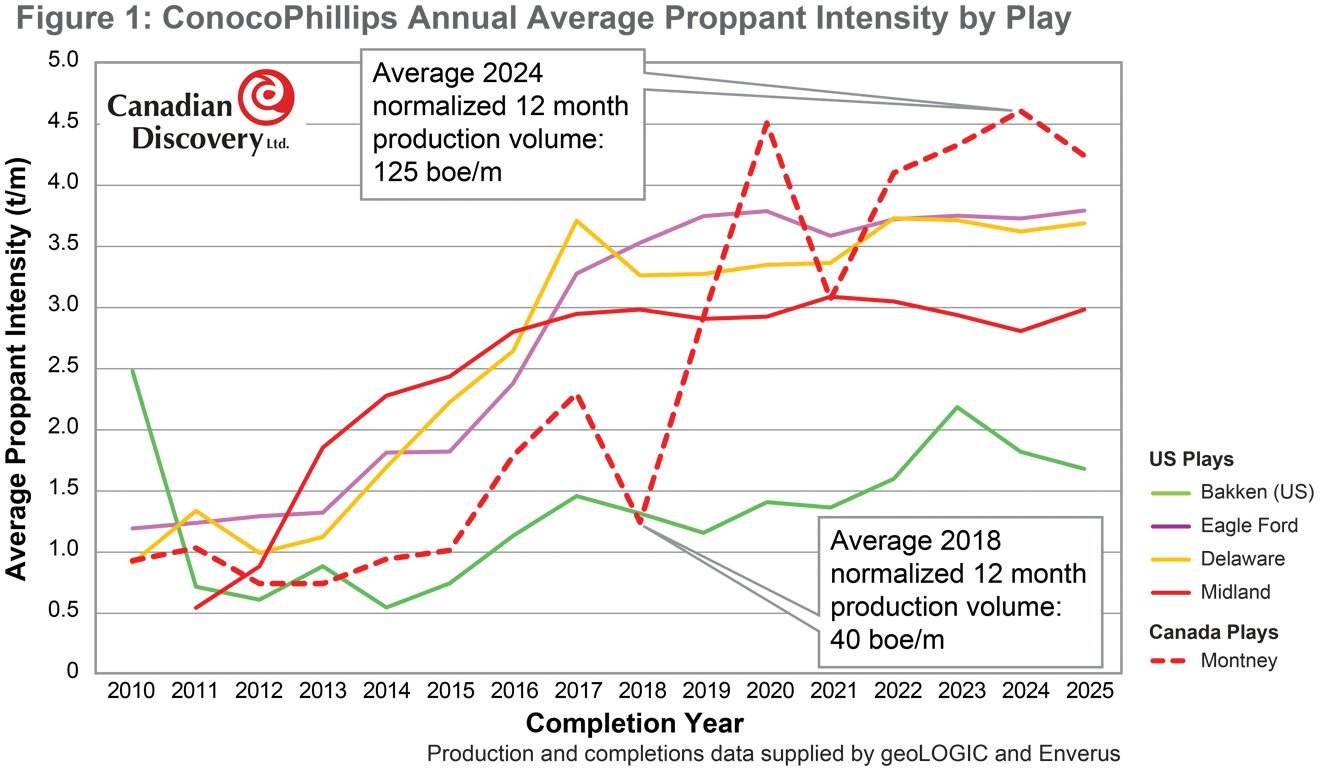
en.Wedoany.com Reported - ConocoPhillips is one of the very few operators in North America active simultaneously in Canada's Montney (Inga area, northeastern British Columbia) and multiple major unconventional basins in the U.S., including the Eagle Ford, Bakken, and Permian (Delaware and Midland sub-basins). Data show that before 2018, ConocoPhillips' average proppant intensity in the Montney was lower than in its U.S. basins; thereafter, the company significantly increased intensity in the Montney. Based on 2025 data, ConocoPhillips' average proppant intensity in the Montney is approximately 4.3 tons/meter, higher than in any of its U.S. basins and exceeding that of any other Montney operator, while normalized production has notably increased.
Examining all operators, average proppant intensity across 11 major unconventional basins (9 in the U.S., 2 in Canada) has increased between 2010 and 2025, but the Montney has consistently lagged behind other basins in this metric. Significant differences exist among basins, likely due to variations in their areal and stratigraphic distribution; they also share several similarities as unconventional targets: porosity and permeability ranges broadly overlap, all exhibit some degree of overpressure, are fine-grained and typically shaly (though organic matter, silica, and carbonate content vary considerably), and target intervals are relatively thick, typically tens of meters or more (the U.S. Bakken is a thinner outlier).
U.S. basins such as the Permian, Appalachia, Haynesville, and Eagle Ford surpassed the current (2025) Montney average proppant intensity of approximately 2.1 tons/meter under similar economic conditions between 2013 and 2016. This period coincides with the largest year-over-year increases in normalized 12-month production for the Permian, Appalachia, and Eagle Ford basins. If Montney operators increase proppant intensity to match U.S. peers (as ConocoPhillips has already done), can they achieve significant production gains while realizing economic returns?
A positive but nonlinear relationship exists between proppant intensity and normalized 12-month production (barrels of oil equivalent), where production increases with intensity but at a diminishing rate, following a power-law curve. Based on these nonlinear power-law curves, increasing proppant intensity yields smaller production gains for the relatively liquid-rich Montney compared to gas-rich U.S. basins (Haynesville, Utica, Marcellus), but is more similar to oil-prone U.S. basins like the Permian and Eagle Ford. If the current Montney average proppant intensity is increased by 67% from 2.1 tons/meter to 3.5 tons/meter (the current average proppant intensity in the Permian and Eagle Ford), normalized 12-month production would increase by 20%.
Adding more proppant to wells carries cost implications, but the fact that many U.S. basins have used significantly higher proppant intensities at scale for years suggests this approach has economic merit, especially since some of these basins have lower normalized production than the Montney.
Several uncertainties remain to be addressed. Beyond potential geomechanical issues from substantially increasing proppant intensity, there is currently a notable lack of Montney well proppant intensity data comparable to U.S. peers, which affects confidence in the Montney curve at higher intensity values (e.g., above 3.5 tons/meter). As more high-proppant-intensity data points emerge, they may reveal a different production relationship than the currently calculated curve. Given the similarities between the Montney and analogous U.S. basins, and the relative scale and consistency of high-intensity data points in U.S. basins (150,000 wells over a 15-year analysis period, of which 30,000 used intensities above 3.5 tons/meter, completed by some of North America's largest and most technologically advanced operators), there is no directly obvious reason why similar U.S.-style completion techniques would not improve Montney well production and economic performance, as ConocoPhillips has already demonstrated.
Other considerations include the need for more water (frac fluid) to accompany increased proppant intensity; the Montney's sand concentration (kilograms of proppant per cubic meter of frac fluid) reached 250 kg/m³ in 2025, while the range for other studied basins over the same period was 100 to 175 kg/m³, placing the Montney at a high level.
The Montney's uniqueness compared to U.S. basins lies in its classification as a gas basin, yet liquid hydrocarbons constitute a significant proportion of its production, requiring a different production strategy than most U.S. basins (which target primarily oil or gas). Anecdotally, some Montney operators restrict early gas flow rates to sustain natural gas liquids production; if allowed to produce at maximum potential, 12-month production would be higher, but natural gas liquids production would decline faster. Under this assumption, the lower 12-month production from restricted wells artificially depresses the proppant intensity versus production relationship, and unrestricted production might reveal a more positive relationship.
Given the similarities among North American unconventional basins and the trends highlighted by the large sample size from analogous U.S. basins, more Montney operators should consider adopting ConocoPhillips' completion script. Nearly all U.S. basins with reservoir characteristics similar to the Montney indicate that significantly higher proppant intensity can be used to achieve economic benefits. Additional data charts and details on Montney versus U.S. completion comparisons, along with a discussion of Duvernay completions, can be found in a recent CDL Digest article, available for free download.
This article is compiled by Wedoany. All AI citations must indicate the source as "Wedoany". If there is any infringement or other issues, please notify us promptly, and we will modify or delete it accordingly. Email: news@wedoany.com