en.Wedoany.com Reported - The construction bid results for the station building and related works of Shenzhen's largest high-speed rail station, Xili Station, have recently been finalized. China Railway Construction Corporation (CRCC) subsidiaries, China Railway Urban Construction Group and China Railway Construction Group, won the XLSG-6 and XLSG-8 sections respectively, with a combined bid amount of approximately 6.434 billion yuan, covering key construction areas such as the west throat, east plaza, and the east side of the main station building.
From the division of the station building and related works sections, the sections won by CRCC are not peripheral projects but integral parts of the main construction system of Xili Station. The XLSG-6 section, won by China Railway Urban Construction Group with a bid amount of about 1.892 billion yuan, mainly covers the west throat area and related civil works, decoration, and landscaping. The XLSG-8 section, won by China Railway Construction Group with a bid amount of about 4.542 billion yuan, mainly covers the east plaza and the east side of the main station building, including civil works, steel structure above the elevated level of the main station building, and roof decoration. The combined total of over 6.4 billion yuan for the two sections indicates that CRCC holds a significant engineering share in the construction of this super-large comprehensive transportation hub. The overall construction of the Xili Station building and related works is divided into four sections: XLSG-6, XLSG-7, XLSG-8, and XLSG-9. Besides the two CRCC subsidiaries, China Construction Fifth Engineering Bureau and China Railway Construction Engineering Group also undertake respective sections, with the total amount for the four sections reaching approximately 13.085 billion yuan. This division method reflects the massive scale of the project and indicates that the construction of Xili Station requires collaborative work from multiple large state-owned enterprises covering station buildings, plazas, throat areas, mechanical and electrical installation, steel structures, decoration, and supporting production and living facilities. For CRCC, winning bids totaling 6.4 billion yuan not only means new engineering orders but will also further strengthen its participation in the rail transit hub construction market in the Guangdong-Hong Kong-Macao Greater Bay Area.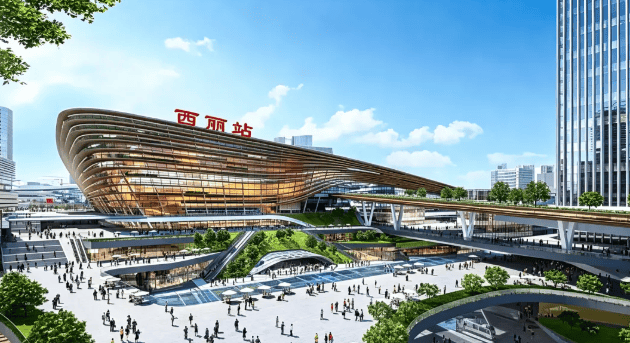
The positioning of Xili Station determines that this bid holds greater significance as a hub.
According to the plan, the Xili High-Speed Rail Hub is one of Shenzhen's "five main and five auxiliary" railway passenger transport hubs. Upon completion, it will surpass Shenzhen North Station to become the city's largest high-speed rail station and rail transit interchange station. The project will form a multi-level rail transit network of "4 high-speed railways + 2 intercity lines + 4 metro lines," incorporating the Ganzhou-Shenzhen High-Speed Railway, Shenzhen-Maoming Railway, Shenzhen-Shanwei Railway, Shenzhen-Zhuhai High-Speed Railway, as well as the Shenzhen-Huizhou Intercity, Shenzhen-Dongguan-Zengcheng Intercity, and connecting to Shenzhen Metro Lines 13, 15, 27, and 29. For Shenzhen, Xili Station is not merely an additional high-speed rail station but a key project to restructure the city's western transportation organization, alleviate the receiving and dispatching pressure on Shenzhen North Station, and enhance Shenzhen's function as a national railway hub city. In the past, Shenzhen North Station has borne a heavy load of high-speed rail passenger flow and urban rail transit transfers. With the increasing population mobility, industrial commuting, and intercity connections in the Greater Bay Area, the capacity of existing hubs is gradually approaching high-load operation. After the completion of Xili Station, a new core for high-speed rail and intercity transportation will form in western Shenzhen, more closely connecting areas such as Nanshan, Bao'an, Guangming, and Longhua with other cities in the Greater Bay Area. Travel times from Shenzhen to Zhongshan, Guangzhou, Dongguan, Huizhou, and Shenshan are expected to be compressed to between 20 minutes and 1 hour. The supporting capacity of the rail transit network for industry, residence, business, and scientific innovation resources will also be simultaneously enhanced. For the sections undertaken by CRCC, the quality of project implementation will directly affect the future station-city integration effect, transfer efficiency, and long-term operational stability of this super hub.
Xili Station also has a distinct station-city integration attribute.
The project involves not only the construction of the railway station building but also integrates plaza spaces, municipal配套设施, urban development, rail transit transfers, and regional functional reshaping. The Xili area itself is home to universities, research institutions, technology companies, and urban renewal spaces. After the transportation hub is completed, the surrounding areas may further accommodate headquarters offices, technology services, commercial facilities, public services, and talent residential needs. During the construction of the station building and related works, the east plaza, west plaza, main station building, throat area, and municipal配套设施 require a high degree of coordination. The construction units must not only complete structural engineering and building installation but also handle complex issues such as underground spaces, rail interfaces, traffic diversion, pipeline relocation, green construction, safety production, and cross-disciplinary collaboration. The sections undertaken by CRCC's China Railway Urban Construction Group and China Railway Construction Group involve key areas on the west and east sides, which must comply with railway engineering construction standards while also adapting to the spatial organization requirements of the urban comprehensive hub. If Xili Station is to achieve efficient transfers between high-speed rail, intercity lines, metro, buses, taxis, private vehicles, and slow traffic systems in the future, the construction phase must comprehensively consider structural reservations, flow line organization, equipment installation, fire safety, decoration effects, and operational maintenance conditions. For large state-owned construction enterprises, such projects test not only individual construction capabilities but also the system integration capabilities for comprehensive transportation hub projects.
From an industrial chain perspective, the construction of Xili Station will drive demand in multiple sectors, including steel structures, mechanical and electrical installation, rail transit equipment, decoration, intelligent construction, building materials, BIM collaboration, smart station systems, municipal engineering, and green construction. As the station building project enters the substantive construction phase, upstream material supply, specialized subcontracting, equipment procurement, and on-site construction organization will all enter a high-intensity advancement period. CRCC's winning of approximately 6.434 billion yuan in bid shares means it will bear significant responsibilities in construction organization, quality control, schedule fulfillment, and multi-unit coordination. As the project progresses towards its planned completion in 2028, Xili Station is expected to become a new transportation gateway for western Shenzhen and a key sample for observing the construction of super hubs in the Greater Bay Area, station-city integration development, and the competition of state-owned enterprise engineering capabilities.
This article is compiled by Wedoany. All AI citations must indicate the source as "Wedoany". If there is any infringement or other issues, please notify us promptly, and we will modify or delete it accordingly. Email: news@wedoany.com