en.Wedoany.com Reported - UK space-based solar startup Space Solar has signed a letter of intent with US space data storage company Lonestar to host Lonestar's StarVault data storage module on Space Solar's planned OSPREYBuilder demonstration spacecraft, scheduled for launch in 2028.
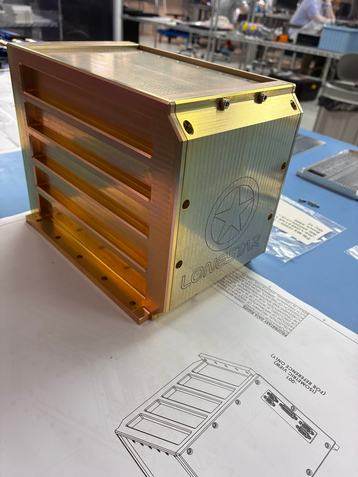
Lonestar Chairman and Founder Chris Stott stated that the company is building the future of resilient, sovereign data storage in space, having already tested data storage on the lunar surface and in cislunar space, and plans to deploy a constellation of interconnected vaults in every orbit, with scaling operations requiring energy support. He noted that Space Solar's in-orbit assembly capability is key, and its platform could eventually accommodate hundreds or even thousands of systems, forming a single connected space fabric. Stott also said that collaboration with Sam (Adlen), Martin (Soltau), and the Space Solar team is a significant step for both companies and the entire orbital data economy. Lonestar successfully demonstrated data operations on the lunar surface in February 2025, including storing a DCD article.
Space Solar and Lonestar have begun exploring their ability to complement the trend of orbital data centers (ODCs), which has gained widespread attention in the industry in recent months. According to the statement, the two companies aim to combine two high-profile concepts in space: placing data and artificial intelligence computing beyond Earth, and harvesting orbital energy to make it possible. With its space energy goals, Space Solar positions itself as both a host and a customer for Lonestar.
Founded in 2022, Space Solar's initial vision was to create an orbital network of 1,400-meter, 800-ton "CASSIOPeiA" solar power stations capable of beaming over 600 MW of electricity to ground stations on Earth, addressing critical human energy needs. The company plans to conduct relevant demonstrations in 2028. In 2025, Space Solar completed the CASSiDi project, an 18-month, £1.7 million ($2.27 million) effort aimed at advancing space-based solar power to a new level of maturity, funded by the UK Space Agency and the UK Department for Energy Security and Net Zero. In 2026, the company was selected for the NATO Diana program from 3,600 applications. In a December 2025 blog post, the company stated it was focusing on seed round funding.
The two companies aim for multi-orbit deployment, hoping to deploy StarVault modules to low Earth orbit, medium Earth orbit, and geostationary orbit. From 2030 onward, they plan to expand to larger, higher-power hosting structures to pursue scalable sovereign orbital data infrastructure.
This article is compiled by Wedoany. All AI citations must indicate the source as "Wedoany". If there is any infringement or other issues, please notify us promptly, and we will modify or delete it accordingly. Email: news@wedoany.com