en.Wedoany.com Reported - On June 9, Google DeepMind announced the launch of the Google DeepMind Accelerator: Robotics program, targeting early-stage European robotics startups. The first cohort of selected companies gathered in London this week to begin the program. The three-month initiative provides participating teams with technical guidance, product support, AI technology stack resources, and access to the Gemini Robotics model from Google DeepMind and Google teams.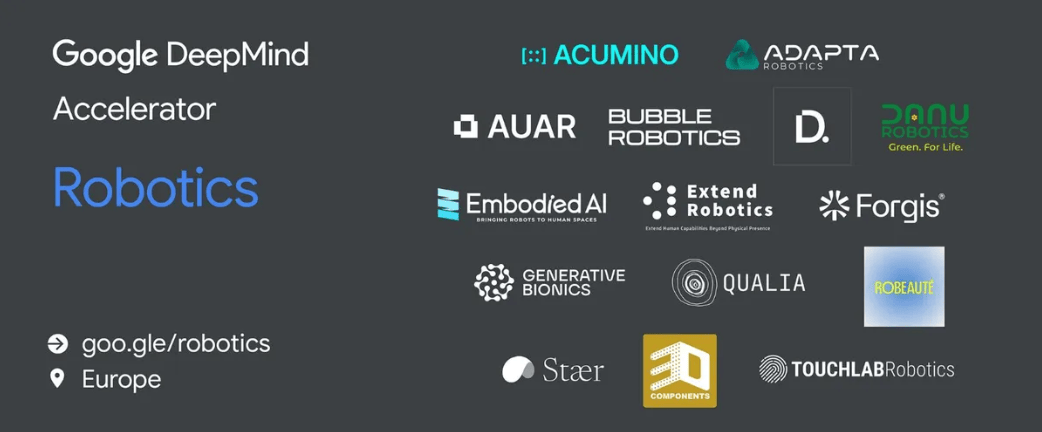
This accelerator program is designed for "physical AI" and embodied intelligence startup teams, with the core goal of helping European robotics companies transform cutting-edge AI research capabilities into deployable robotic products. The selected companies cover areas including industrial manufacturing, logistics, healthcare, construction, marine exploration, circular economy, advanced navigation, human-robot interaction, and neurosurgery. These range from quality control platforms for robotic welding and metal 3D printing, to industrial task execution systems adaptable to different robot hardware, automated construction micro-factories, autonomous marine robot swarms, waste sorting robots, remote robot operation software, flexible electronic skin, and micro-robots for brain tissue. Unlike accelerators that merely provide entrepreneurial guidance, Google DeepMind has directly integrated the Gemini Robotics model and Google AI technology stack into its support scope, meaning selected companies can conduct technical validation around key areas such as perception, reasoning, planning, manipulation, and multi-form robot adaptation.
The first cohort includes 15 companies: 3D-Components, Acumino, Adapta Robotics, AUAR, Bubble Robotics, Danu Robotics, Deltia, Embodied AI, Extend Robotics, Forgis, Generative Bionics, Qualia, ROBEAUTE, Staer, and Touchlab.
The robotics industry is transitioning from traditional automation equipment towards stronger environmental understanding and task generalization capabilities. In the past, industrial robots largely relied on fixed programs, structured workstations, and specialized fixtures, resulting in long deployment cycles and high costs for scenario migration. The development of embodied intelligence models enables robots to build stronger task understanding capabilities through vision, language, action, and environmental information, allowing them to deconstruct goals, plan actions in unfamiliar scenarios, and adjust execution paths based on real-time changes. The Gemini Robotics series models previously launched by Google DeepMind emphasize enabling robots to perceive physical spaces, understand natural language instructions, use tools, and execute complex tasks. If these capabilities can be combined with the hardware, software, industry scenarios, and customer data of European startups, it may accelerate the transition of robots from laboratory demonstrations to real-world factories, hospitals, construction sites, marine facilities, and service environments.
Europe's robotics industry has a strong foundation in manufacturing, medical equipment, engineering software, and precision hardware. However, startups still face barriers in computing resources, foundational model capabilities, commercialization channels, and access to cross-border customers. By launching this robotics accelerator in Europe, Google DeepMind can both expand the external developers and application partners within its Gemini Robotics ecosystem, and test the adaptability of embodied intelligence models across different mechanical forms, sensor combinations, and application scenarios through early-stage enterprise feedback. As foundational robotics models enter the industrialization phase, collaboration between model companies, cloud platforms, hardware enterprises, and vertical industry teams will become closer. Competition among robotics startups will also shift from single mechanical structures or control algorithms to comprehensive capabilities encompassing "model capability, data loops, scenario understanding, and reliable delivery."
The program will now move into phases of online training, technical coaching, and product validation, with plans for a subsequent showcase in London. Whether the first cohort of companies can translate the capabilities of models like Gemini Robotics into stable engineering systems will require validation through customer field testing, cost control, safety compliance, and large-scale deployment. For the robotics industry, the significance of such accelerators lies in connecting cutting-edge AI models with real-world physical demands earlier, generating more observable samples for the next phase of embodied intelligence applications.
This article is compiled by Wedoany. All AI citations must indicate the source as "Wedoany". If there is any infringement or other issues, please notify us promptly, and we will modify or delete it accordingly. Email: news@wedoany.com