en.Wedoany.com Reported - On June 10, Northrop Grumman Corporation developed a new W-band chip based on gallium nitride (GaN), capable of enhancing wireless signal transmission speed and clarity in the high-frequency spectrum. It is designed for applications such as secure satellite communications, military radar, and future 5G/6G networks. The chip transitioned from development to market-ready conditions in less than six months, adopting a more compact and cost-effective design approach to replace traditional high-frequency equipment that is larger and consumes more power.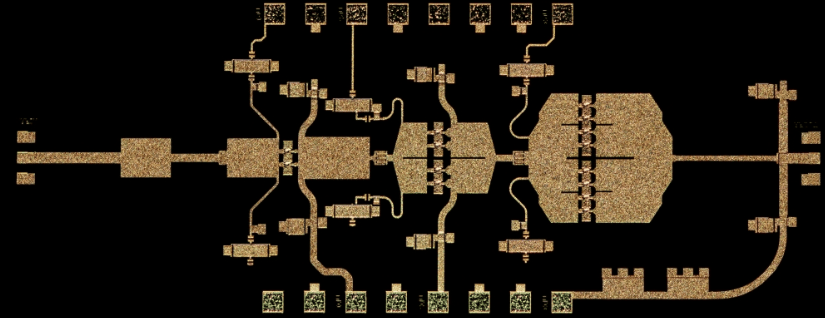
The W-band typically corresponds to the millimeter-wave high-frequency range, suitable for supporting greater bandwidth and higher data rates in wireless transmission, but it also imposes stricter requirements on device materials, RF design, heat dissipation capabilities, and manufacturing processes. Traditional high-frequency systems often require numerous discrete components and complex packaging, resulting in higher overall system size, energy consumption, and integration difficulty. Northrop Grumman's new GaN chip consolidates high-frequency transmission, reception, and signal processing capabilities into a smaller footprint, helping to reduce system complexity in satellite communication payloads, radar front-ends, and next-generation wireless network equipment.
Gallium nitride material is the key foundation for this type of chip. Compared to some traditional semiconductor materials, GaN offers higher power density, stronger high-frequency performance, and better high-temperature stability, making it suitable for radar, satellite links, electronic warfare, millimeter-wave communications, and high-power RF front-ends. W-band devices must maintain signal clarity and transmission efficiency at extremely high frequencies, where material performance and chip structure directly impact link quality. Through this chip, Northrop Grumman has validated its rapid development capabilities in the high-frequency microelectronics field, while also providing new device options for dual-use military and civilian communication systems.
The industrial significance of this advancement extends beyond defense applications. As 5G evolves toward 5G-Advanced, 6G research progresses, and satellite internet expands, high-frequency spectrum resources are becoming a critical direction for future wireless communications. Higher frequency bands can provide greater bandwidth, but coverage distance, penetration capability, device power consumption, and terminal costs remain challenges for industrialization. If highly integrated GaN chips can reduce system size and power consumption, they could drive upgrades in millimeter-wave communications, secure satellite links, airborne communications, ground station equipment, and high-precision sensing systems. For the information and communication industry chain, sectors such as RF chips, power amplifiers, packaging and testing, antenna arrays, satellite terminals, and radar modules will all benefit from enhanced high-frequency device capabilities.
Subsequent milestones will focus on the chip's verification progress within specific system platforms, cost control for mass production, W-band communication link test results, and its adoption by more satellite, secure communication, and next-generation wireless network projects. If the technology continues to mature, Northrop Grumman will strengthen its competitiveness in the high-frequency GaN microelectronics field and drive the expansion of W-band devices from specialized high-end systems to broader communication and sensing applications. For future network construction, such chips indicate that competition in wireless infrastructure is continuing to advance toward higher frequencies, greater integration, and lower power consumption.
This article is compiled by Wedoany. All AI citations must indicate the source as "Wedoany". If there is any infringement or other issues, please notify us promptly, and we will modify or delete it accordingly. Email: news@wedoany.com