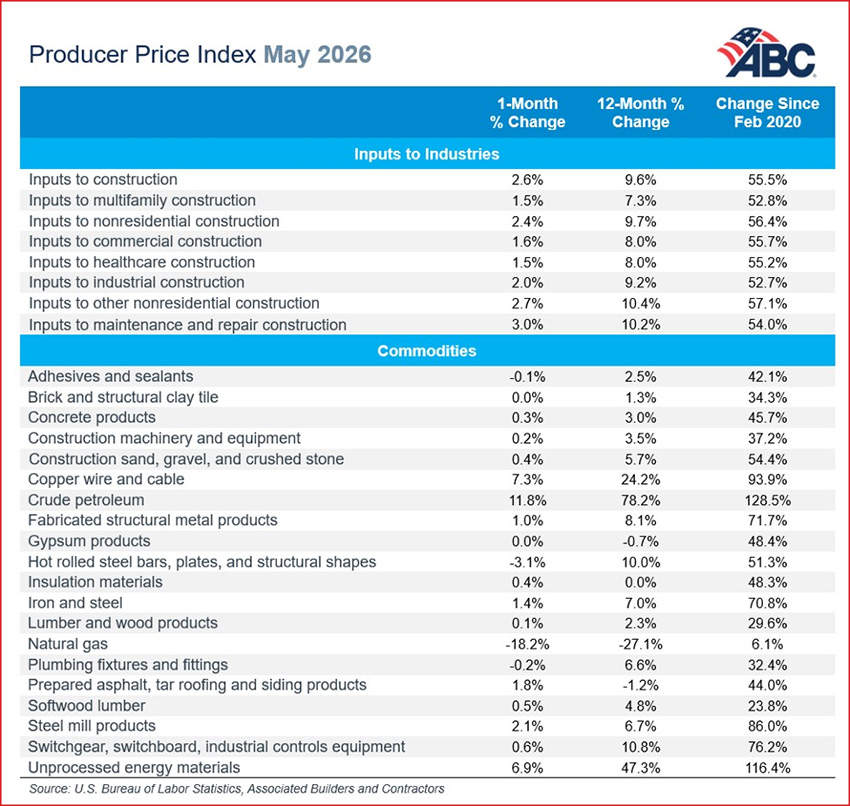
en.Wedoany.com Reported - Building materials prices rose 2.6% month-over-month in May, pushing material costs nearly 10% higher compared to the same period last year. An analysis by the Associated Builders and Contractors (ABC) of the Producer Price Index (PPI) released by the Bureau of Labor Statistics (BLS) on June 11 shows that overall construction input prices increased 9.6% year-over-year, while nonresidential construction input prices rose 2.4% month-over-month and 9.7% year-over-year. This price surge is primarily driven by tariffs, rising metal prices, and higher energy costs impacting the construction supply chain, reigniting concerns over project costs and contractor profit margins.
Ken Simonson, Chief Economist at the Associated General Contractors (AGC), noted that ABC's data is based on the Producer Price Index tracking construction goods inputs. Broader BLS indicators show that materials and certain services purchased by contractors rose 1.7% month-over-month and 8.1% year-over-year in May, while the comparable index for new nonresidential construction increased 1.8% month-over-month and 8.4% year-over-year.
The BLS reported that the Producer Price Index for final demand rose 1.1% month-over-month and 6.5% year-over-year in May, marking the largest annual gain since November 2022. Nearly 80% of the monthly increase was attributed to rising energy costs. ABC Chief Economist Anirban Basu stated that construction input prices surged again in May, with year-over-year gains now approaching 10%. The ongoing conflict in Iran continues to push oil prices higher, contributing significantly to overall material price increases, but more concerning is the persistent rise in prices of tariff-affected inputs such as steel and copper.
Materials heavily used in industrial, infrastructure, and data center projects continue to experience the strongest price increases.
Metals and Energy Drive Price Increases
According to ABC data, copper wire and cable prices rose 7.3% month-over-month and 24.2% year-over-year in May. Steel prices increased 1.4% month-over-month and 7.0% year-over-year, while hot-rolled bars, plates, and structural steel prices remain 10.0% higher than the same period last year. Federal producer price data shows that mill products rose 6.7% year-over-year, copper and brass shapes increased 26.8%, and aluminum shapes rose 48.8%.
Simonson stated that the recent price surge reflects geopolitical and trade-related pressures. In an email to the Engineering News-Record (ENR), he noted that the Middle East conflict led to a 19.9% month-over-month and 105.9% year-over-year increase in the PPI for diesel fuel, which in turn drove up freight PPI and the fuel surcharges many contractors now pay. Tariffs have pushed up prices for aluminum, copper products, and prefabricated structural metal components. According to BLS data, truck freight prices rose 17.3% year-over-year, highlighting how rising energy costs are being transmitted through the construction supply chain.
This price acceleration comes amid uneven construction demand. ABC reported in May that contractor backlog rose to 8.8 months, the highest level in 10 months, driven primarily by sustained investment in data centers. Contractors remain generally optimistic about sales, staffing, and profit margins, even as Basu notes that material prices are rising. This optimism contrasts with weak spending data in other market segments. According to ABC's previous analysis, private nonresidential construction spending fell for the fourth consecutive month in January, reflecting a slowdown in large-scale manufacturing project activity as several semiconductor projects near completion. Basu stated that aside from data centers, few industries are generating enough momentum to offset this slowdown.
Contractors also face labor cost pressures. Simonson pointed out that average hourly earnings for construction production and nonsupervisory workers rose 5.0% compared to May 2025, while the overall private sector increase was 3.6%. Combined with rising freight costs and persistent increases in metal prices, these pressures are adding strain to the construction supply chain, even as contractors maintain a generally optimistic outlook.
This article is compiled by Wedoany. All AI citations must indicate the source as "Wedoany". If there is any infringement or other issues, please notify us promptly, and we will modify or delete it accordingly. Email: news@wedoany.com