Fermilab Provides Data Infrastructure Support for DOE's Genesis Mission
en.Wedoany.com Reported - Fermilab is providing data infrastructure support for the U.S. Department of Energy's Genesis Mission through the Fermi Data Platform, which is built on thousands of hard drives and forms the backbone of the laboratory's scientific storage infrastructure. The DOE launched the Genesis Mission to accelerate scientific discovery and innovation through artificial intelligence, requiring not only supercomputers but also secure, first-class data infrastructure to store and enable efficient access for researchers nationwide.
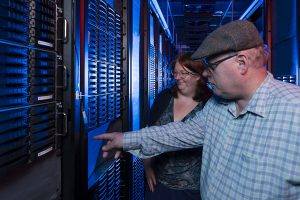
As a U.S. particle physics laboratory, Fermilab has decades of experience handling massive datasets, giving it long-standing expertise in scientific data management. Currently, the Fermi Data Platform supports datasets from multiple experiments and technologies, including measurement and simulation data from the Compact Muon Solenoid (CMS) experiment at CERN's Large Hadron Collider (LHC), data from Fermilab's Short-Baseline Neutrino Program, as well as data from quantum research, microelectronics development, and cutting-edge theoretical work. The laboratory is also preparing for the data needs of the upcoming flagship project, the Deep Underground Neutrino Experiment (DUNE). Project lead Oliver Gutsche stated that by orchestrating thousands of disks, the platform provides petabytes of storage space and ensures fast, secure data access for researchers.
With tools like the Fermi Data Platform, the Genesis Mission's American Science Cloud brings together expertise from DOE national laboratories, academic institutions, and industry partners, combining it with advanced AI technologies and new AI model development to accelerate discoveries across interdisciplinary fields from high-energy physics to materials science to fusion energy research. The American Science Cloud will become a comprehensive infrastructure integrating advanced AI services, where researchers can describe their needs, and AI tools will access supercomputers, scientific datasets, and simulation capabilities at national laboratories. Chin Guok, lead for American Science Cloud Partner Integration, noted that data is the common foundation of major scientific endeavors, AI is fundamentally data-driven, and the Fermi Data Platform can support AI training and inference on large-scale scientific datasets.
The goal of the Genesis Mission is to shorten the time from posing a scientific question to obtaining a meaningful answer, by automating intermediate steps such as searching scientific publications, running simulations, and filtering results, presenting researchers with a refined picture to focus on. Gutsche used battery material screening as an example: the system can conduct literature searches, run simulations for verification, and narrow down the list for further study. This process does not replace researchers but enables them to work faster and focus on key insights. The role of the Fermi Data Platform is to store project datasets and help bridge the gap between raw scientific data and the structure and metadata required by machine learning models, providing the data storage and access tools needed for active, repeated access. After the platform was confirmed as an American Science Cloud infrastructure partner, researchers were able to more seamlessly utilize DOE resources.
This article is compiled by Wedoany. All AI citations must indicate the source as "Wedoany". If there is any infringement or other issues, please notify us promptly, and we will modify or delete it accordingly. Email: news@wedoany.com
Related Products



G.652.D Wavelength-extended Non-dispersion Shifted Single-mode Optical Fiber
HONGAN GROUP CO., LTD.
Flat Portable Satellite Terminal 0.35m Aperture Manual Portable Terminal
China Starwin Science & Technology Co., Ltd.

GYTA Type Non-Self-Supporting Aerial/Duct Optical Cable
TONGDING INTERCONNECTION INFORMATION CO., LTD.

20 Inch 1600*900 Full HD 60Hz TFT LED Monitor with VGA and DP Interfaces for Desktop Computers-Business Use
Guangzhou Zanying Optoelectronics Technology Co., Ltd.