en.Wedoany.com Reported - Airbus Helicopters is testing an aerodynamic improvement kit on the Airbus PioneerLab test platform in Germany, which could alter the performance of its conventional rotorcraft. The PioneerLab is a flying rotorcraft laboratory based on the H145 light twin-engine helicopter and is one of four rotorcraft laboratories operated by Airbus.
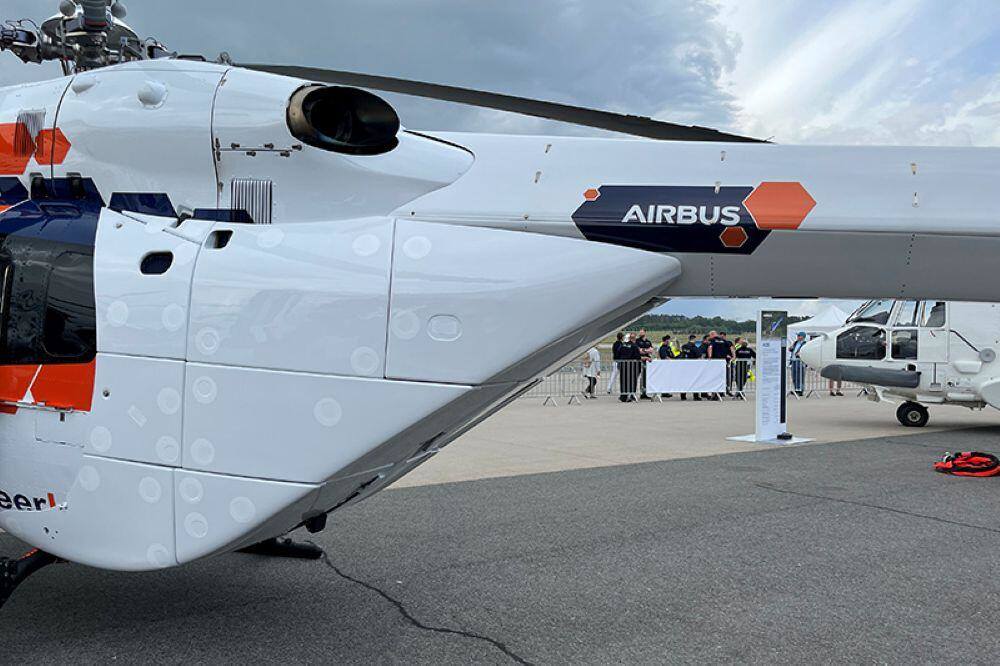
For testing, Airbus produced composite fairings that conform to the tail boom and aft fuselage, and added an improved horizontal stabilizer with downward-curving wingtips. The modified tail boom cross-section changed from elliptical to diamond-shaped, redirecting the main rotor downwash in the same direction as the airflow from the anti-torque system. Johannes Plaum, Head of Research and Technology for Airbus Helicopters in Germany, stated on June 10, the opening day of the ILA Berlin Air Show, that this design generates partial anti-torque for free, thereby reducing the power required for the fenestron (ducted anti-torque system).
A similar tail boom was previously installed on the Racer high-speed compound rotorcraft demonstrator, but this is the first time the system has been integrated into Airbus's conventional rotorcraft. Early flight demonstrations indicate that these improvements reduce drag at low speeds and enhance stability during forward flight. Regarding the new aft fuselage shape, the company will conduct further testing in subsequent flight trials.
The current H145 aft fuselage configuration creates a low-pressure zone during flight, leading to increased drag in forward flight. The new design allows airflow to flow more smoothly toward the tail boom. The testing follows a phased approach: initially focusing on the impact of the improved tail boom, then gradually adding the horizontal stabilizer and aft fuselage improvements, and finally testing what Plaum calls the "complete full package." As of the report, flight tests for the horizontal stabilizer and tail boom have been completed. The tests are conducted at Airbus's Donauwörth facility.
Beyond aerodynamic improvements, Airbus is also advancing the development of a hybrid propulsion system. The plan involves removing the two Safran Arriel engines from the PioneerLab and replacing them with a single 1,000 shaft horsepower Pratt & Whitney Canada PW210S engine and two 250-kilowatt electric motors developed by Collins, powered by lithium-ion batteries. Plaum stated that engineers have completed the preliminary design review of the hybrid propulsion system and are now entering the detailed system design phase, followed by bench system testing and flight testing. The project aims to achieve a 30% reduction in fuel consumption, which could be further enhanced when combined with aerodynamic improvements.
Plaum refers to these two initiatives as "technology building blocks," which could influence the design of future light rotorcraft. A similar development path occurred with the EC135 Bluecopter experimental helicopter, which flew in 2015 and had a significant impact on the new H140 twin-engine rotorcraft currently being flight-tested by Airbus. The H140 is scheduled to enter commercial service in 2028.
This article is compiled by Wedoany. All AI citations must indicate the source as "Wedoany". If there is any infringement or other issues, please notify us promptly, and we will modify or delete it accordingly. Email: news@wedoany.com