en.Wedoany.com Reported - This week, spot container freight rates from East Asia and China to the West Coast declined, while rates to the East Coast showed mixed trends, and liquid tanker spot rates softened again.
In container freight, rates to the West Coast fell to $5,800-$7,100/FEU (40-foot equivalent unit) this week, while rates to the East Coast were mixed, currently ranging between $7,600 and $9,150/FEU.
Data from Xeneta, a maritime and freight rate analysis company, shows that rates to the West Coast edged down slightly, while those to the East Coast remained largely flat.
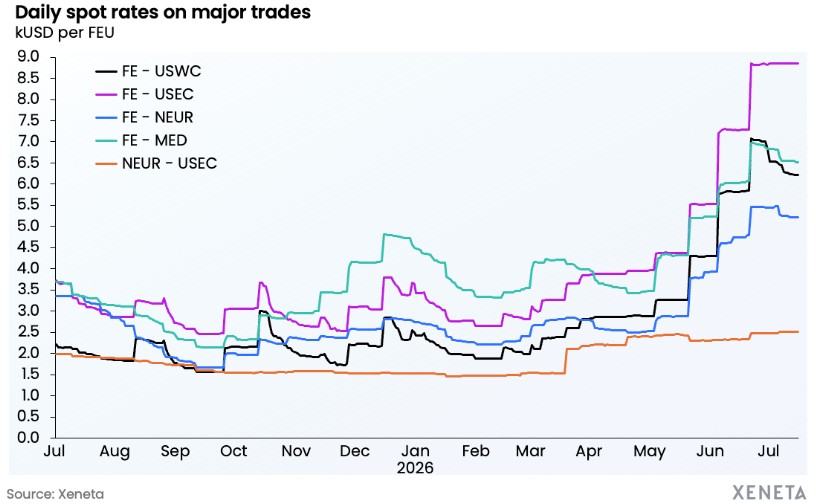
Emily Stausboll, senior shipping analyst at Xeneta, said rates could decline further in early August, but the gradual softening indicates that the pace of decline is far slower than the rate of increase during the market surge.
Stausboll noted that blank sailings have begun to appear on some routes from Asia to North America, but even with softening rates, they remain at very healthy levels for carriers, who want to profit from capacity utilization for as long as possible. No carrier is willing to be the first to significantly cut capacity, as competitors could step in and take their volumes, limiting the scope to reverse the decline in spot rates through capacity management.
Stausboll believes carriers will use the renewed conflict between Iran and the United States and the resulting rise in fuel costs as a reason to slow rate declines through surcharges. However, operationally, nothing has changed in container shipping this week, as the vast majority of vessels did not transit the Strait of Hormuz or the Red Sea before the latest escalation, and they still do not now.
Rates from supply chain consultancy Drewry fell this week due to increased capacity and slowing demand. Drewry said six sailings are scheduled to be blanked on the transpacific route next week, compared to nine this week, indicating that carriers are deploying more capacity, widening the supply-demand gap. Drewry expects rates to remain stable next week.
Rates from online shipping marketplace and platform provider Freightos showed that rates to the East Coast were largely flat, while those to the West Coast fell by 6%. Judah Levine, head of research at Freightos, said that despite rising crude oil prices due to escalating tensions in the Middle East, container rates have eased slightly overall as carriers add capacity on some routes and gradually exit the earlier peak season.
Levine mentioned that carriers had announced significant increases in GRI (General Rate Increase) and PSS (Peak Season Surcharge) effective July 15, but actual spot rates edged down on major east-west routes, with prices to the North American East Coast flat. Daily rates so far this week show continued declines on the West Coast and from Asia to the Mediterranean. Carriers' decision not to implement mid-month increases suggests that recent forecasts of cooling demand after the hot market in June and early July may be materializing. He also noted that port congestion in Asia could mitigate downward pressure on rates. Severe port congestion in the Far East is absorbing capacity, which may alleviate the downward pressure on spot rates from current demand declines and capacity increases. Delays at major origin ports were initially triggered by a surge in volumes, exacerbated by adverse weather, including Typhoon Bavi last week.
The New York Freight Index (NYFI) fell 1% to the West Coast and rose 7.0% to the East Coast; the Shanghai Containerized Freight Index (SCFI) fell 0.56%, marking the third consecutive weekly decline after 10 weeks of gains.
Container ships and container shipping costs are relevant to the chemical industry because, while most chemicals are liquid and transported by tankers, container ships carry polymers such as polyethylene (PE) and polypropylene (PP), which are shipped in pellet form. Titanium dioxide (TiO2) is also transported in containers. Additionally, liquid chemicals are shipped in isotanks.
In tanker freight, ICIS-assessed US chemical tanker freight rates generally softened this week, with declines in batch cargo rates from the US Gulf (USG) to major trade routes. Rates from the US Gulf to Rotterdam edged down this week, particularly in the clean petroleum products (CPP) market, which saw a notable decline. This prompted more tonnage to enter the chemical sector, further driving rates lower.
Overall, the spot market was notably quiet, although this trade route appeared busier than others. Several large biofuel cargoes appeared on the market and continued to dominate. Additionally, caustic soda, ethylene glycol, and styrene for late July and early August loading were also present. Similarly, the US Gulf-to-Asia trade route continued to face downward pressure, as the spot market has been relatively calm over the past few weeks. Contract of affreightment (COA) volumes were reportedly lower than expected.
Consequently, rates continued to face downward pressure, softening further. With several larger ethylene dichloride (EDC) and monoethylene glycol (MEG) cargoes confirmed, regular carriers had to significantly reduce rates under intense competition. Additionally, ample space remained available in July, and several non-liner carriers indicated they could return to the region in August, potentially further depressing rates.
A similar situation occurred on the US Gulf-to-South America route, with few cargoes quoted on the market and ample space still available in July and August. Most participants believe that shipowners with available space may have to lower rates to complete loadings, thus driving rates down. Newly proposed US tariffs on Brazil could pressure this route, particularly for benzene, ethanol, and soybean oil, which might shift to Europe or Asia. On the bunker fuel side, fuel prices rose significantly week-on-week as energy prices surged after heightened tensions in the Middle East.