Myriad Advances Wyoming Uranium Drilling, Government Once Estimated 655 Million Pounds
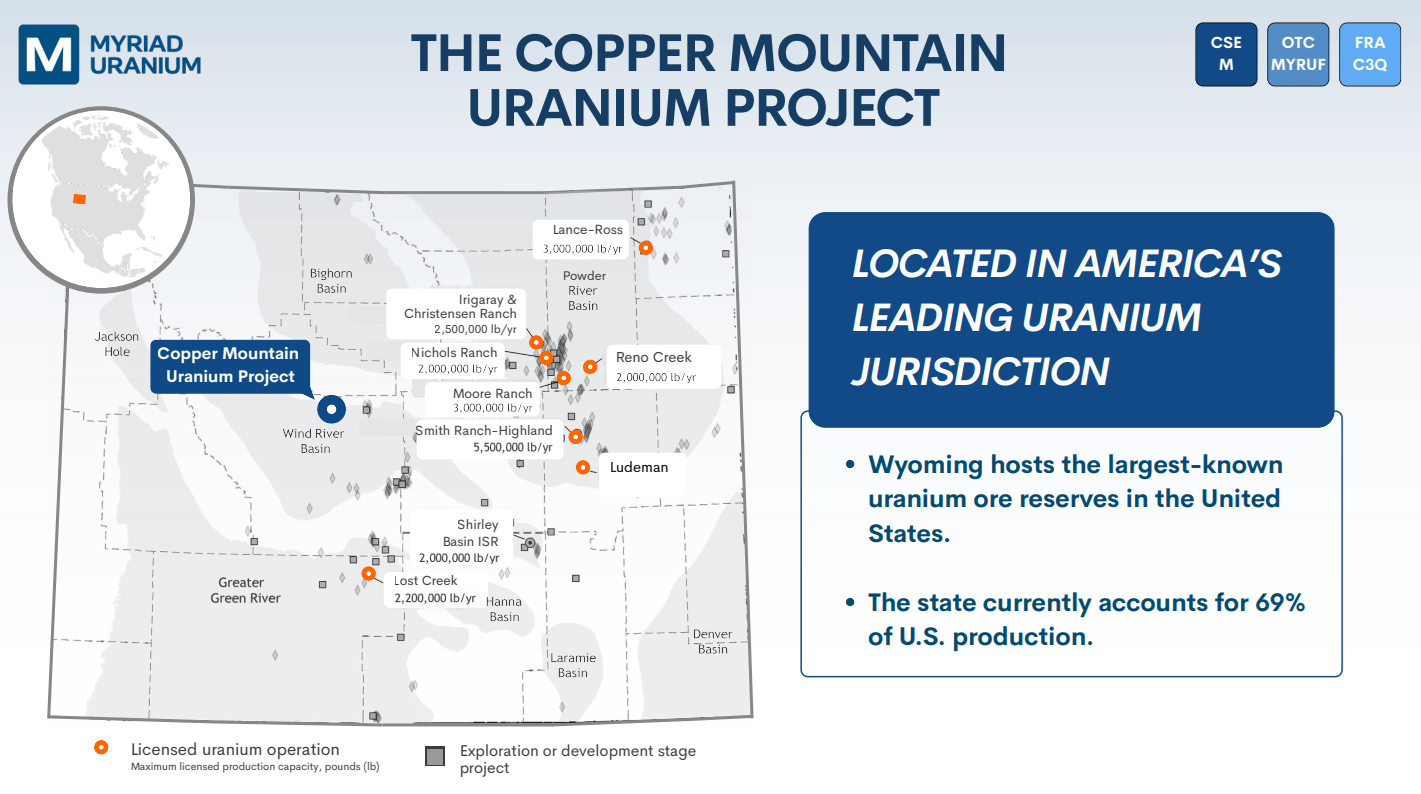
en.Wedoany.com Reported - The United States consumes approximately 50 million pounds of uranium annually, yet domestic production amounts to only about 1 million pounds. This long-standing supply gap, historically filled by imports from Kazakhstan, Russia, and Canada, has become a central issue in U.S. energy security policy. As the federal government prioritizes domestic mineral production as a national security imperative and supports domestic energy projects through permitting reform and potential minimum price mechanisms, the investment environment for U.S. uranium developers has significantly improved.
Against this backdrop, Myriad Uranium Corp (CSE:M) presents a noteworthy opportunity for the market. The company holds three uranium projects in the United States, with its core asset being the Copper Mountain uranium project in central Wyoming—a large-scale conventional uranium asset. This project was within two years of production before the 1979 Three Mile Island accident brought the U.S. uranium industry to a halt. Decades later, with geopolitical and policy shifts favoring domestic supply, Myriad is advancing a drilling program that management believes will transform a historically significant mineral claim into one of America's most strategically important uranium assets.
Wyoming is not just an operational location for Myriad; it is the primary uranium-producing state in the U.S., accounting for approximately 69% of domestic output and featuring a regulatory framework that explicitly supports uranium development. Myriad already holds an approved and bonded 222-hole work program at the Copper Mountain project, reflecting both the project's quality and the efficiency of operating within Wyoming's mature permitting environment. Phase 2 drilling has been confirmed to commence shortly, and the company currently has approximately $12 million to $13 million in cash to fund this program—a relatively strong liquidity position for a junior mining company at this stage of development. Myriad's two additional assets in New Mexico and Arizona add breadth to the portfolio, entirely free from the geopolitical and logistical risks affecting overseas uranium development.
The Copper Mountain uranium project has deep historical institutional support. In the 1970s, Union Pacific Railway, in partnership with Southern California Edison, invested the equivalent of approximately $125 million today in exploration, drilling 2,000 holes, discovering seven deposits, and planning a large-scale conventional mine intended to supply a cluster of nuclear reactors in California. This plan defined a historical resource of 27 million pounds, extending to a depth of 600 feet, covering six of the seven identified deposits.
In 1982, the U.S. Department of Energy commissioned Bendix Engineering to evaluate the broader project area. Using existing drilling data, geochemical and geophysical information, Bendix estimated the property could contain up to 655 million pounds of uranium. This is not a current NI 43-101 compliant resource estimate and remains classified as an exploration target, but as an independent government-commissioned study, it provides the geological basis for understanding why Myriad's technical team believes the project has potentially significant national scale. Myriad's Chief Geologist, George Van Der Walt, stated that Bendix's work was background work to establish the basis for an exploration target, utilizing extensive drilling data already completed by Union Pacific and conducting some of its own drilling, concluding there was potential for approximately 245 million pounds within the controlled area, with an expanded estimate suggesting up to 655 million pounds.
Radiometric and magnetic surveys conducted by Myriad in December 2025 identified strong uranium anomalies in the eastern portion of the project area, which lies largely outside the scope of historical drilling programs. All seven known deposits and fifteen or more identified targets are located on the western side of a north-south trending structural corridor.
One of the more significant technical advancements at the Copper Mountain project comes from Myriad's Phase 1 drilling program, completed approximately 15 months ago. Drilling focused on the Canning deposit, the largest of the seven historical deposits, accounting for about 50% of the historical resource estimate. Myriad CEO Thomas Lamb noted that when comparing laboratory assay results with historical gamma probe grades, the grades were significantly higher than the probe grades. For the 500-1000 ppm range, confirmed laboratory assay grades were 50-60% higher, indicating the detection of substantial previously undetected uranium, extending mineralized intercepts and improving grades.
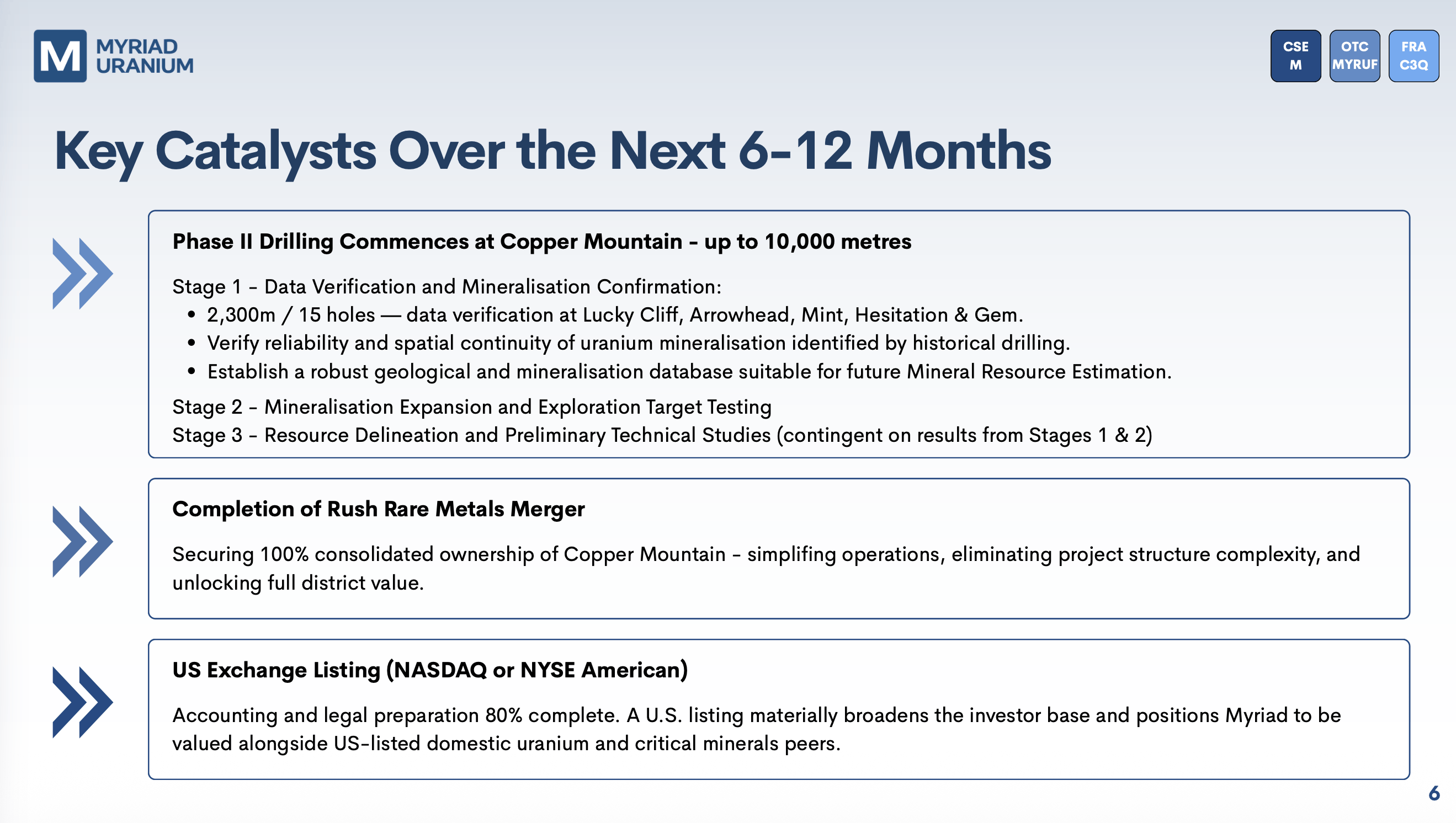
Myriad's Phase 2 drilling program is structured in three stages. The first stage targets several of the remaining six historical deposits outside Canning, using historical drilling data to effectively guide hole placement. Van Der Walt noted that with the existing historical drilling at Canning, Myriad does not need to replicate as many holes—perhaps a few hundred instead of 800—to advance to a resource estimate. The second stage involves new targets identified through geophysical surveys, primarily in the eastern area. The third stage will move towards resource delineation and ultimately the release of a formal NI 43-101 mineral resource estimate. A parallel corporate development is the impending acquisition of Rush Rare Metals, which holds the remaining 25% interest in Copper Mountain. This transaction, expected to close approximately six weeks after the interview date, will give Myriad 100% ownership of the project, eliminating structural overhang and simplifying the asset structure.
Beyond Copper Mountain, Myriad's portfolio includes two other assets. The Red Basin project in New Mexico recently had a 10% interest sold, with Myriad retaining a free carried interest. The acquirer, backed by advanced weapons technology group Overmatch and Bay Area venture capital firm 8VC, which is associated with the PayPal network, represents a well-capitalized strategic buyer. The Breccia Pipe project in Arizona was recently acquired and has been optioned to Wedgemont Resources. Its target geological environment is the same as Energy Fuels' Pinyon Pine mine, currently considered one of the highest-grade uranium mines in the U.S. The breccia pipe within the project has a historical estimate of approximately 1 million pounds at a grade of about 0.79%. Wedgemont can earn up to a 75% interest in the project, with all costs borne by them, providing Myriad with option exposure to a potentially high-grade asset at zero incremental cost.
Overall, Myriad Uranium Corp holds three fully domestic uranium projects in the United States, anchored by the Copper Mountain asset in Wyoming. This asset boasts $125 million in historical exploration investment, a government-commissioned estimate of up to 655 million pounds of uranium, and Phase 1 drilling results confirming grades 50-60% higher than historical data. With Phase 2 drilling imminent, a cash position of $12 million to $13 million, and the upcoming consolidation providing 100% project ownership, the company offers investors an opportunity to participate in one of the most thoroughly explored uranium claim positions in U.S. history, at a time when domestic uranium supply has become a clear federal policy priority.
The United States is at a turning point in domestic resource policy. For decades, the gap between domestic uranium consumption and production was filled by imports. However, with reliance on Russian fuel fabrication, disruptions in Central Asian supply chains, and shifts in the global critical materials landscape, the structural vulnerability of the U.S. uranium supply has been acknowledged. The policy response has been substantive. The Trump administration's executive framework explicitly positions energy and mineral security as national security priorities, and a minimum price mechanism for domestically produced uranium is under active discussion. The Inflation Reduction Act and the CHIPS Act demonstrate that U.S. policy can direct significant private capital towards domestic industrial priorities by altering the risk-reward profile of investments—a logic that applies equally to uranium. As Myriad CEO Thomas Lamb stated, the U.S. is now supporting domestic energy projects, and this support will only grow. Wyoming alone accounts for 69% of current U.S. domestic uranium production, and the state's most advanced conventional uranium project—Copper Mountain—belongs to Myriad's portfolio. On the demand side, U.S. nuclear capacity is not shrinking but expanding, driven by data center power demand, artificial intelligence infrastructure buildout, and bipartisan consensus on nuclear energy's role in decarbonization. The U.S. consumes 50 million pounds of uranium annually while producing only 1 million pounds—a ratio that cannot be sustained indefinitely within a domestic energy security framework. The capital and regulatory conditions needed to close this gap are now more favorable than at any time since the Three Mile Island incident.
This article is compiled by Wedoany. All AI citations must indicate the source as "Wedoany". If there is any infringement or other issues, please notify us promptly, and we will modify or delete it accordingly. Email: news@wedoany.com
Related Products

Double-slide Triple-sealed Hot Air Isolation Door
Xi'an Yingchuan Electric Power Equipment Co., Ltd.


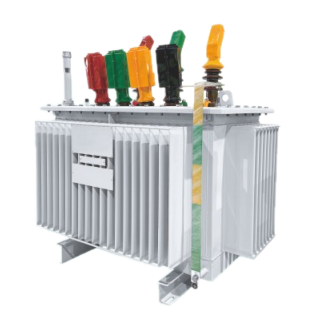
IS(B)□-M·RL Series Oil-immersed 3D Transformer (Planar / 3D Wound Core)
Guangdong Kehua Electric Power Technology Co., Ltd.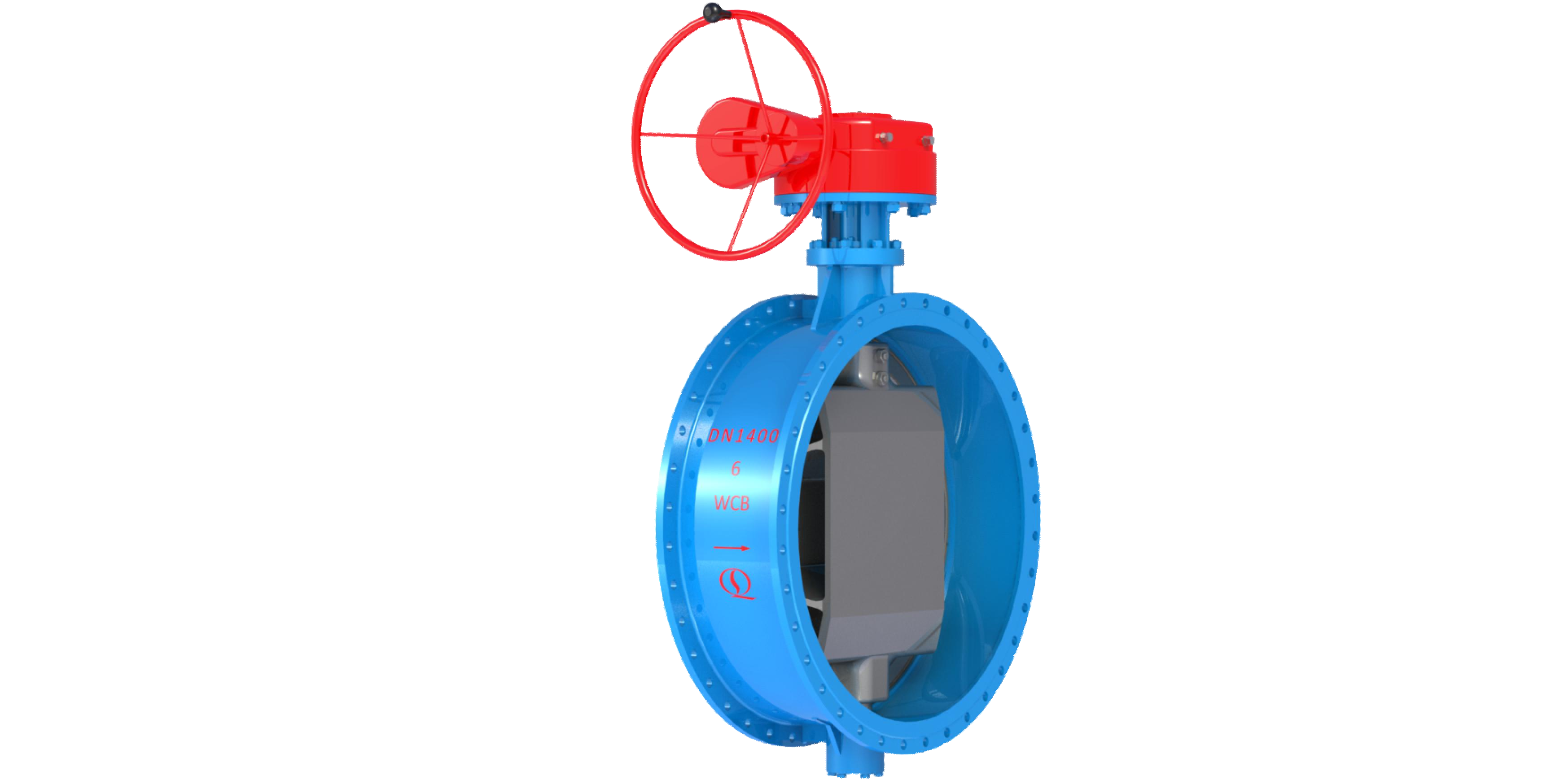
Bidirectional Metal Hard Sealed Seawater Butterfly Valve
Henan Quanshun Flow Control Science & Technology Co., Ltd.