en.Wedoany.com Reported - Atomic Eagle Ltd (ASX:AEU) has expanded known uranium mineralization and discovered multiple high-grade zones beyond existing resource boundaries during drilling at the Chisebuka deposit of its wholly-owned Muntanga Uranium Project in Zambia.
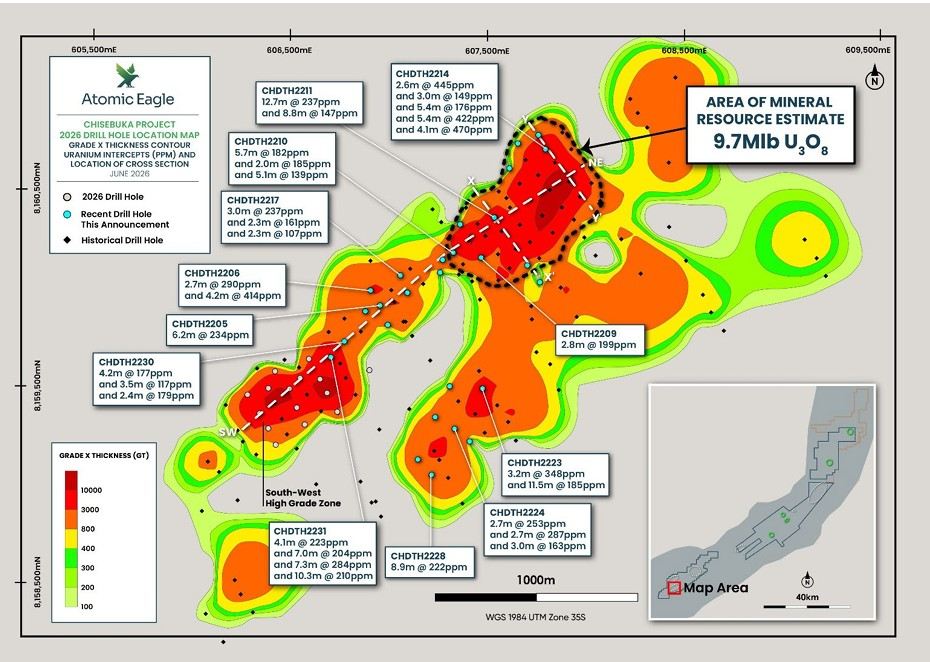
The company released new results from resource extension drilling at the Chisebuka deposit. Drill hole CHDTH2214 intersected 5.4 meters at 422 ppm eU₃O₈ from 47 meters depth; drill hole CHDTH221 intersected 12.8 meters at 237 ppm eU₃O₈ from 40.9 meters depth; drill hole CHDTH2231 intersected 10.3 meters at 210 ppm eU₃O₈ from 81.4 meters depth; and the same drill hole CHDTH2231 intersected 7.3 meters at 284 ppm eU₃O₈ from 47.2 meters depth.
Recent drilling has expanded the surface projection of the northern high-grade zone to 900 meters by 600 meters, and the southwestern high-grade zone to 830 meters by 400 meters. The company confirmed mineralization continuity between the southwestern high-grade zone and previously defined resource areas.
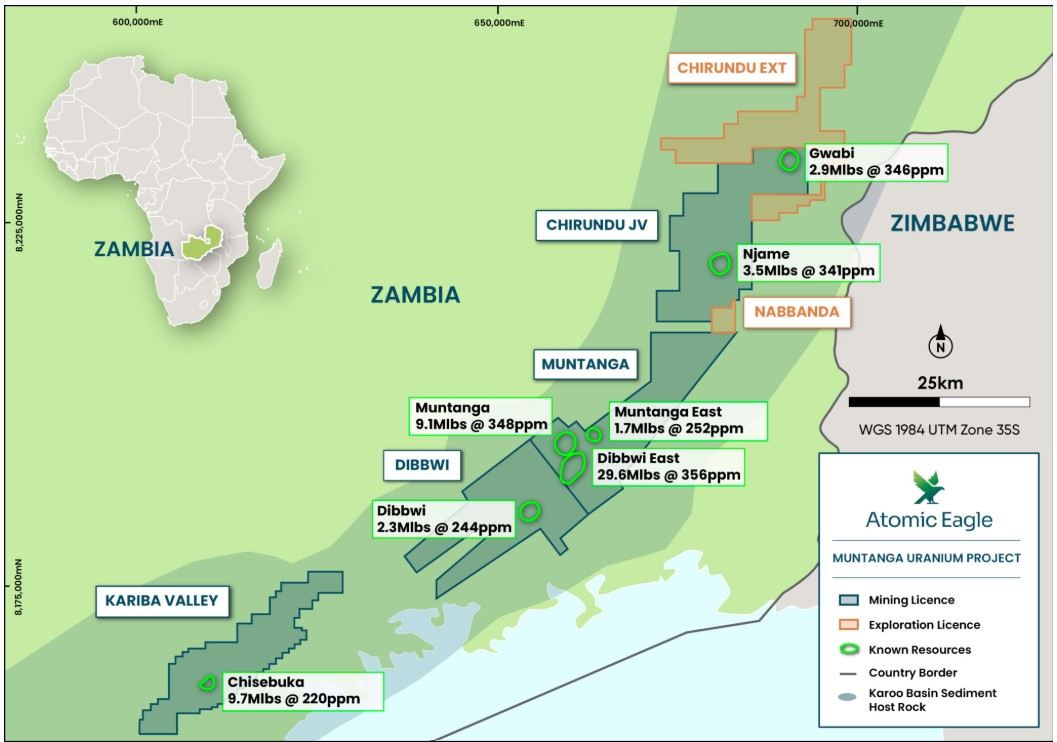
The 2026 drilling program aims to explore mineralization beyond existing resources within the broader Chisebuka area. Previously, Atomic Eagle reported that the deposit hosts an inferred mineral resource of 19.9 million tonnes at 220 ppm U₃O₈, containing 9.7 million pounds of U₃O₈.
Following the previously reported 13 initial drill holes, Atomic Eagle has completed an additional 29 holes, bringing the total drilling for the current Chisebuka program to 42 holes for 4,209 meters. Recent work has primarily focused on testing continuity between the southwestern high-grade zone and the resource area, as well as extensions of the resource boundary and southern mineralization zone.
The company stated that mineralization in the northern high-grade zone extends from the surface in the northwest to depths exceeding 100 meters in the southeast, with thicknesses of up to 80 meters in the core of the deposit. Mineralization in the southwestern zone starts near the surface and extends along the dip to depths below 100 meters to the southeast, with thicknesses of up to 60 meters in the core of the zone.
Chief Executive Officer Phil Hoskins said the first phase of the 2026 exploration program successfully expanded the previously defined resource boundary at Chisebuka and identified an additional high-grade zone to the southwest. Hoskins stated that Chisebuka shows potential to become a major contributor to the company's larger-scale mine target.
Atomic Eagle has also mobilized two drill rigs to commence the first drilling program at the Muntanga North exploration target. Ground radiometric surveys have been completed for the first six targets at Muntanga North, and wide-spaced exploration drilling is currently underway, with results expected in the coming weeks. Hoskins said the survey program optimized several new exploration targets that had never been historically drilled, including Muntanga North. Access permits for the Namakande 1 and Namakande 2 targets have also been approved, with ground radiometric surveys expected to begin before drilling in the third quarter of 2026.
Atomic Eagle's Muntanga Uranium Project covers a 146-kilometer strike length along Lake Kariba in Zambia and includes four mining licenses and two exploration licenses. The project has total mineral resources of 86.2 million tonnes at 309 ppm U₃O₈, containing 58.8 million pounds of U₃O₈, of which measured and indicated resources total 40 million pounds and inferred resources total 18.8 million pounds.
Atomic Eagle expects to commence a 12-hole reverse circulation drilling program at Chisebuka later this month, totaling approximately 900 meters, aimed at confirming grades estimated by gamma tools. The company also plans diamond drilling in the fourth quarter of 2026 to further confirm grades and collect core for metallurgical testing. At Muntanga North, exploration drilling is underway at newly optimized radiometric targets, with Namakande 1 and 2 scheduled for ground surveys and drill testing in the third quarter of 2026.
This article is compiled by Wedoany. All AI citations must indicate the source as "Wedoany". If there is any infringement or other issues, please notify us promptly, and we will modify or delete it accordingly. Email: news@wedoany.com